

President Trump’s Department of War Announces Over $80M Investment in Mining Schools at Historic Roundtable With Mining Executives
Funding proposals for three universities aim to expand mining and metallurgy research, develop new technologies and strengthen America’s critical minerals workforce.
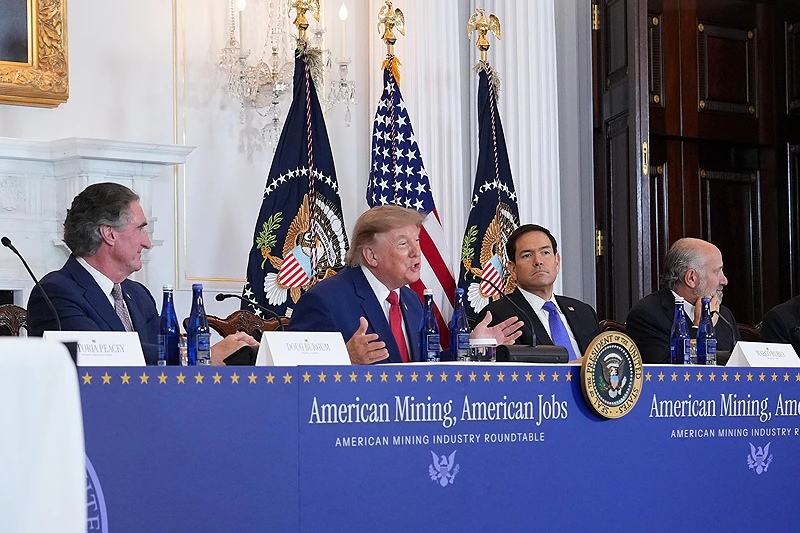
WASHINGTON, D.C.: The US Department of War has announced more than $80 million in proposed investments for three universities as the Trump administration seeks to strengthen the country’s critical minerals supply chain and train the next generation of mining and metallurgy specialists.
The proposed funding would support the Colorado School of Mines, South Dakota School of Mines and Technology, and Johns Hopkins University.
The Department of War said the investments would help create technology innovation hubs and connect students with defence industry projects. The programmes would also support new processes, prototypes and advanced training in mining, geology and metallurgy.
The department has increasingly focused on strengthening the US defence industrial base and reducing vulnerabilities in critical supply chains. Its industrial-base programmes include efforts to expand domestic capacity and improve access to materials needed for national security.
Three Universities Set to Receive Funding
The Colorado School of Mines could receive $32.7 million under the proposed plan.
The funding would establish a Critical Minerals Innovation and Commercialization Hub. The programme would support pilot-scale technology development, materials qualification and closer cooperation between universities and industry.
The South Dakota School of Mines could receive another $25 million.
Its proposed Critical Minerals Merit Scholars Consortium would establish four workforce-development programmes across three mineral and STEM institutions. The participating universities would include South Dakota School of Mines, the University of Kentucky and Missouri University of Science and Technology.
Johns Hopkins University could receive $23.6 million for a multi-material recycling innovation hub.
The proposed hub would work with emerging technology developer AGILEWorks. Its activities would include scrap sourcing, process development, testing, qualification and integration of new materials into existing defence platforms.
Focus on Critical Minerals Workforce
The proposed programmes aim to address a growing need for specialists in geology, mining and metallurgy.
The Department of War said the investments would help train hundreds of students in advanced-degree programmes. It also expects the university partnerships to create stronger links between academic research and defence companies.
The approach reflects the department’s broader push to strengthen the US industrial base. Current Department of War programmes focus on expanding suppliers, improving industrial capacity and developing technologies important to national security.
The proposed university hubs would give students opportunities to work on practical projects while helping companies develop new technologies and processes.
Critical Minerals and National Security
Critical minerals play an important role in modern manufacturing and defence technologies. Disruptions to supplies can create risks for industries that depend on specialised materials.
The proposed investments therefore combine education, research and industrial development.
The administration says strengthening domestic production and processing would help make US supply chains more resilient.
The Department of War has also identified critical technologies and industrial-base development as important areas for maintaining US technological and military advantages.
The proposed funding would give universities a larger role in that effort by linking research programmes with industry requirements.
Building the Next Generation of Specialists
The programmes would focus on students pursuing careers in mining, geology, metallurgy and related fields.
Officials expect the investment to expand the pool of highly trained specialists who can support critical minerals production, processing and recycling.
The initiative also aims to encourage collaboration between universities, technology companies and defence organisations.
The Trump administration has said it wants the United States to remain a global leader in critical minerals production and processing.
The proposed university investments form part of that wider effort. If approved, they could help develop new technologies while preparing a workforce capable of supporting the country’s future mineral and defence needs.