IBA Karachi Hosts Panel Discussion on Wars, Crisis and Deterrence Stability in South and West Asia
Web Desk May 7, 2026KARACHI: Institute of Business Administration Karachi hosted a comprehensive panel discussion titled “Wars, Crisis, and Deterrence Stability in South and West Asia” at its Main Campus, bringing together academics, legal experts and policy specialists to discuss regional conflicts, global security challenges and evolving military strategies.
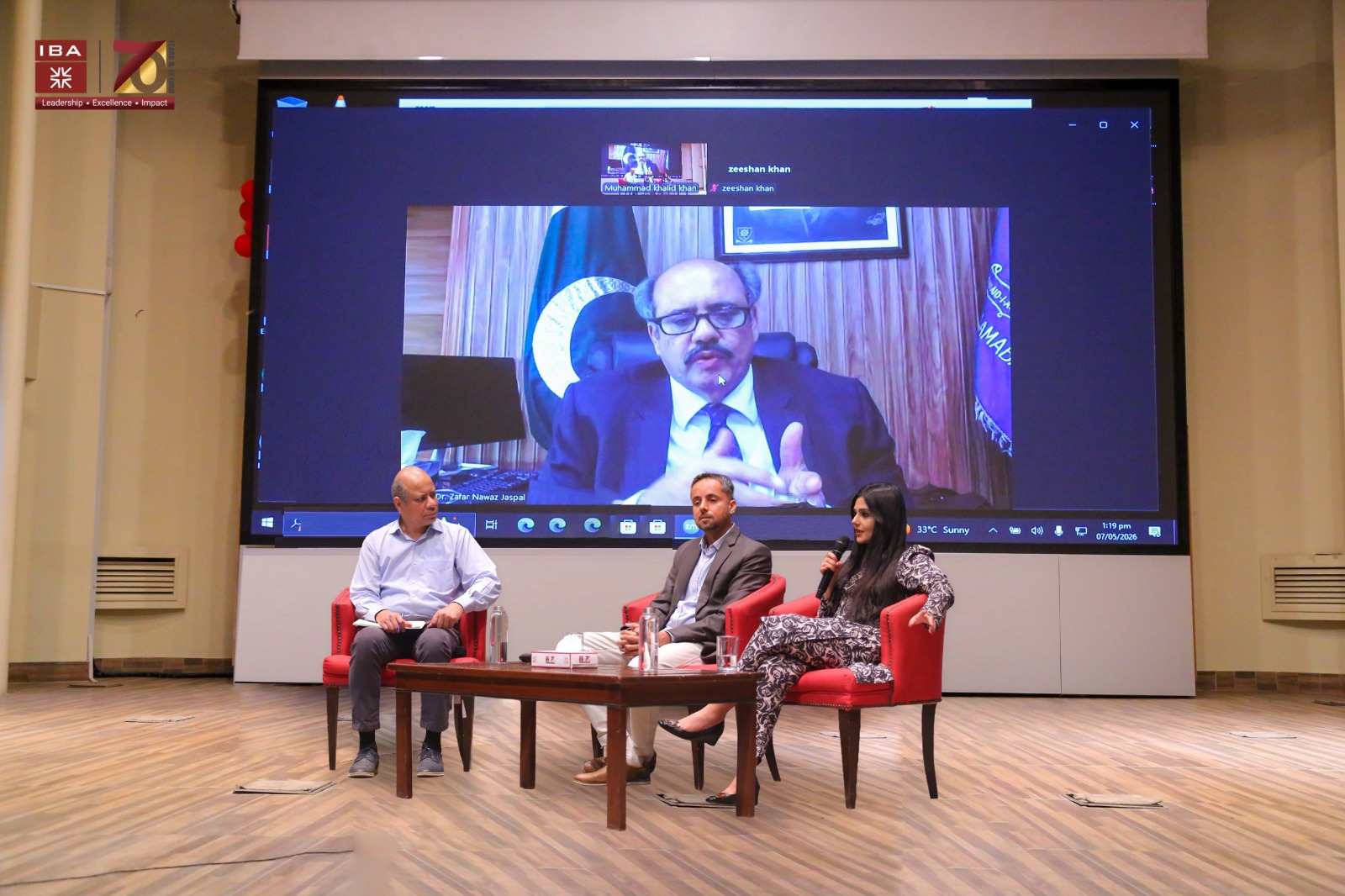
KARACHI: Institute of Business Administration Karachi hosted a comprehensive panel discussion titled “Wars, Crisis, and Deterrence Stability in South and West Asia” at its Main Campus, bringing together academics, legal experts and policy specialists to discuss regional conflicts, global security challenges and evolving military strategies.
The session was organized by the School of Economics and Social Sciences (IBA-SESS) and focused on the changing dynamics of warfare, nuclear deterrence, international law and geopolitical instability in South Asia and the Middle East.
The panel featured Zafar Nawaz Jaspal, who joined online, alongside Reema Omer and Sajjad Ahmed. The discussion was moderated by Farhan Hanif Siddiqi.
Opening the discussion, Dr. Siddiqi highlighted the growing frequency of wars and militarized crises around the world, including the Russia-Ukraine conflict, the ongoing Gaza crisis, tensions involving Iran and Israel, and recurring instability in South Asia.
Prof. Dr. Jaspal discussed the emergence of what he described as the “Fourth Nuclear Age,” explaining that the current global strategic environment is increasingly shaped by state-centric conflicts, military modernization and weakening international arms control mechanisms.
He emphasized that military power has once again become central in global politics, while traditional deterrence frameworks are facing serious challenges due to technological advancements and changing geopolitical realities.
Ms. Omer focused on the legality of modern warfare under international law. She stressed that despite concerns regarding selective implementation, international law remains essential for accountability, particularly for countries in the Global South.
She also discussed legal principles governing the use of force, self-defence and international navigation, underlining the importance of maintaining rules-based international conduct amid rising global tensions.
Dr. Sajjad Ahmed provided insights into Iran’s foreign policy and strategic thinking, explaining how historical experiences, sanctions and regional security concerns continue to shape Tehran’s geopolitical posture.
He further explored Iran’s emphasis on sovereignty, resistance to foreign intervention and the link between domestic political pressures and external policy decisions.
The panel also examined India-Pakistan relations, deterrence stability, future escalation risks and the growing impact of emerging military technologies, including drones, missile systems, cyber warfare and multi-domain operations on regional security.
The discussion concluded with an interactive question-and-answer session where students, faculty members and participants engaged with the speakers on key geopolitical and strategic issues facing the region.