Vance-led US team en route to Islamabad for Iran talks, deal to be signed ‘today’: Trump
Web Desk April 20, 2026A major diplomatic push is underway as US President Donald Trump announced that a high-level American delegation, including Vice President JD Vance, special envoy Steve Witkoff, and adviser Jared Kushner, is en route to Islamabad for critical negotiations with Iran. Trump claimed that a deal could be signed “today,” expressing cautious optimism that the long-running standoff between Washington and Tehran may be approaching a turning point.
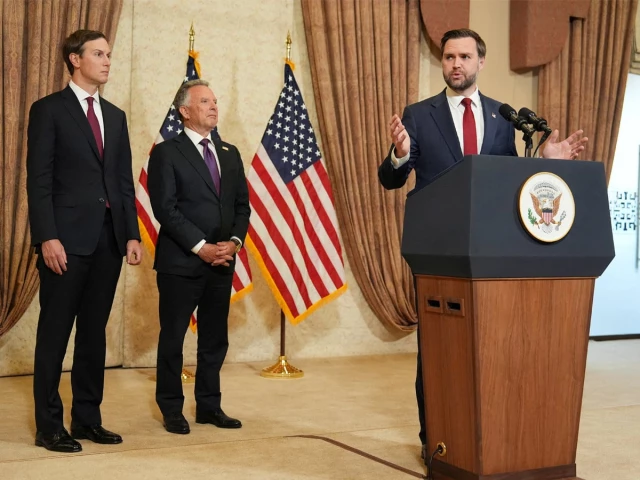
A major diplomatic push is underway as US President Donald Trump announced that a high-level American delegation, including Vice President JD Vance, special envoy Steve Witkoff, and adviser Jared Kushner, is en route to Islamabad for critical negotiations with Iran. Trump claimed that a deal could be signed “today,” expressing cautious optimism that the long-running standoff between Washington and Tehran may be approaching a turning point.
The Magnum Ice Cream Company Appoints Mert Turgut as General Manager Pakistan
Speaking in interviews with Fox News and the New York Post, Trump said he would be open to meeting Iranian leadership personally if progress is achieved in the ongoing talks. “If they want to meet, I have no problem meeting them,” he stated, while reiterating that the central US demand remains unchanged: Iran must abandon any pursuit of nuclear weapons.
At the same time, Trump acknowledged uncertainty surrounding the negotiations, declining to comment on potential consequences if the talks collapse as the ceasefire deadline nears. “It wouldn’t be pretty,” he said, when asked about possible escalation measures.
Iran Maintains Hard Line, Rejects Second Round of Talks
On the Iranian side, President Masoud Pezeshkian reiterated Tehran’s willingness to pursue diplomatic solutions while emphasizing deep mistrust of Washington. He stressed that Iran seeks to end the conflict while maintaining “national honor” and warned that reconstruction and economic stabilization will require careful planning after prolonged hostilities.
Iranian Foreign Ministry spokesperson Esmail Baghaei confirmed there is currently “no plan” for a second round of talks with the United States, accusing Washington of “violent acts,” shifting demands, and failing to uphold commitments under the ceasefire framework.
Baghaei reaffirmed Iran’s position that its nuclear program and missile capabilities are non-negotiable, stating that Tehran “does not believe in ultimatums” and will not compromise on what it considers national security red lines.
A senior Iranian source also told international media that major differences persist over the nuclear issue, while adding that Iran’s defensive capabilities remain outside the scope of negotiation. The source further warned that continued US restrictions on the Strait of Hormuz are undermining peace efforts.
Strait of Hormuz Crisis Deepens Global Concerns
Tensions have escalated sharply in the strategically vital Strait of Hormuz, where both Iran and the United States have imposed maritime restrictions. The US recently seized an Iranian-flagged cargo vessel, prompting Tehran to accuse Washington of “armed piracy” and vow retaliation.
The incident has intensified fears of disruption to global oil flows, as nearly one-fifth of the world’s crude supply passes through the strait. Oil prices surged and global markets reacted with volatility following the escalation.
China, responding to the situation, called for restraint and urged all parties to respect the ceasefire agreement. Beijing emphasized that the Strait of Hormuz remains a critical global trade route and warned against further escalation. Chinese President Xi Jinping also stressed the importance of maintaining safe maritime passage during discussions with regional leadership.
Pakistan Emerges as Key Diplomatic Hub
Pakistan continues to play a central mediating role in the crisis. According to official sources, Field Marshal Asim Munir held high-level discussions with President Trump, focusing on de-escalation efforts and maritime security concerns. Islamabad is expected to host renewed talks as diplomatic momentum builds.
Preparations for the US delegation’s arrival have been underway in the Pakistani capital, with heightened security measures and logistical arrangements around key venues.
Iran Signals Resistance but Leaves Door for Diplomacy
Despite rejecting immediate negotiations, Iranian leadership continues to emphasize diplomacy as a theoretical pathway forward. Pezeshkian stated that rational and diplomatic channels should be used to reduce tensions, but reiterated that “vigilance and distrust” toward the United States remain essential.
Iranian officials accused Washington of repeatedly violating agreements and pursuing what they described as “unrealistic and excessive demands.” Tehran has also warned that it will defend its national interests using all available capabilities if threatened further.
Global Stakes Rise as Ceasefire Nears Expiration
With the fragile ceasefire set to expire within days, international concern is mounting over the possibility of renewed escalation. The ongoing conflict has already disrupted global energy markets, contributed to inflationary pressures, and intensified geopolitical instability across the Middle East.
Analysts warn that failure of the Islamabad talks could trigger a renewed cycle of confrontation, particularly if maritime tensions in the Strait of Hormuz continue to escalate. European allies and global institutions have urged both sides to prioritize diplomacy and avoid further military escalation.
As negotiations unfold, the world watches closely to see whether Islamabad becomes the venue for a breakthrough—or the point where another diplomatic opportunity collapses under mounting pressure.