Kim Jong Un Oversees New Ballistic Missile Tests as North Korea Expands Weapons Capability
Web Desk April 20, 2026North Korean leader Kim Jong Un has overseen a series of ballistic missile test launches aimed at evaluating new warheads equipped with cluster munitions and fragmentation capabilities, according to state media Korean Central News Agency (KCNA) on Monday.
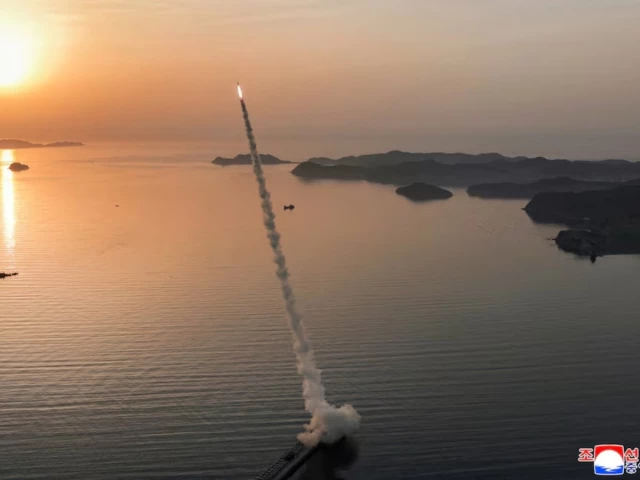
North Korean leader Kim Jong Un has overseen a series of ballistic missile test launches aimed at evaluating new warheads equipped with cluster munitions and fragmentation capabilities, according to state media Korean Central News Agency (KCNA) on Monday.
Powerful 7.5 Magnitude Earthquake Strikes Off Japan Coast, Tsunami Alerts Issued
The tests mark North Korea’s fourth ballistic missile launch this month and seventh so far this year, underscoring its continued efforts to advance missile technology in defiance of international sanctions imposed by the United Nations Security Council.
KCNA reported that five upgraded short-range Hwasong-11 Ra tactical ballistic missiles were launched toward a designated target island approximately 136 kilometres away. The strikes reportedly covered a wide area, demonstrating what Pyongyang described as “high-density suppression strike capability.”
South Korean authorities confirmed the launches, stating that missiles were fired from near Sinpo on North Korea’s eastern coast at around 6:10 a.m., prompting renewed calls from Seoul for restraint and an end to what it called “provocative actions.”
The South Korea Ministry of Unification noted an unusually large presence of senior frontline military commanders at the test site, suggesting the launch was closely tied to operational deployment planning near the heavily militarized border.
North Korea remains technically at war with South Korea since the 1950–53 Korean War ended in an armistice rather than a peace treaty, leaving the peninsula in a prolonged state of military tension.
KCNA said Kim expressed satisfaction with the results, praising the development of advanced warhead systems and urging further progress in missile technology to strengthen combat readiness.
Images released by state media showed Kim accompanied by his daughter, widely believed to be named Ju Ae, observing the launches alongside senior military officials. Her repeated appearances at major weapons tests have fueled speculation about her potential political future within the leadership structure.
Security analysts say the latest tests indicate North Korea’s intent to improve strike precision and expand battlefield lethality, raising concerns that deployed systems could place key military installations in Seoul and surrounding regions within range.
International reactions have included condemnation from the United Kingdom, which urged Pyongyang to return to diplomatic engagement and avoid further escalation.
Experts also suggest that global geopolitical tensions, including ongoing conflicts involving missile and nuclear programs elsewhere, may be reinforcing North Korea’s determination to expand its strategic arsenal.
Kim has previously declared North Korea’s nuclear status “irreversible,” signaling continued expansion of its self-described deterrent capability despite international pressure.