
Shehbaz Sharif Warns Water Must Not Become a Political Weapon
At the Bishkek summit, Pakistan’s prime minister calls for respect for water treaties, stronger regional cooperation and dialogue amid rising tensions.
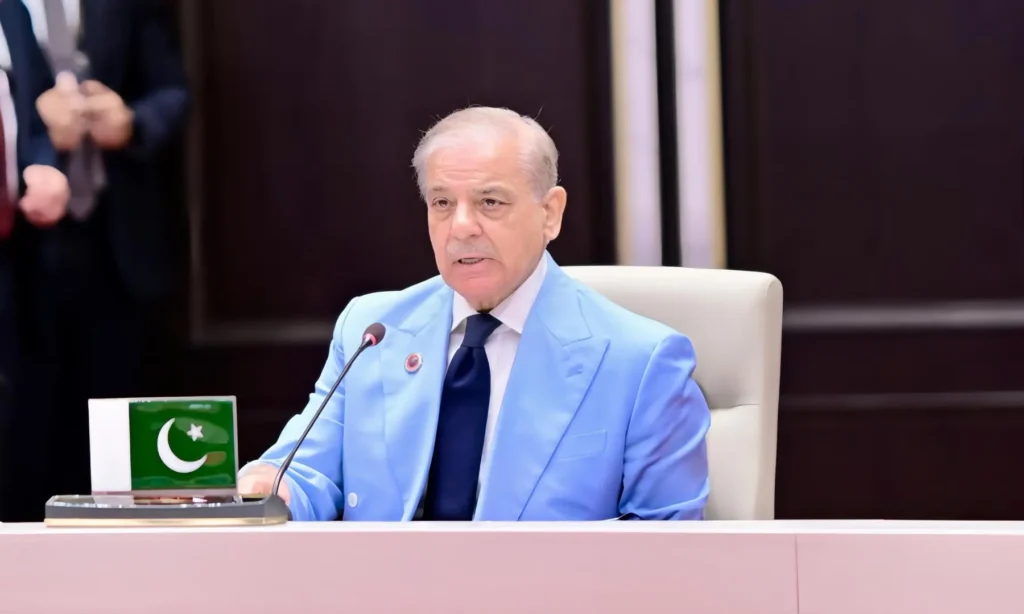
Prime Minister Shehbaz Sharif addresses the SCO summit in Bishkek.
BISHKEK: Prime Minister Shehbaz Sharif has warned that water must never be used as a tool of political pressure, stressing that shared water resources are vital to the future of millions across the region.
Addressing the Shanghai Cooperation Organisation (SCO) Council of Heads of State meeting in Bishkek on Tuesday, Shehbaz Sharif called for lasting peace and respect for international commitments. Without naming India, he referred to the Indus Waters Treaty (IWT), saying agreements governing shared rivers must be honoured in both letter and spirit.
“Water is the lifeblood of our region,” the prime minister said, emphasising its importance for communities, agriculture and future generations. He warned against using water as an instrument of coercion or political leverage.
His remarks came a day after the Permanent Court of Arbitration ruled that the Indus Waters Treaty remains in force and rejected India’s justification for suspending the agreement. The court also directed India to suspend work on a hydroelectric project in occupied Kashmir.
The dispute over the treaty has remained a major source of tension between Pakistan and India since New Delhi announced the unilateral suspension of the agreement in April 2025. The move was followed by a brief military confrontation between the two countries the following month.
Terrorism Remains a Major Regional Challenge
Turning to security, Shehbaz described terrorism as one of the most serious threats confronting the region. He said Pakistan had played an active role in strengthening cooperation through the SCO Regional Anti-Terrorist Structure.
The prime minister highlighted Pakistan’s long campaign against militancy, saying the country had lost more than 90,000 lives and suffered economic losses exceeding $150 billion over the past two and a half decades.
He also reiterated Pakistan’s desire for a peaceful and stable Afghanistan. However, he warned that lasting peace would remain difficult while militant groups continued to use Afghan territory for attacks against Pakistan and other countries.
Pakistan Sets Out Priorities for SCO Chairmanship
Pakistan is set to assume the chairmanship of the SCO Council of Heads of State for 2026–27, with Islamabad scheduled to host the next summit.
Shehbaz said Pakistan would focus its chairmanship on areas including information technology, artificial intelligence, energy, poverty reduction, disaster management, healthcare, culture and sports.
One of Islamabad’s key proposals is an SCO framework for sovereign AI infrastructure and governance. The initiative, according to the prime minister, would encourage responsible and inclusive technological development while ensuring that member states are not left behind.
Pakistan’s chairmanship will be guided by the theme “Turning Vision into Action: Connectivity, Innovation and Shared Prosperity.”
Shehbaz urged member states to move beyond declarations and translate the SCO’s vision into practical outcomes.
Sahar Ansari’s Literary Legacy Takes Centre Stage at Arts Council Karachi
Connectivity and Economic Cooperation
The prime minister described regional connectivity as essential to economic development, arguing that secure transport routes, energy corridors and resilient supply chains have become strategic necessities.
He highlighted the China-Pakistan Economic Corridor (CPEC) as an important link between regional economies and the Arabian Sea. Islamabad, he said, would continue supporting railway, road and energy projects connecting countries across the region.
Shehbaz also called for implementation of the SCO Development Strategy through 2035 and described the proposed SCO Development Bank as an important step towards financing regional development.
Pakistan, he added, would continue supporting poverty reduction, social protection and inclusive development through its role in the SCO’s Special Working Group on Poverty Reduction.
Rising Geopolitical Tensions
The prime minister opened his address by congratulating Kyrgyzstan on its successful SCO chairmanship and praised President Sadyr Japarov and his administration for hosting the summit.
Reflecting on the SCO’s 25-year history, Shehbaz said the organisation had developed from a small initiative into a major regional platform for security, stability and cooperation.
He warned that the international environment was increasingly shaped by geopolitical tensions, economic fragmentation, climate-related challenges and rapid technological change.
Against this backdrop, he said the SCO could help its members confront common challenges through cooperation and dialogue.
Pakistan, he stressed, remained committed to the principles of the United Nations and SCO charters and supported the peaceful resolution of disputes through international law.
Pakistan Highlights Mediation Role
Shehbaz also spoke about Pakistan’s diplomatic efforts to reduce tensions in the Middle East, particularly its role in facilitating dialogue between the United States and Iran.
He said Pakistan’s diplomatic initiatives had contributed to the Islamabad Memorandum of Understanding signed in June, which provided a framework aimed at de-escalating the conflict.
The prime minister said Islamabad remained committed to peace-building efforts and thanked countries that had supported its diplomatic initiatives.
He also referred to the recent trilateral defence agreement between Pakistan, Saudi Arabia and Türkiye, describing it as defensive in nature and stressing that it was not directed against any country.
On Gaza and the West Bank, Shehbaz called for stronger international action to protect Palestinian civilians and support their right to self-determination.
Dar Holds Talks with Iranian and Chinese Officials
Separately, Deputy Prime Minister and Foreign Minister Ishaq Dar met Iranian Foreign Minister Abbas Araghchi on the sidelines of the SCO summit.
According to Pakistan’s Foreign Office, the two officials discussed bilateral relations and regional developments. Dar stressed that dialogue and diplomacy remained essential and said sincere implementation of the Islamabad MoU was the way forward.
Dar had earlier met Iranian President Masoud Pezeshkian during the summit. Pakistan has continued to position itself as a mediator in efforts to reduce tensions in the Middle East.
Dar also met Chinese Foreign Minister Wang Yi, with both sides reaffirming the All-Weather Strategic Cooperative Partnership between Pakistan and China.
Their discussions covered bilateral cooperation, regional issues and preparations for the upcoming United Nations General Assembly session in New York, including the process for selecting the next UN secretary-general.
Dar also held talks with Belarusian Foreign Minister Maxim Ryzhenkov on bilateral relations and regional developments.