Mauritania: The Hidden Sahara Nation of Ancient Cities and Desert Wonders
From UNESCO-listed caravan towns and lush desert oases to one of the world’s largest fishing fleets visible from space, Mauritania offers a rare glimpse into one of Africa’s least-visited destinations.
Traditional fishing boats gather along Mauritania's Atlantic coast beneath the vast Sahara landscape.
Mauritania, a vast West African nation where nearly 90% of the land lies within the Sahara Desert, remains one of the world’s least-visited destinations despite offering extraordinary landscapes, centuries-old heritage and unique cultural experiences. The country attracts fewer than 10,000 international visitors each year, yet travellers who venture there discover ancient caravan cities, dramatic desert oases and one of the world’s richest Atlantic fishing grounds.
Stretching across the Sahara, Mauritania combines history, culture and natural beauty in a way few destinations can match. Although limited tourism infrastructure has slowed visitor growth, the country has remained free from terrorist attacks since 2011 and ranks as less affected by terrorism than many European nations, according to international security assessments.
The journey often begins in Nouadhibou, Mauritania’s second-largest city and its most important fishing hub. Fed by the nutrient-rich Canary Current, the Atlantic waters support enormous populations of fish and octopus. Thousands of traditional fishing boats crowd the harbour, creating a spectacular scene so large that satellite imagery can capture it from space.
Further south, the capital Nouakchott rises directly from the desert. Home to roughly one-third of the country’s five million residents, the city blends modern government buildings and mosques with sandy streets that preserve its close connection to the surrounding Sahara. The capital offers visitors a lively introduction to Mauritanian culture while maintaining its distinctive desert identity.
Hearing Loss: Everyday Noise May Be Damaging Your Ears More Than You Think
Camels remain central to everyday life across Mauritania. With an estimated two million camels nationwide, communities continue to rely on them for transport, dairy production and trade. The Beila Camel Market, the second largest in Africa, attracts traders from across the region, where buyers regularly pay more than $1,000 for a single animal.
Travelling east along the historic Route de l’Espoir (Road of Hope) reveals the country’s vast desert interior. The highway links Nouakchott with the remote city of Néma, opening access to some of Mauritania’s most significant historical sites. Long-distance journeys often become memorable experiences as passengers stop for prayers and spend nights camping beneath the clear Saharan sky.
Beyond Néma lies Oualata, a UNESCO World Heritage Site renowned for its red-earth architecture decorated with intricate geometric designs created by local women. Once a thriving stop on trans-Saharan trade routes connecting West Africa with Timbuktu, the town now receives fewer than 30 international visitors each year. Many historic homes stand partially abandoned as younger generations move to larger cities in search of better economic opportunities.
Families in Oualata continue to safeguard priceless handwritten manuscripts that date back centuries. Rather than preserving them in public institutions, residents protect these rare documents inside private homes, passing them from one generation to the next.
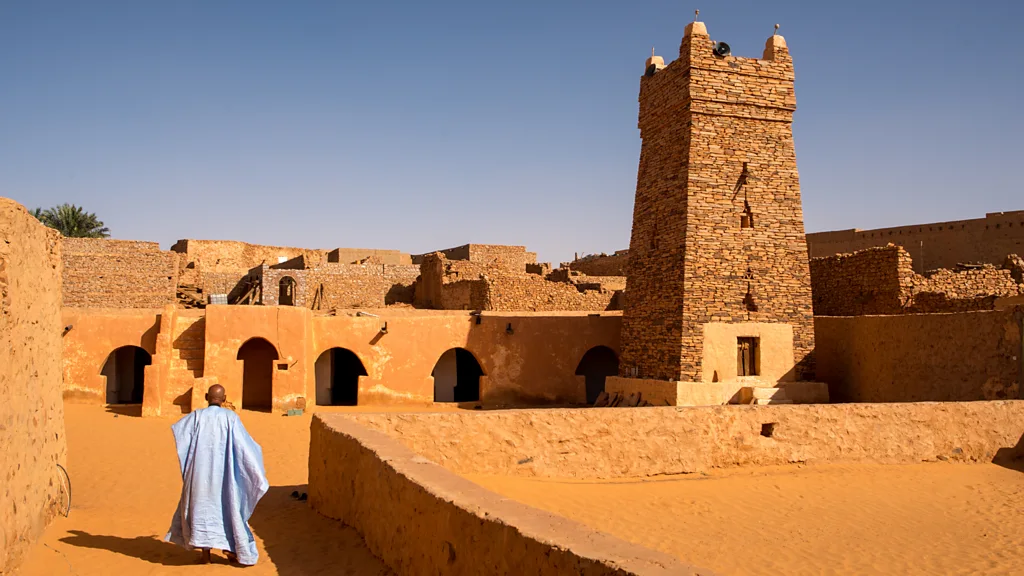
Another UNESCO-listed destination, Chinguetti, ranks among Africa’s most historic caravan cities. Founded in the eighth century, it later became an influential centre of Islamic scholarship and trade. Today, advancing sand dunes threaten many of its stone and mud buildings, gradually reclaiming sections of the ancient settlement.
The city’s ancient mosque features one of the oldest continuously used minarets in the Muslim world, while its traditional libraries preserve remarkable collections of manuscripts covering astronomy, medicine, mathematics, poetry and Islamic law. Restoration projects have helped protect these libraries, allowing visitors to explore a literary heritage that has survived for centuries.
Before leaving Mauritania, many travellers visit the oasis of Terjit, where clusters of palm trees flourish inside rocky desert canyons. The oasis provides a striking contrast to the surrounding Sahara and symbolises the resilience of communities that have lived and travelled through one of Earth’s harshest environments for generations.
Although Mauritania remains overlooked by mainstream tourism, its ancient heritage, dramatic desert scenery and authentic cultural traditions offer adventurous travellers one of Africa’s most distinctive and rewarding experiences.