
Andy Burnham: King Charles Appoints Andy Burnham as Britain’s New Prime Minister
New UK leader pledges action on the cost-of-living crisis, economic reform and continued support for Ukraine after replacing Keir Starmer.
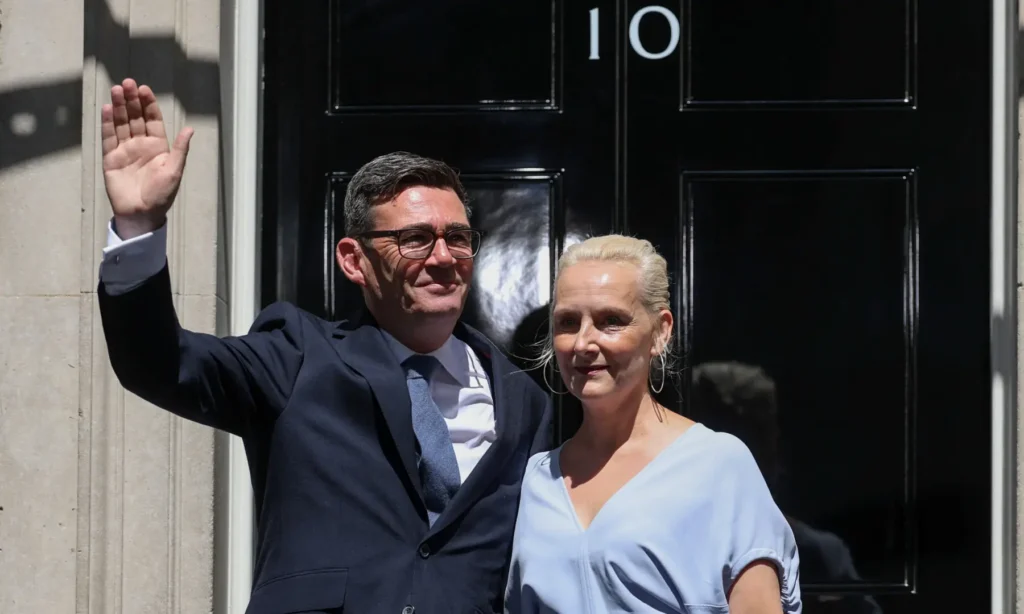
Andy Burnham delivers his first speech outside 10 Downing Street after becoming UK prime minister.
Andy Burnham officially became the United Kingdom’s new prime minister on Monday after King Charles III invited him to form a government following Keir Starmer’s resignation.
Buckingham Palace confirmed that Burnham accepted the King’s invitation to lead the government, making him Britain’s sixth prime minister in the past decade.
Soon after taking office, Burnham delivered his first speech outside 10 Downing Street. Supporters gathered outside the prime minister’s residence and applauded as he outlined his priorities.
Burnham promised to introduce measures this week to ease the cost-of-living crisis. He also announced plans to unveil a 10-year national strategy later this year.
“Britain needs to show the world that we can regain our stability once again,” Burnham said.
Naql-e-Makani: SOVAPA Alumni Series Brings Rajinder Singh Bedi’s Classic Drama to Life
“We have not been good enough, and we need to be better.”
He pledged to give households “breathing space” by introducing measures to reduce living costs while explaining how the government would finance its plans.
Government Sets Out Economic Priorities
Burnham said his administration would help more young people find employment through education reform and expanded mental health support.
He also pledged to build more council homes and reduce welfare spending through long-term investment rather than spending on policy failures.
Furthermore, Burnham said his government would continue to follow fiscal rules while maintaining Britain’s defence commitments to international allies.
Support for Ukraine Remains Unchanged
The new prime minister confirmed that US President Donald Trump and Ukrainian President Volodymyr Zelensky would receive some of his first international phone calls.
Moreover, Burnham pledged to maintain Britain’s strong support for Ukraine.
He said President Zelensky would have no doubt about the UK’s continued backing.
“Britain’s support is steadfast and resolute,” Burnham said, adding that he would personally continue supporting Ukraine.
Cabinet Formation and Political Challenges
Burnham is expected to announce his senior Cabinet appointments later on Monday. Attention is focused on who will replace Rachel Reeves as finance minister.
The former Mayor of Greater Manchester, widely known as the “King of the North,” returned to Parliament only weeks ago before Labour selected him to replace Starmer.
Labour MPs believe Burnham can help counter the growing popularity of Nigel Farage’s Reform UK party.
Earlier, Starmer delivered his farewell speech outside Downing Street. He defended his government’s record and said Britain had become stronger and fairer during his two years in office.
World Leaders Welcome Burnham
International leaders quickly congratulated Burnham on becoming prime minister.
European Commission President Ursula von der Leyen said she looked forward to strengthening cooperation between the European Union and the United Kingdom.
European Council President Antonio Costa also welcomed the appointment. He expressed hope that both sides would continue improving relations for the benefit of citizens and businesses.
A New Direction for Britain
Before taking office, Burnham told The Times that Britain needed a different approach to government after years of political instability.
He said future public spending would focus on early investment, economic growth and helping people succeed rather than paying for long-term policy failures.
Burnham also promised swift action to ease financial pressure on families, saying voters repeatedly raised concerns about the rising cost of living during his campaign.
Despite his ambitious agenda, the new prime minister faces significant challenges. These include slow economic growth, rising public debt, higher borrowing costs and increasing pressure on public finances.
In addition, irregular migration and volatile global energy prices remain major issues for the new government.
Burnham previously served as a Labour MP between 2001 and 2017. He later built a strong reputation as Mayor of Greater Manchester.
He recently described his leadership as Labour’s “last chance” to regain public confidence before the next general election, expected in 2029.
His first major policy decision came before taking office when he cancelled the previous government’s £1.8 billion nationwide digital identity programme.
His office said the savings would instead support measures aimed at reducing the cost of living and addressing more urgent national priorities.