Islamabad MoU: Pakistan, Saudi Arabia, Turkiye and Egypt Back Swift Progress in US-Iran Negotiations
Pakistan, Saudi Arabia, Turkiye and Egypt welcomed the signing of the Islamabad Memorandum of Understanding (MoU) between the United States and Iran during the Regional Four (R-4) meeting in Cairo, stressing the need for a swift and successful conclusion to the next phase of negotiations.
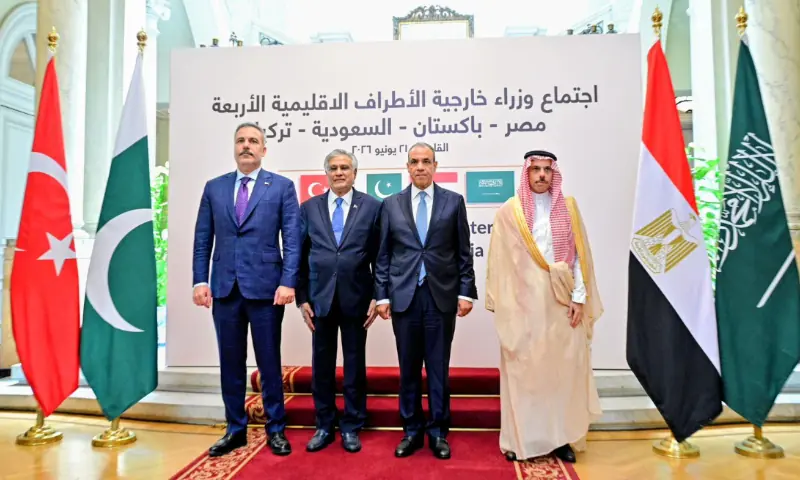
Foreign ministers attend the R-4 meeting in Cairo and endorse the Islamabad MoU.
Pakistan, Saudi Arabia, Turkiye and Egypt welcomed the signing of the Islamabad Memorandum of Understanding (MoU) between the United States and Iran during the Regional Four (R-4) meeting in Cairo, stressing the need for a swift and successful conclusion to the next phase of negotiations.
The meeting took place as Pakistan, alongside co-mediator Qatar, facilitated high-level technical discussions in Switzerland between US and Iranian delegations to finalise details of the agreement.
According to a joint statement shared after the meeting, the participating countries described the Islamabad MoU as a constructive move towards de-escalation and an important step in ending a conflict that threatened regional security, energy markets, international maritime routes, global supply chains and global trade.
US-Iran Talks: US and Iran Begin Direct Switzerland Negotiations to Secure Lasting Peace
The foreign ministers praised regional and international efforts that helped secure the understanding and highlighted the importance of implementing all commitments agreed by the parties.
The ministers particularly acknowledged Pakistan’s role in helping achieve the agreement and recognised Qatar’s support in securing a successful outcome.
They also welcomed Pakistan’s continued coordination with regional partners throughout the diplomatic process.
The statement emphasised the importance of quickly advancing the next stage of negotiations to achieve a lasting, verifiable and mutually acceptable solution to unresolved issues.
The ministers stressed that future efforts should reflect the concerns of regional countries, particularly regarding the security and stability of Gulf Arab states and the Levant region, while strengthening collective security and supporting long-term regional stability.
Reaffirming support for the Palestinian cause, the ministers stated that progress towards peace, security and stability in the Middle East remains closely linked to achieving a just and lasting settlement for Palestinians.
They devoted special attention to the humanitarian and political situation in Gaza, the West Bank and East Jerusalem.
The ministers reiterated support for the Palestinian people’s legitimate rights, including self-determination and the establishment of an independent Palestinian state based on the June 4, 1967 borders with East Jerusalem as its capital, in line with relevant United Nations Security Council resolutions.
In a separate update, Pakistan’s Foreign Office said the R-4 meeting reviewed developments linked to the Islamabad MoU, exchanged views on regional and international issues, and reaffirmed support for dialogue, diplomacy and coordinated efforts for peace and prosperity.
The ministers also discussed strengthening cooperation within the R-4 framework to address shared challenges and opportunities.
On the sidelines of the meeting, Deputy Prime Minister and Foreign Minister Ishaq Dar met Egyptian President Abdel Fattah El-Sisi and discussed bilateral ties, regional developments and cooperation under the R-4 platform.
Dar conveyed greetings from President Asif Ali Zardari, Prime Minister Shehbaz Sharif and Field Marshal Syed Asim Munir, while reaffirming Pakistan’s commitment to expanding its longstanding relationship with Egypt.
He welcomed President El-Sisi’s acceptance of an invitation to visit Pakistan and expressed hope that leadership exchanges would take place soon.
President El-Sisi praised Pakistan’s constructive role in promoting dialogue, reducing tensions and supporting diplomatic engagement across the region.
The leaders agreed that stronger coordination under the R-4 framework could contribute to peace, economic development and long-term regional prosperity.