World Cup: Football Unites America Beyond Political Divisions During 250th Anniversary
The FIFA World Cup is bringing communities together across the United States, showcasing the country’s diversity, shared celebrations, and renewed sense of unity despite political differences.
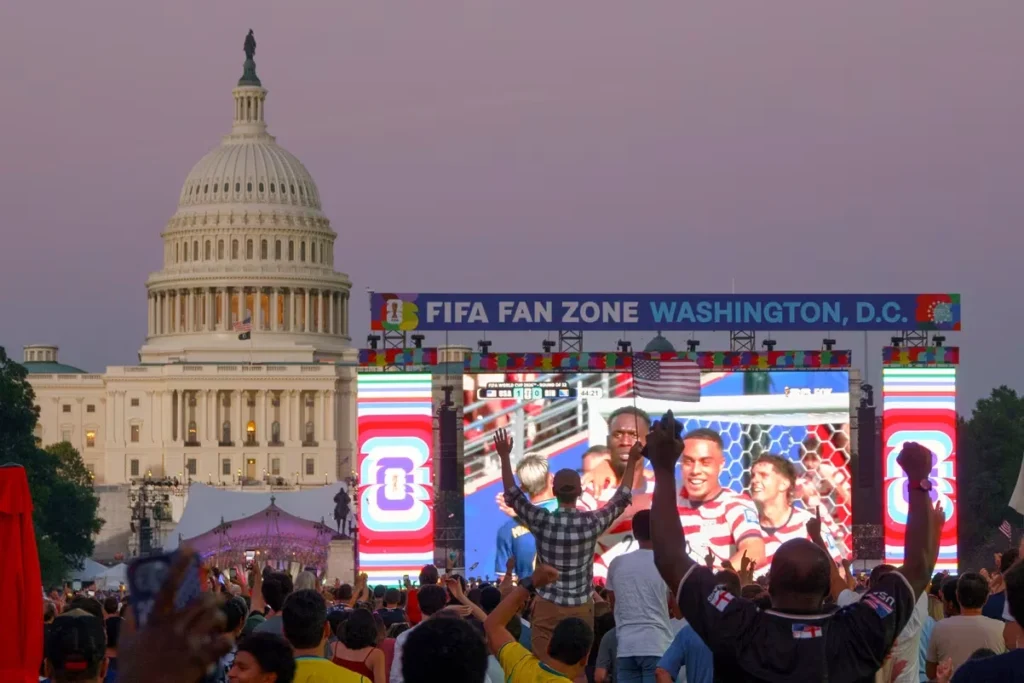
Fans celebrate together during the FIFA World Cup in the United States.
World Cup celebrations are transforming cities across the United States, offering a rare moment of national unity as the country marks its 250th anniversary. Packed stadiums, crowded restaurants, and vibrant street gatherings have highlighted America’s cultural diversity and demonstrated football’s ability to bring together people from different backgrounds during a period of political polarization.
The tournament has attracted supporters from across the globe, turning American cities into multicultural meeting points where fans proudly celebrate both their heritage and their adopted homeland. Communities with roots in Mexico, Brazil, Colombia, Nigeria, Germany, England, and many other nations have gathered alongside American supporters, reflecting the country’s long-standing identity as a nation shaped by immigration.
Headline: Russia Oil Terminal: Ukraine Strikes Major Fuel Facility in St Petersburg
While concerns surrounded the competition before kickoff—including high ticket prices, commercial interests, and criticism of FIFA’s governance—the atmosphere has shifted dramatically since the tournament began. The excitement on the pitch and the celebrations beyond the stadiums have become the defining features of the event.
Team USA has emerged as a symbol of the country’s diversity. The squad is coached by an Argentine manager and features players with multicultural backgrounds. Defender Antonee Robinson was raised in England, midfielder Malik Tillman developed through Germany’s youth system, and forward Folarin Balogun, born in New York to Nigerian parents and raised in England, represents the global nature of modern American football.
Balogun’s presence has also highlighted the importance of birthright citizenship in the United States. His eligibility to represent the national team drew renewed attention after the US Supreme Court upheld the constitutional principle shortly before he scored for the United States during the tournament.
Beyond Team USA’s performances, the competition has revitalized city centres across the country. Fans wearing jerseys from dozens of nations have filled public squares, restaurants, and sports bars, creating an atmosphere many cities have not experienced since before the COVID-19 pandemic. The shared experience of watching matches has encouraged communities to reconnect in person after years of social and political division.
Football has traditionally carried deep political significance in many parts of Europe and South America. In the United States, however, the tournament has largely provided a common ground where supporters from different political beliefs can celebrate together. Unlike many issues that divide public opinion, the national team’s success has become a source of shared pride.
FIFA President Gianni Infantino has argued that football helps people better understand one another by bringing different cultures together. The organisation also viewed the 2026 World Cup as an opportunity to complement celebrations marking the 250th anniversary of American independence.
The contrast between the two events has become increasingly noticeable. While World Cup matches have drawn enthusiastic crowds and lively celebrations, several official anniversary events have attracted more modest attendance amid ongoing political debate. Analysts suggest that football’s broad international appeal has resonated more strongly with many communities than highly politicised public commemorations.
As the tournament continues, the World Cup is demonstrating that sport can unite diverse communities, encourage cultural exchange, and offer moments of shared optimism. At a time when political divisions often dominate public life, football has reminded many Americans—and visitors from around the world—of the country’s diversity, openness, and enduring capacity to come together.