PHDEC Promotes Olive Oil Quality and Export Opportunities Through Technical Webinar
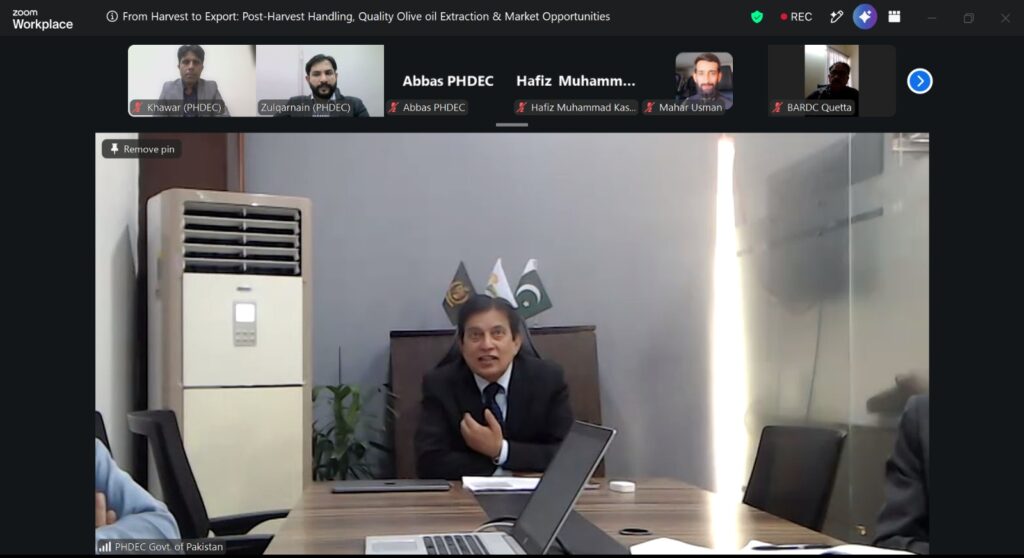
Olive Oil development in Pakistan takes centre stage at a PHDEC webinar on harvesting, extraction quality and export opportunities.
The Pakistan Horticulture Development and Export Company (PHDEC), under the Ministry of Commerce, Government of Pakistan, organised a technical webinar on olive harvesting, post-harvest handling, quality oil extraction and export opportunities to strengthen Pakistan’s olive value chain.
Titled “From Harvest to Export: Post-Harvest Handling, Quality Olive Oil Extraction & Market Opportunities,” the session brought together experts and stakeholders to discuss ways to improve olive oil quality, strengthen processing facilities and expand export potential.
Muhammad Naseer, CEO of PHDEC, said federal and provincial governments remained committed to developing olive cultivation as an emerging agricultural sector. He noted that Pakistan has approximately seven million olive plants, with fruit production and orchard productivity gradually increasing.
He expressed optimism that Pakistan could move from being a net importer of olive oil to becoming a net exporter through improved production, modern processing facilities, quality assurance and export-focused development.
PHDEC Encourages Investment and Market Linkages
Naseer highlighted PHDEC’s role in providing technical guidance, supporting growers and processors, coordinating with provincial governments, and promoting product development and export marketing.
He also encouraged private-sector investment in olive processing facilities, noting the government’s support for emerging ventures in the sector.
Briefing participants on FOODAG 2026, the CEO said PHDEC had allocated stalls for olive-sector stakeholders to display their products and connect with potential business partners. The company also planned a dedicated olive session alongside the event to discuss industry opportunities and challenges.
PHDEC invited olive growers, processors and other stakeholders to participate in FOODAG and benefit from networking and business development opportunities.
Experts Highlight Harvesting and Oil Quality
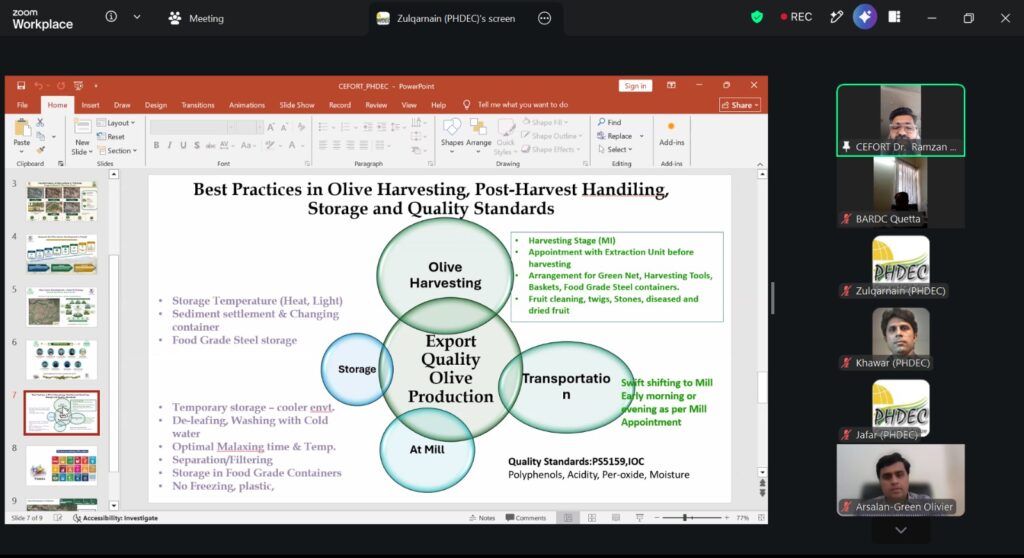
Dr. Ramzan Anser of CEFORT delivered a technical presentation on harvesting, fruit maturity assessment, post-harvest handling and methods to preserve olive oil quality.
He explained that fruit maturity plays a central role in determining the appropriate harvesting time. CEFORT has established a laboratory where farmers can submit olive fruit samples to assess oil content and identify the optimal harvesting stage.
Sharing an example of progress in local cultivation, Anser reported that Bostan Olive Farm in Kallar Kahar had produced approximately 100 tonnes of olive fruit. He also highlighted yields of up to 45 maunds.
He discussed the Punjab government’s Chief Minister’s Initiative for Agricultural Transformation in Potohar and District Khushab, under which Kallar Kahar is emerging as an important olive-growing area.
Anser further reported that the Secretary of Agriculture, Punjab, was inaugurating a cold-press olive oil extraction unit with a capacity of 400 kilograms on the day of the webinar. The local private olive community purchased the unit with a subsidy of PKR 8.25 million from the Punjab government.
Proper Processing and Storage Protect Quality
Dr. Abdullah Baloch of BARDC Quetta explained olive oil extraction, mill operations, processing controls, storage and packaging practices.
For export-oriented production, he recommended harvesting when approximately 70–80% of the fruit remains green, while stressing the importance of selecting the appropriate maturity stage for the intended oil quality.
Baloch advised growers to transport olives in plastic crates rather than sacks to reduce damage and heat exposure. He also urged them to deliver harvested fruit to processing mills as quickly as possible, preferably on the same day and within 48 hours.
These practices, he explained, can help preserve fruit quality and support the production of high-quality olive oil.
Certification Support for Processors and Exporters
A PHDEC representative also outlined the company’s Certification Support Program for olive oil processors and exporters.
Under the pilot initiative, PHDEC supports GlobalG.A.P. and ISO 22000 certification through an 80:20 cost-sharing model. The company, through the Export Development Fund (EDF), covers 80% of eligible certification costs, while participating stakeholders contribute the remaining 20%.
The programme aims to help businesses strengthen quality and food-safety systems and improve their readiness to access international markets.
Coordinated Efforts Needed to Expand Exports
The webinar concluded with a call for closer cooperation among growers, researchers, processors, government institutions and exporters to develop Pakistan’s olive industry.
PHDEC emphasised that technical training, improved processing infrastructure, certification support and stronger market connections will play an important role in building a competitive, quality-focused and export-oriented olive sector.
With olive cultivation expanding and investment opportunities emerging, the company reaffirmed its commitment to supporting the industry’s development and strengthening Pakistan’s position in international olive oil markets.