Bilawal Calls for Political Reset, Urges Consensus to Restore Trust in State Institutions
PPP chairman says Parliament, media, judiciary and Election Commission need reforms; opposes any forced division of Sindh and calls for dialogue with political opponents
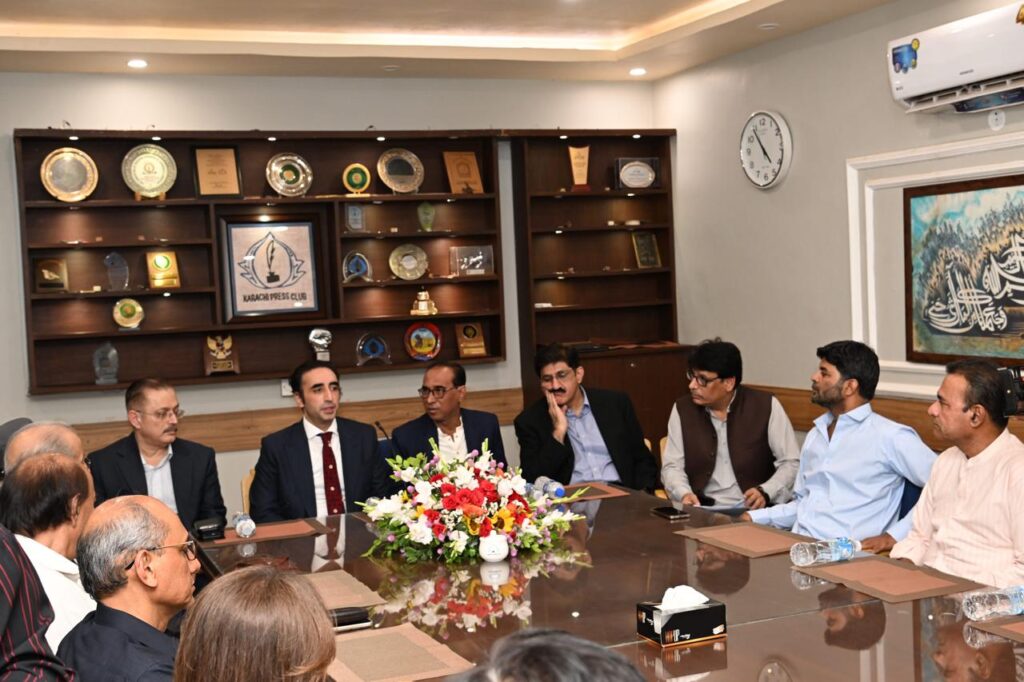
Bilawal Bhutto calls for political consensus and institutional reforms at Karachi Press Club.
Pakistan Peoples Party (PPP) Chairman Bilawal Bhutto Zardari has called on all political forces to adopt a joint democratic strategy. He said Pakistan needs a political reset to address its challenges and restore public trust in state institutions.
Addressing journalists at the Karachi Press Club, Bilawal called for stronger Parliament, a free media and a credible Election Commission. He also stressed the need for impartial accountability and a stronger judiciary through political consensus.
He said the country’s system had not collapsed suddenly. Rather, it had been brought to this point through various actions. Public confidence in major institutions had weakened, he observed. Restoring that trust requires a comprehensive political response.
“The system did not collapse by itself. It was made to collapse,” he said.
Bilawal also accepted responsibility for the situation. He acknowledged his own mistakes and called on political leaders to recognise their share of responsibility.
Bilawal Calls for Media Freedom and Journalist Protection
The PPP chairman expressed concern over the condition of journalists and the media. He said journalists were facing particularly difficult circumstances.
Without press freedom, he argued, genuine democratic dialogue and public debate cannot flourish. Journalists should not fear legal action simply for reporting the truth or highlighting public problems.
He referred to PECA, the Anti-Terrorism Act and other laws. He warned that fear of legal consequences could prevent journalists from performing their professional duties.
Bilawal urged the Karachi Press Club and press clubs across Pakistan to prepare proposals on media freedom and journalists’ protection. He also called for recommendations covering their legal and professional challenges.
The PPP, he said, would raise these concerns in Parliament and become the journalists’ voice on these issues.
Parliament Must Lead the Political Reset
Bilawal described Parliament as the country’s principal decision-making forum. He said political differences should be resolved through debate, dialogue and consultation.
The PPP chairman called the opposition’s role one of the most important and patriotic responsibilities in a parliamentary democracy. Questioning the patriotism of opposition members for criticising the government, he said, damages Parliament and democracy.
Arslan Khan Attends Reception Honouring Pakistani-American Community Leader Dr Khalil Memon
He stressed that disagreements should be settled through arguments, not arrests or intimidation. Political differences must be expressed through words and parliamentary debate rather than threats, bullets or imprisonment.
Bilawal also defended Jamiat Ulema-e-Islam-Fazl (JUI-F) chief Maulana Fazlur Rehman’s right to criticise the government. He urged the government to respond through dialogue instead of arrests, NAB proceedings or other pressure tactics.
He also recognised Pakistan Tehreek-e-Insaf (PTI) and its founder Imran Khan as political realities and important stakeholders. The government, he said, must engage all political forces to restore confidence in Parliament.
The PPP chairman said concerns over alleged election rigging must receive serious attention. Disputed election results undermine confidence in the resulting Parliament. Therefore, electoral reforms are essential to restore trust in the democratic process.
He also said the return of reserved seats to the opposition should be considered as part of efforts to rebuild parliamentary confidence.
Calls for an End to Political Victimisation
Bilawal criticised the use of accountability institutions for political purposes. He said the National Accountability Bureau (NAB) had often served as an instrument of political revenge.
Parliamentarians should not fear investigations simply because they vote on legislation or speak in the House. He called for an end to political victimisation and urged the release of political prisoners.
Bilawal described it as a recurring tragedy that former prime ministers had faced imprisonment after leaving office. He said Pakistan must end this political tradition.
He called for an impartial accountability system that targets genuine corruption without pursuing political opponents. Corruption, he added, cannot be attributed to politicians alone.
Government projects and official decisions also involve bureaucrats and other officials. Modern technology and digitisation, he said, could improve transparency and help curb corrupt practices.
Economic Hardship Requires Collective Action
The PPP chairman expressed concern over rising poverty, unemployment and inflation. He warned that people’s economic difficulties could increase further.
Pakistan had experienced difficult periods before, he said. However, the current economic situation demands serious attention and collective action.
Bilawal regretted that political parties remained occupied with confrontation and divisive politics. Their attention, he said, should instead focus on the everyday problems facing citizens.
He urged political forces to work together on economic challenges. Public welfare, he stressed, must become the central focus of national politics.
Urges Consensus on Judiciary and Constitutional Reforms
Bilawal said restoring public confidence requires reforms across Parliament, the Election Commission, accountability institutions, the judiciary and the media.
He questioned the credibility of a judicial system trusted only by the government. A system cannot function effectively if opposition parties, lawyers and even judges remain dissatisfied with it.
The PPP chairman cited the 1973 Constitution and the 18th Amendment as examples of reforms achieved through broad political and public consensus.
He said he had worked extensively to secure approval of the 26th Constitutional Amendment through mutual agreement. Although complete consensus was absent, the amendment secured approval through negotiations.
By contrast, he criticised the passage of the 27th Amendment. He said it had been approved through a “brute majority” rather than political consensus.
PPP Opposes Forced Division of Sindh
Responding to questions about new provinces, Bilawal said the PPP supported their creation in accordance with the Constitution, the law and the people’s wishes.
However, he firmly opposed any unconstitutional or forced attempt to divide Sindh, including Karachi.
He warned that imposing such a decision against the wishes of Sindh’s people could deepen divisions across the province. The consequences, he said, would not remain limited to Karachi.
Bilawal named Hyderabad, Mirpurkhas, Tando Allahyar, Nawabshah and other cities as areas that could also face tensions. The PPP, he maintained, would not support any move that created confrontation among Sindh’s people.
He also rejected using a referendum to bypass the constitutional procedure for creating a new province. Referring to Pakistan’s political history, he said referendums had often served undemocratic purposes.
The PPP chairman clarified that he had not discussed making Karachi a federal territory with the prime minister. Nor had he discussed placing Karachi, Gwadar and Islamabad under a joint administrative arrangement.
He also said he had held no such conversation with the President of Pakistan. Without an official federal cabinet decision, he added, media speculation should not be treated as fact.
Calls for Dialogue on Terrorism and National Challenges
Bilawal described terrorism as a serious national challenge. He urged all political parties to unite against the threat.
If PTI leaders were willing to cooperate in counterterrorism efforts, the government should renew its engagement with the opposition, he said. Talks should resume from the point where previous discussions had stopped.
He called for making the opposition a partner in important national matters. Cooperation across political divides, he stressed, remains essential for addressing security challenges.
Concluding his remarks, Bilawal urged the Karachi Press Club and other press clubs to organise seminars and discussions with political parties. Such forums should allow journalists to question political leaders directly.
He said Pakistan’s way forward lies in democracy, dialogue and political consensus. Resolving public problems, rather than pursuing political revenge and division, must remain the priority.
Chief Minister Murad Ali Shah, provincial ministers, representatives of journalist organisations and a large number of journalists attended the session.