

Pakistan Test cricket finds belief in the Caribbean ahead of England
Pakistan’s victory over the West Indies ended a long overseas drought, but weaknesses in the middle order remain a major concern before the England series.
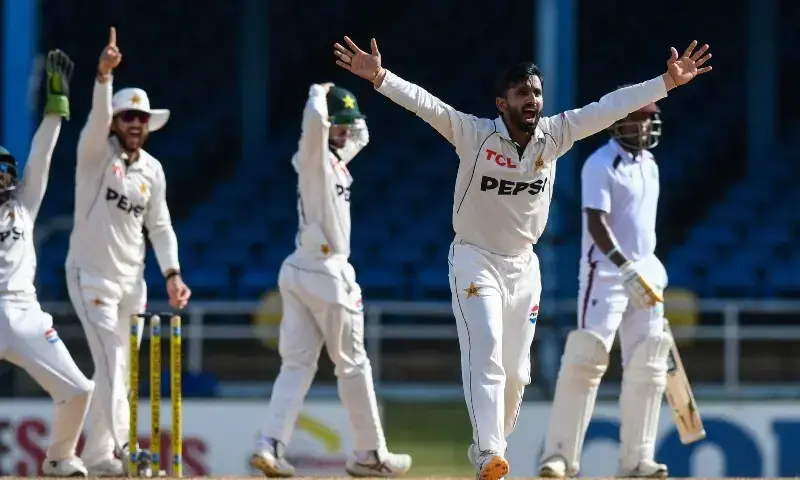
Pakistan celebrate their Test victory over the West Indies ahead of the England series.
Pakistan Test cricket has received a timely boost after an emphatic eight-wicket victory over the West Indies in Trinidad, but the result has also exposed how much work remains before the team begins its three-Test series against England on Aug 19.
The victory at Queen’s Park Oval was Pakistan’s first away Test win since July 2023, when they defeated Sri Lanka in Galle. It also ended an eight-match losing run in Tests played outside Pakistan and offered evidence that players emerging from the domestic system can still make a significant impact when given their opportunity.
Pakistan had endured a difficult period overseas before the Trinidad breakthrough. They suffered a 3-0 defeat in Australia, followed by 2-0 series losses in South Africa and Bangladesh. They then lost the opening Test against the West Indies, extending concerns about their ability to cope when conditions and momentum turn against them.
The second Test, however, produced a markedly different performance.
After struggling on the quicker surface in the opening match, Pakistan adapted effectively to conditions that increasingly favoured spin. Their bowlers dismissed the West Indies for just 117 in the second innings before the visitors reached their target of 75 with eight wickets remaining.
Abdullah Shafique was at the heart of the turnaround. Brought into the squad following the withdrawal of injured Shan Masood, the opener responded with an unbeaten 160 in the first innings.
His marathon effort lasted more than seven hours and came from 323 deliveries. It was also the first 150-plus score by a Pakistan batsman in a Test in the West Indies since 1977.
More importantly, Shafique’s performance was supported by his record in domestic cricket. He scored 369 runs at an average of 41 in six matches during the 2025-26 Quaid-i-Azam Trophy, including four half-centuries. His first-class career has also produced more than 3,700 runs at an average above 45.
The bowling attack provided another strong argument for the importance of domestic cricket.
Off-spinner Sajid Khan, recalled after missing the first Test, claimed eight wickets across the match. Left-arm spinner Ali Usman also made an impact during his debut series, while Mohammad Ali produced important breakthroughs as Pakistan gradually dismantled the West Indies batting line-up.
Sajid’s recall was backed by strong domestic numbers. In his five most recent first-class matches before the Caribbean tour, he had taken 25 wickets, including impressive match figures against Oil and Gas Development Company and Khan Research Laboratories.
Usman arrived with 198 first-class wickets at an average of 28.72, while Mohammad Ali had claimed 19 wickets during the 2025-26 Quaid-i-Azam Trophy season at an average of 23.21.
The figures suggest that Pakistan’s domestic structure continues to produce red-ball players with the experience and performances required for international cricket. The greater challenge has been identifying them, giving them opportunities and then trusting them at the highest level.
The selection of Pakistan’s bowling attack in Trinidad was also notable because it appeared to be based more heavily on conditions than reputation. Experienced seamer Mohammad Abbas was left out despite his strong performance in the first Test, underlining a willingness to adjust the attack according to the surface.
That flexibility could prove crucial in England.
The Caribbean victory, however, has not resolved Pakistan’s biggest weakness: their middle order.
Salman Ali Agha and Mohammad Rizwan remain under pressure to provide greater consistency once the top order is breached. Salman has recorded only two half-centuries in his last 14 Test innings, while several low scores during that period have increased concerns about his reliability.
His performances in the Caribbean were particularly disappointing, with scores of 20 and zero across the two Tests.
Rizwan’s recent record is similarly unconvincing. He has produced just one half-century in his last 10 Test innings, a 59 against Bangladesh. His scores against the West Indies included 12 and 11 in the first Test and 18 in the second.
The issue is therefore bigger than simply a shortage of runs. Both players have shown they can produce substantial innings, but Pakistan need them to do so more frequently, especially when early wickets leave the middle order exposed.
Collapses have been a recurring problem for the side.
Pakistan have repeatedly surrendered promising positions through loose shots, poor partnerships and an inability to convert starts into substantial totals. The first Test in the Caribbean provided another example when they collapsed for 120 in their second innings.
Even after winning in Trinidad, questions remain over whether the lower middle order can consistently absorb pressure and extend Pakistan’s advantage.
Animal Cruelty: Nadia Afgan challenges Pakistan’s acceptance of dog culling
England will present a considerably tougher examination.
The Tests at Headingley, Lord’s and Edgbaston will bring different conditions, with the Dukes ball and movement through the air likely to challenge Pakistan’s batsmen. England’s aggressive style will also put pressure on the visitors to maintain their concentration for long periods.
The Trinidad victory has nevertheless restored something Pakistan badly needed: confidence.
Shafique’s return provides encouragement at the top of the order, while the bowling attack has demonstrated that it can be reshaped according to conditions. The performances of Sajid and Usman have also reinforced the value of looking closely at domestic cricket.
But England will demand more than a strong response to difficult circumstances.
The bigger question is whether Pakistan can sustain pressure throughout a Test rather than waiting for opportunities to appear. Their middle order will be central to that challenge. If they can convert starts into partnerships and partnerships into imposing totals, the Caribbean victory could become the first step towards a genuine red-ball revival.
There is also an important lesson in the Trinidad result. Pakistan did not need to search far beyond their own domestic system to find players capable of contributing at Test level.
The talent was already producing runs and wickets away from the international spotlight.
What remains uncertain is whether Pakistan can turn that talent into consistent Test performances. The West Indies victory has provided an encouraging glimpse. England, beginning at Headingley on Aug 19, will offer a far sterner measure of whether Pakistan have genuinely turned a corner.