
Older Actresses Are Finally Getting More Than Mother-in-Law Roles in Pakistani Dramas
From Saba Hameed to Nadia Afgan, veteran performers are being given flawed, layered characters as Pakistani television slowly moves beyond familiar stereotypes
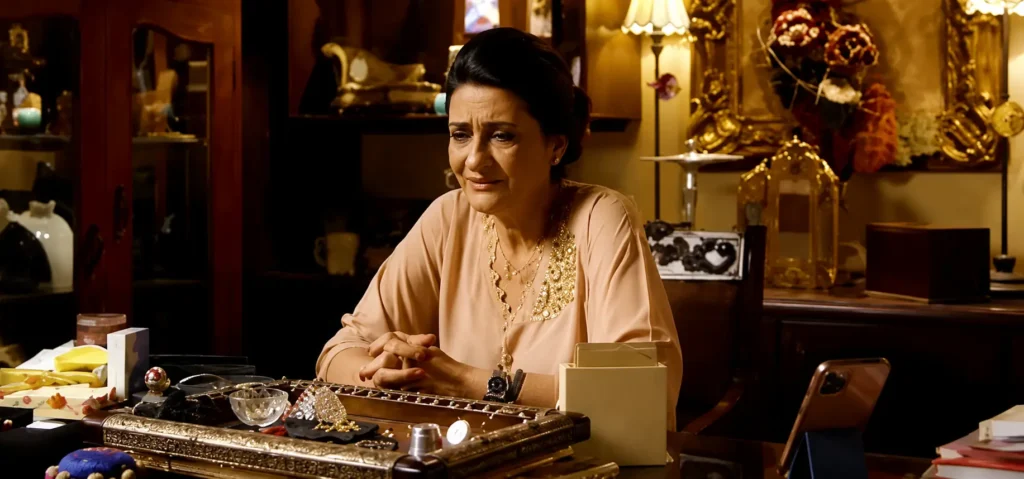
Veteran Pakistani actresses are taking on more complex and layered roles in television dramas
For years, Pakistani television offered older women a narrow choice of identities: the saintly mother, the controlling mother-in-law or the stern grandmother. But a new generation of dramas is beginning to change that pattern, giving older actresses characters with contradictions, histories, ambitions and emotional lives of their own.
Saba Hameed’s calculating matriarch in Noor Jahan manipulates the politics of her household. Sakina Samo’s Barkat Ahmad in Qarz-i-Jaan makes stern judgements while carrying her own complexities. Sania Saeed’s character in Aap Ki Izzat compromises her principles to retain control over her troubled son.
Elsewhere, Hina Khawaja Bayat’s character in Aik Aur Pakeezah offers sharp observations over a hookah, while Arjumand Rahim’s Taj Bibi in Sher wrestles with loneliness, spinsterhood and the scars of an old romance. Savera Nadeem’s character in Bismil confronts an unfaithful husband, while Nadia Afgan in Tann Mann Neelo Neel portrays a woman struggling to understand years of silence within her marriage.
These are not simply mothers or mothers-in-law whose primary function is to advance the stories of younger protagonists. They have histories. They make mistakes. They manipulate, suffer, regret, resist and sometimes surprise the audience.
That change matters because mature male actors have traditionally enjoyed much greater freedom on Pakistani television.
Older male characters have long been written as politicians, feudal landlords, businessmen, judges, villains and powerful patriarchs. Actors such as Humayun Saeed, Faisal Rehman, Faysal Quraishi and Adnan Siddiqui have continued to play major romantic or central roles well into their 40s and 50s, often opposite women considerably younger than themselves.
Their female contemporaries have faced a very different trajectory.
Women have traditionally been moved into maternal roles much earlier, sometimes while still in their 30s or 40s. Once an actress crossed an invisible age threshold, the industry often treated her romantic or professional identity as something that had ended.
That formula is now being challenged, albeit gradually.
The shift is particularly visible in prime-time dramas where ensemble casts have become more prominent. The younger romantic leads may remain central, but older characters are increasingly being given storylines that reveal their motivations and vulnerabilities.
Hina Khawaja Bayat has noticed the change.
She recalls how female actors in their 30s were once routinely cast as considerably older women and sometimes played mothers to actors only a few years younger than themselves. While she believes the age problem has not disappeared, she says the roles available to mature actresses have become more interesting.
Her own performance in Aik Aur Pakeezah, as well as her role as Saba Qamar’s mother in Case Number 9, offered opportunities to explore characters beyond conventional maternal stereotypes.
Bayat also credits performers themselves for adding depth to otherwise ordinary roles. An actress, she argues, can bring nuance and personality to a character that might appear forgettable on paper.
Nadia Afgan sees a similar transformation.
According to her, older actresses once received largely predictable saas and nand roles. More recent projects, however, have offered characters with individual motivations and distinct story arcs.
Her own performances in Aik Aur Pakeezah, Sharpasand and Dar-i-Nijaat illustrate that change. She also points to Saba Hameed’s performances in Dr Bahu and Sania Saeed’s work in Aap Ki Izzat as examples of the stronger characters now being written for mature women.
Arjumand Rahim makes a similar observation. She believes the 8pm prime-time slot has increasingly produced better-developed roles for older women.
Her character Taj Bibi in Sher, for instance, was integral to the main story rather than merely a supporting presence. Nafisa in Meri Zindagi Hai Tu also had a past that directly influenced the personality of the central character.
Yet Rahim believes the improvement is uneven. Longer serials occupying other time slots can still rely heavily on simplistic, predictable characters, with little effort made to create meaningful arcs for older women.
The question, then, is why this shift is happening now.
One obvious explanation is the changing audience.
Pakistani viewers are no longer consuming television in isolation. Streaming platforms, international films and global television have exposed audiences to stories built around complicated characters of different ages.
Viewers increasingly recognise the difference between a character who exists simply to deliver exposition and one who has an emotional journey of her own.
Social media has reinforced this change.
Clips that attract attention online are not always centred on the young female lead or the romantic couple. Sometimes the most widely shared moments belong to a grandmother delivering an unexpectedly sharp observation, a mother confronting an unfaithful husband or an aunt delivering a perfectly timed line.
That reaction demonstrates something important: audiences respond to good writing regardless of a character’s age.
Truth Social API Launched as Trump Media Charges Traders Up to $100,000 for Fast Feeds
The changing realities of Pakistani women may also be influencing television.
Women in their 50s and beyond today may have careers, travel independently, maintain friendships, run businesses or pursue interests outside the home. Their lives cannot easily be reduced to kitchen politics and relationships with their in-laws.
Television is beginning, slowly, to acknowledge that reality.
The industry itself has also changed. The actresses who entered Pakistani television during the 1980s and 1990s have accumulated decades of experience and developed loyal audiences.
There is therefore no shortage of performers capable of carrying emotionally demanding stories.
Atiqa Odho believes contemporary scripts increasingly give actors across the age spectrum greater room to perform. She says mature performers are now being offered more substantial supporting roles as well as major characters, allowing experienced artists to move beyond the limitations of conventional leading-lady roles.
That benefits dramas as much as the actors.
A strong ensemble cast creates more complicated relationships and gives viewers multiple characters to care about. Instead of watching only the romance between two young protagonists, audiences become invested in an entire family and the conflicts that connect its members.
The result can be richer television.
But the progress remains incomplete.
Bushra Ansari has pointed out that many older female characters continue to fall into familiar patterns. They are often portrayed as harsh, manipulative or emotionally burdened, with their apparent complexity simply becoming another version of the traditional domineering matriarch.
Even when writers attempt something different, the character may still be trapped within the domestic world.
There are still relatively few Pakistani dramas centred on older women as entrepreneurs, politicians, professionals or independent individuals. Stories about female friendships, late-life romance, personal reinvention and starting over after 50 remain rare.
In many dramas, older women continue to be mothers, mothers-in-law and grandmothers first and individuals second.
Their conflicts revolve around marriage, inheritance, family honour and domestic control, while careers, friendships, politics and personal ambition remain largely unexplored.
That is where the next major evolution could take place.
The audience has already shown that it is willing to embrace older female characters when writers give them intelligence, humour, vulnerability and agency. The popularity of shows such as Baby Baji demonstrated the appetite for stories in which multiple generations can command attention.
The challenge now is to move those women from the edges of the story to its centre.
Pakistani television has started to recognise that age does not have to be the end of a character’s journey. It can be the beginning of a more interesting one.
For veteran actresses who spent decades being asked to play variations of the same mother or mother-in-law, that may be the most welcome change of all.