
New York Muslims Reclaim Their City 25 Years After 9/11
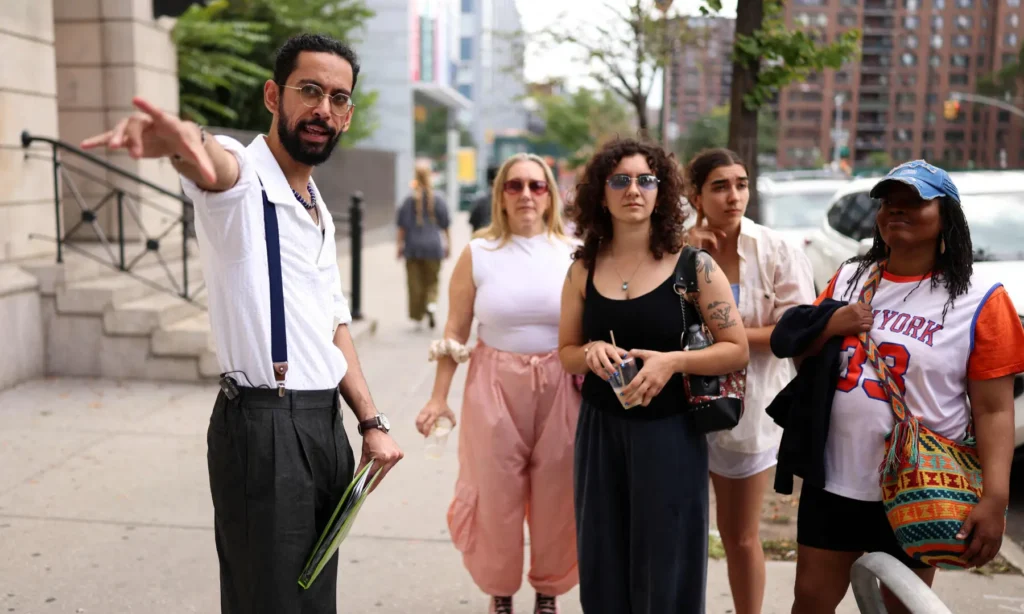
Asad Dandia leads a guided tour highlighting New York’s Muslim history and communities.
New York’s Muslim community has undergone a profound transformation in the 25 years since the September 11, 2001 attacks, with Muslims gaining greater political and cultural influence across the city.
For Asad Dandia, the journey has been deeply personal. He was eight years old when he watched the attacks on television at his Pakistani-immigrant parents’ home in New York.
The tragedy was followed by years of suspicion, anger and Islamophobia. Dandia later experienced the impact personally when a police informant infiltrated his family home while posing as his friend.
Now 33, the historian leads walking tours focused on New York’s Muslim communities. He says the city looks very different from the one he knew after 9/11.
“Twenty-five years after 9/11, we mourn and we grieve what happened,” Dandia told AFP. “At the same time, we recognise that I am not responsible for what happened.”
He said Muslims should not be blamed for the attacks and stressed that he considers himself as much a New Yorker as anyone else.
Islamophobia After 9/11
The September 11 attacks killed nearly 3,000 people after hijacked planes struck the World Trade Centre and the Pentagon. A fourth aircraft crashed into a Pennsylvania field following a passenger revolt.
Karachi Traders, Lawyers Join JI Strike Against Petrol Levy and Power Costs
The attacks triggered widespread fear and suspicion towards Muslim communities in the United States.
Muslims reported increased harassment and physical attacks. Some people also stopped wearing visible religious clothing, including hijabs, in an effort to avoid attention.
US authorities introduced several measures targeting Muslim communities after the attacks. Thousands of men and boys were required to register with the government, while immigration enforcement also led to deportations.
Mohammed Razvi, a Pakistani-born community activist, remembers the atmosphere as one of intense fear. He founded the Council of Peoples Organisation to support Muslims in New York after 9/11.
Razvi said people in his neighbourhood faced hostility because of their religion and background. He also began introducing himself as “Mo” because of the stigma he encountered when using his given name, Mohammad.
A Terrifying Encounter With Surveillance
Dandia later became a direct target of a controversial NYPD surveillance programme.
At 19, he was a college student involved in a mutual-aid charity. A young Bangladeshi man joined the organisation and gradually became close to Dandia and his family.
The two shared meals, played sports and spent time together. The man even slept at Dandia’s home.
Seven months later, Dandia learned that the man was an NYPD informant. He had been sent to monitor Dandia and members of his community.
“It was heartbreaking, but it was also terrifying,” Dandia recalled.
The experience changed his relationship with the world around him. Dandia later joined rights groups in challenging the surveillance programme.
Their legal action resulted in a landmark settlement. The agreement placed restrictions on similar NYPD surveillance activities and established independent oversight of the police department.
Gadier Abbas, an attorney with the Council on American-Islamic Relations, described the programme as a major example of the anti-Muslim sentiment that followed 9/11.
He believes the situation has changed significantly since then.
Muslim Political and Cultural Influence Grows
New York’s Muslim community has expanded both institutionally and politically over the past quarter-century.
More than 100 mosques have been added across the city since 2001, according to the report. A major new mosque is also expected to become the largest in New York state.
Public expressions of Muslim faith have become increasingly visible. Muslim communities now play a stronger role in civic life, business, culture and politics.
That transformation is also reflected in City Hall.
Zohran Mamdani became New York City’s first Muslim mayor after taking office in 2026. His oath of office was taken on the Holy Quran, marking a historic moment for Muslim New Yorkers.
Mamdani’s rise has also highlighted the persistence of Islamophobia in American political life.
Islamophobia Has Not Disappeared
Despite greater representation, discrimination against Muslims remains a concern.
The city has witnessed anti-Muslim demonstrations and hostile rhetoric targeting Mamdani. A far-right influencer organised a rally in March under the slogan “Stop the Islamic Takeover of New York City”.
Some political figures have also attacked Mamdani because of his faith and political views.
The debate has become particularly sensitive around the September 11 memorial. Some relatives of attack victims have criticised Mamdani over his support for Palestinian rights, while other families have defended him.
The continuing tensions show that greater Muslim representation has not eliminated Islamophobia.
‘There Is a Lot of Hope’
For Abbas, however, the progress of American Muslims offers reason for optimism.
Muslims now work across almost every part of American society. Their presence extends into politics, law, business, education and community leadership.
Dandia also sees a major change in how Muslims view their place in New York.
He said the Muslim community has developed greater institutional power. More importantly, he believes other New Yorkers increasingly recognise Muslims as an integral part of the city.
The transformation has taken decades.
Dandia said the community’s growth reflects a broader lesson about New York. The city, he argued, is built by many communities rather than by one group alone.
Twenty-five years after 9/11, New York’s Muslim community continues to confront prejudice. At the same time, its growing political, cultural and institutional presence shows how much the city has changed since the attacks.