

China-Egypt Ties Deepen as Desert Industrial Zone Drives New Growth
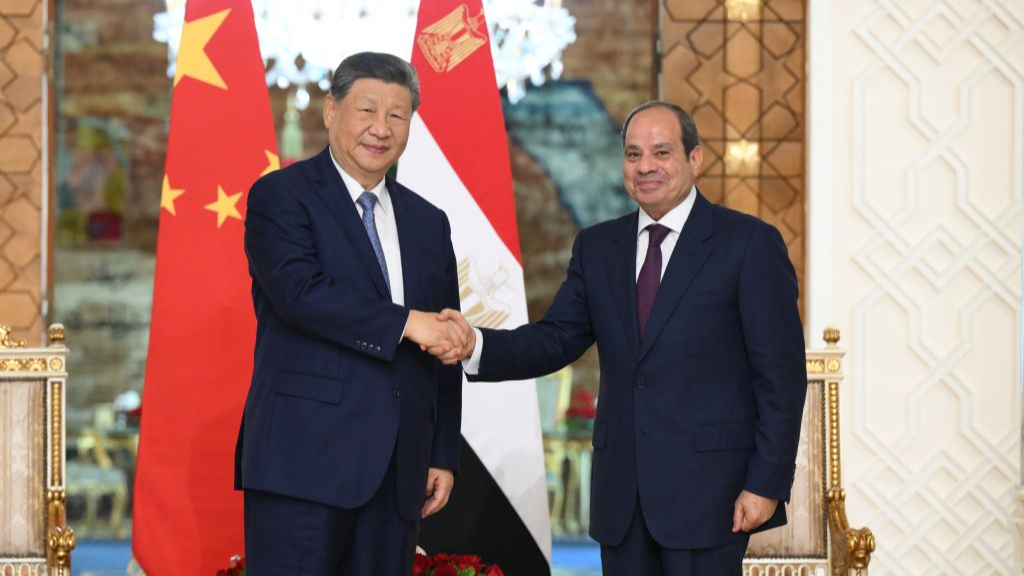
China-Egypt cooperation expands from Suez industrial investment to trade, agriculture and strategic partnerships.
China-Egypt ties are entering a broader phase as economic cooperation expands beyond major infrastructure projects into manufacturing, agriculture, energy, employment and strategic coordination.
A decade after China and Egypt launched the second phase of their joint economic and trade cooperation zone near the Suez Canal, the once undeveloped desert has developed into an industrial cluster of nearly 200 companies.
The China-Egypt TEDA Suez Economic and Trade Cooperation Zone has created about 10,000 jobs, while cumulative investment has exceeded $4.7 billion, according to reports by People’s Daily.
The zone hosts companies involved in building materials, petroleum equipment, electrical equipment and machinery. Its development has turned the area into an important platform connecting China’s Belt and Road Initiative with Egypt’s strategy for the Suez Canal Corridor.
The transformation also reflects a wider change in China-Egypt ties, with cooperation increasingly linking investment to employment, production and access to markets.
During talks with Egyptian President Abdel Fattah El-Sisi on Wednesday, Chinese President Xi Jinping called for deeper cooperation and continued efforts to build a China-Egypt community with a shared future.
Suez Zone Becomes an Engine of Local Development
The Suez cooperation zone is also moving beyond traditional manufacturing.
Solar energy projects and emerging circular-economy initiatives are adding a greener dimension to the industrial development. Chinese-invested projects have also contributed to Egypt’s energy infrastructure and workforce development.
GPGI, CMPO Investors Face September 14 Deadline in Securities Class Action
A solar park substation project has provided about 16,000 gigawatt-hours of electricity since its completion, according to the report.
Chinese companies have also trained Egyptian engineers and workers. Some local employees have advanced into technical and management positions.
At a joint venture between China XD Electric and Egypt’s EGEMAC, Egyptian employees make up 97 percent of the workforce.
These developments highlight the employment and skills benefits that can accompany foreign investment.
In a signed article published in Egyptian media ahead of his visit, Xi said China and Egypt should pursue mutual benefit and win-win cooperation and establish a benchmark for joint development.
Egyptian Products Gain Ground in China
Trade between the two countries is increasingly moving in both directions, with Egyptian products gaining greater access to China’s consumer market.
Chinese official data shows that bilateral trade reached 95.19 billion yuan, or about $14.16 billion, during the first seven months of 2026.
That represented an 18.7 percent increase from the same period a year earlier.
Chinese exports to Egypt increased 17.5 percent, while imports from Egypt rose 49.4 percent.
Agricultural products have emerged as a particularly strong area of growth. China’s imports of Egyptian agricultural products increased 82.6 percent during the first seven months of 2026.
Agricultural goods accounted for 41.7 percent of China’s total imports from Egypt during that period.
Egypt became China’s largest source of frozen strawberries and its third-largest source of flax. The two products accounted for 96.7 percent and 7.7 percent of China’s respective imports.
Egypt is also a major global exporter of oranges. In 2025, Egyptian exporters shipped fresh oranges worth about $26 million to China.
The expanding market has encouraged producers to focus on quality as demand from Chinese consumers grows.
Market Access Brings New Opportunities
China’s trade measures are also creating new opportunities for Egyptian exporters.
Egyptian newspaper Al-Ahram reported that China’s zero-tariff measures for African products have opened access to a market of more than 1.4 billion people.
However, lower tariffs alone may not guarantee commercial success.
Egyptian companies will still need to maintain product quality, ensure reliable supplies and develop marketing strategies suited to Chinese consumers.
That could make agricultural exports an increasingly important part of the economic relationship.
A Partnership Extending Beyond Trade
The significance of China-Egypt cooperation extends beyond investment and commerce as the countries mark 70 years of diplomatic relations.
Egypt became the first Arab and African country to establish diplomatic relations with the People’s Republic of China. Since then, cooperation has expanded into culture, education, science and technology, healthcare and other areas.
Xi has described China-Egypt relations as an example of friendship, solidarity and coordination between developing countries.
Both countries also play important roles in the Global South and coordinate through multilateral institutions, including the United Nations and BRICS.
Egypt’s geographic and political position gives the partnership additional regional significance. It connects the Arab world and Africa while serving as a major trade and transport hub.
Economic Cooperation Gains Strategic Importance
The partnership comes as the Middle East continues to face security and political challenges.
Xi has called for greater regional autonomy in security affairs, comprehensive approaches to regional hotspots, development-led efforts to strengthen security and stronger international coordination.
For China and Egypt, deeper economic cooperation therefore carries significance beyond individual industrial projects.
The expansion of the Suez zone, rising agricultural exports and growing trade suggest a relationship increasingly built around investment, employment, market access and long-term development.
The next phase of China-Egypt ties will depend on how effectively both sides convert those economic links into sustainable growth and broader cooperation.