

ADVERTISEMENT
Tuesday, June 2, 2026
No Result
View All Result
The AZB More Than Just News
  • HOME
  • Latest News
  • Business
  • PAKISTAN
  • SPORTS
  • WORLD
  • E-Paper
  • SCI-TECH
  • BANKING
  • ARTICLES
  • OPINION
  • MORE
    • MOBILE
    • TELECOM
    • PERSONALITY
    • HEALTH / EDUCATION
  • HOME
  • Latest News
  • Business
  • PAKISTAN
  • SPORTS
  • WORLD
  • E-Paper
  • SCI-TECH
  • BANKING
  • ARTICLES
  • OPINION
  • MORE
    • MOBILE
    • TELECOM
    • PERSONALITY
    • HEALTH / EDUCATION
No Result
View All Result
Daily The Azb
No Result
View All Result
ADVERTISEMENT
Home SCI-TECH

NASA Unveils $4 Billion Roman Space Telescope to Map Universe and Explore Dark Energy

Irfan Shaikh by Irfan Shaikh
April 22, 2026
NASA Unveils $4 Billion Roman Space Telescope to Map Universe and Explore Dark Energy
Share on FacebookShare on Twitter

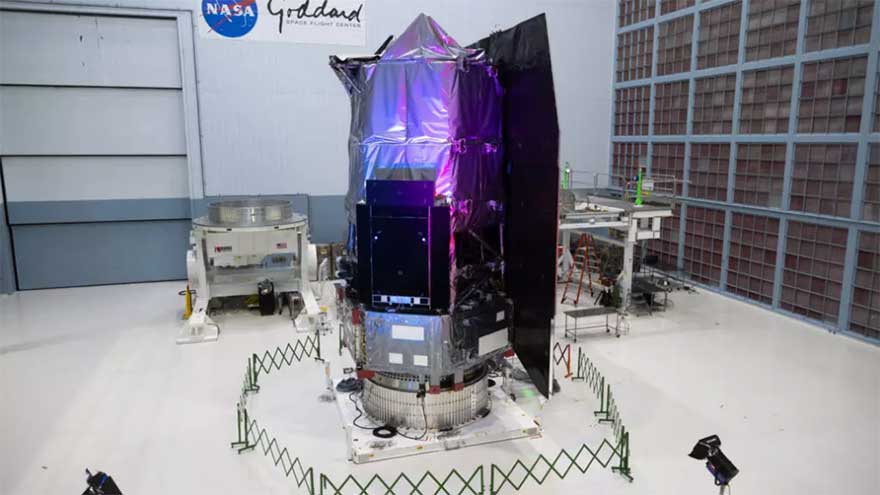
NASA on Tuesday unveiled its next-generation space observatory, the Nancy Grace Roman Space Telescope, a powerful instrument designed to survey vast regions of the universe, detect tens of thousands of distant planets, and investigate the long-standing mysteries of dark matter and dark energy.
Florida Launches Criminal Probe Into OpenAI Over ChatGPT’s Alleged Role in University Shooting

The $4 billion mission, more than a decade in development, is expected to launch no earlier than September aboard a SpaceX rocket from Florida. Once deployed, the telescope will operate from a stable orbit about 1.5 million kilometres from Earth, where it will scan the cosmos with unprecedented clarity and scale.

NASA officials said the Roman telescope will act as a “new atlas of the universe,” dramatically expanding humanity’s view of space. With a field of view at least 100 times larger than the Hubble Space Telescope, it will be capable of capturing enormous sections of the sky in a single observation.

NASA Administrator Jared Isaacman said the mission would reshape astronomical understanding. “Roman will give the Earth a new atlas of the universe,” he said during a briefing at the Goddard Space Flight Center in Maryland.

The telescope is expected to discover tens of thousands of exoplanets, potentially helping scientists better understand how planetary systems form and how common Earth-like worlds may be across the galaxy. It will also observe billions of galaxies, thousands of supernovae, and tens of billions of stars, generating an unprecedented stream of scientific data.

NASA estimates Roman will transmit around 11 terabytes of data per day—surpassing the total lifetime data output of the Hubble Space Telescope within its first year of operation.

Beyond visible cosmic structures, the telescope will focus heavily on the universe’s invisible components—dark matter and dark energy—which together are believed to account for about 95% of the cosmos. Dark matter is thought to hold galaxies together through gravity, while dark energy is driving the universe’s accelerating expansion.

Using advanced infrared imaging, Roman will look back billions of years in time by capturing ancient light from distant celestial bodies. Scientists say this will allow deeper study of how galaxies evolved and how cosmic structures formed over time.

Experts believe the mission will complement existing observatories such as the James Webb Space Telescope, Europe’s Euclid mission, and Chile’s Vera Rubin Observatory, creating a coordinated global effort to map the universe in unprecedented detail.

Astrophysicists say the data could reshape fundamental physics. “Roman will probe how dark matter structures itself throughout cosmic time and how fast galaxies are moving away from us,” said researchers involved in the project.

NASA officials also hinted that discoveries from Roman could lead to breakthroughs not yet imagined. One scientist noted that any future Nobel Prize linked to the mission may come from questions scientists have not yet even formulated.

The telescope is named after Nancy Grace Roman, NASA’s first chief of astronomy and a pioneering figure in space science, often called the “Mother of Hubble.”


Tags: astronomyDarkMatterExoplanetsNASAScienceSpaceTelescopeUniverse
Irfan Shaikh

Irfan Shaikh

Related Posts

Meta Fixes AI Security Flaw After Instagram Account Hijacking Incident
SCI-TECH

Meta Fixes AI Security Flaw After Instagram Account Hijacking Incident

June 2, 2026
Binance and Telenor Pakistan Sign MoU to Promote Blockchain Education and Digital Innovation
Business

Binance and Telenor Pakistan Sign MoU to Promote Blockchain Education and Digital Innovation

June 2, 2026
Intel Welcomes Nvidia’s Entry Into AI PC Chip Market Amid Rising Competition
SCI-TECH

Intel Welcomes Nvidia’s Entry Into AI PC Chip Market Amid Rising Competition

June 2, 2026
NFC-Based Android Banking Attacks Jump 188% in 2026 as Cybercriminals Target Mobile Users
SCI-TECH

NFC-Based Android Banking Attacks Jump 188% in 2026 as Cybercriminals Target Mobile Users

June 1, 2026
AI Boom Faces Cost Crunch as Companies Rethink “Subsidised Intelligence” Era
SCI-TECH

AI Boom Faces Cost Crunch as Companies Rethink “Subsidised Intelligence” Era

June 1, 2026
Ferrari Unveils First Fully Electric Supercar ‘Luce’ With 310kph Top Speed
SCI-TECH

Ferrari Unveils First Fully Electric Supercar ‘Luce’ With 310kph Top Speed

May 26, 2026
China Launches Shenzhou-23 Mission as Space Programme Targets Moon Landing by 2030
SCI-TECH

China Launches Shenzhou-23 Mission as Space Programme Targets Moon Landing by 2030

May 26, 2026
Asia-Pacific Faces High Ransomware Risk in 2025, Kaspersky Warns
SCI-TECH

Asia-Pacific Faces High Ransomware Risk in 2025, Kaspersky Warns

May 22, 2026
SpaceX IPO Filing Links Elon Musk Bonus to 1 Million People Living on Mars
SCI-TECH

SpaceX IPO Filing Links Elon Musk Bonus to 1 Million People Living on Mars

May 22, 2026
Pakistan National Assembly Launches First AI-Powered Parliamentary System
SCI-TECH

Pakistan National Assembly Launches First AI-Powered Parliamentary System

May 20, 2026
Next Post
PCS Karachi Chapter Unveils 2026 Clinical Innovation Roadmap and Launches “The Karachi Beat”

PCS Karachi Chapter Unveils 2026 Clinical Innovation Roadmap and Launches “The Karachi Beat”

Leave a Reply Cancel reply

Your email address will not be published. Required fields are marked *

Are you human? Please solve:Captcha


Most Popular

No Content Available

Must Read

ABAD Pays Tribute to Pakistan Military’s Historic Victory Over India
Business

Chairman (ABAD) Muhammad Hassan Bakshi

February 27, 2026
IoBM, UNESCO EE-Net National Chapters Alliance
Business

IoBM, UNESCO EE-Net National Chapters Alliance

December 26, 2024
The Azb is a 24/7 online news platform that covers a wide range of topics including business, economics, technology, finance, travel, fashion, and lifestyle.

Quick Links

  • Home
  • About us
  • SCI-TECH
  • Live TV
  • Banking

Useful Links

  • Videos
  • Reviews
  • Advertorial
  • Photos
  • About us
  • Author
  • Home
  • Latest News
  • Partner
  • Privacy Policy
  • Russian Theatre Group Celebrates Fifth Anniversary in Pakistan.
  • Terms and Conditions
  • The Azb – More Than Just News
  • Contact

© Copyright 2024 theazb. All Rights Reserved.

No Result
View All Result
  • HOME
  • Latest News
  • Business
  • PAKISTAN
  • SPORTS
  • WORLD
  • E-Paper
  • SCI-TECH
  • BANKING
  • ARTICLES
  • OPINION
  • MORE
    • MOBILE
    • TELECOM
    • PERSONALITY
    • HEALTH / EDUCATION

© Copyright 2024 theazb. All Rights Reserved.