IEEEP Calls for Engineers to Replace Bureaucrats in Technical Leadership Roles
Web Desk April 22, 2026KARACHI: The Institution of Electrical & Electronics Engineers Pakistan (IEEEP) has issued a strong call for structural reforms in Pakistan’s governance of technical sectors, urging that qualified engineers and domain specialists—rather than generalist civil servants—be appointed to lead key ministries, regulatory bodies, and public sector institutions.
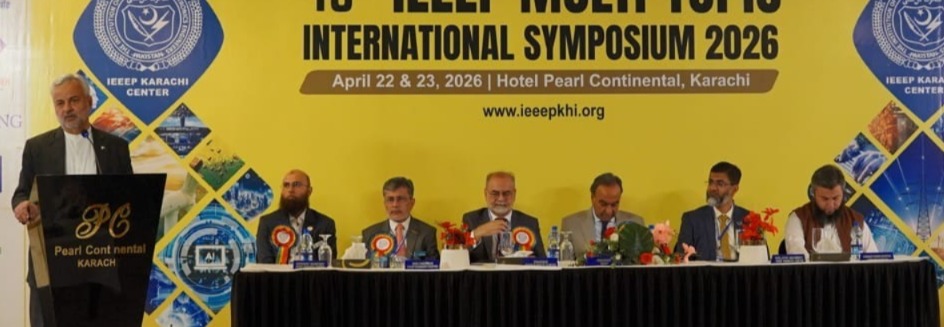
KARACHI: The Institution of Electrical & Electronics Engineers Pakistan (IEEEP) has issued a strong call for structural reforms in Pakistan’s governance of technical sectors, urging that qualified engineers and domain specialists—rather than generalist civil servants—be appointed to lead key ministries, regulatory bodies, and public sector institutions.
Israeli Settlers Storm Al-Aqsa Mosque Compound Amid Rising West Bank Tensions
The demand was made during the inaugural session of the 40th Multi-Topic International Symposium 2026, where senior engineers, academics, and industry experts warned that long-standing inefficiencies in Pakistan’s energy and infrastructure sectors stem from the absence of technical leadership at decision-making levels.
IEEEP President Tahir Basharat Cheema said Pakistan must urgently align itself with global governance practices, arguing that administrative cadres should focus on general management roles, while specialised sectors must be led by professionals with relevant technical expertise.
He criticised the current structure of regulatory authorities such as the National Electric Power Regulatory Authority (NEPRA) and the Oil and Gas Regulatory Authority (OGRA), stating that these institutions require sector experts rather than general administrators. “It is deeply concerning that technical institutions are not being led by experienced professionals from the power sector,” he noted.
Cheema highlighted structural inefficiencies in Pakistan’s energy system, pointing out that outdated infrastructure continues to dominate the grid. He warned that many distribution systems are still based on century-old designs, while core transmission infrastructure dates back several decades, reflecting what he called “systemic stagnation caused by poor technical leadership.”
He also criticised the performance of major institutions in the energy and scientific research sectors, including the Private Power and Infrastructure Board and the Pakistan Council of Scientific and Industrial Research, saying both are struggling with effectiveness and financial sustainability.
IEEEP Karachi Centre Chairman Navid Akram Ansari called for urgent policy reforms to strengthen Pakistan’s engineering and manufacturing base. He urged the government to prioritise local industrial output by promoting “Made in Pakistan” procurement policies, while also reducing taxes on imported raw materials to improve export competitiveness.
He further stressed the need for establishing internationally accredited testing laboratories across the country to improve industrial standards and global competitiveness. Ansari also emphasised the role of institutions such as the Engineering Development Board, Pakistan Engineering Council, and Higher Education Commission in bridging the gap between academia and industry.
Delivering the keynote address, engineering consultant Tahir Mahmood Chaudhry highlighted weaknesses in Pakistan’s higher education system, revealing that only a small fraction of universities have functional placement bureaus. He said this gap is contributing to rising graduate unemployment and weak industry-academia linkage.
Earlier, symposium organisers confirmed that more than 14 research papers will be presented, focusing on advancements in electrical and electronics engineering, particularly in the power sector. A dedicated session will also propose reforms in engineering education.
The symposium has sparked renewed debate on whether Pakistan can continue to rely on generalist administration for highly technical sectors, as experts increasingly warn that global competitiveness demands specialised leadership.