North Korea: North Korea nuclear state stance deepens as Kim Jong Un defends weapons policy
North Korea nuclear state claims were reinforced on Tuesday after leader Kim Jong Un said that acting as a “nuclear state” remains the only viable response to what he described as an increasingly unpredictable global security environment, according to state media KCNA. The comments on North Korea nuclear state policy came during a high-level ruling party meeting in Pyongyang.
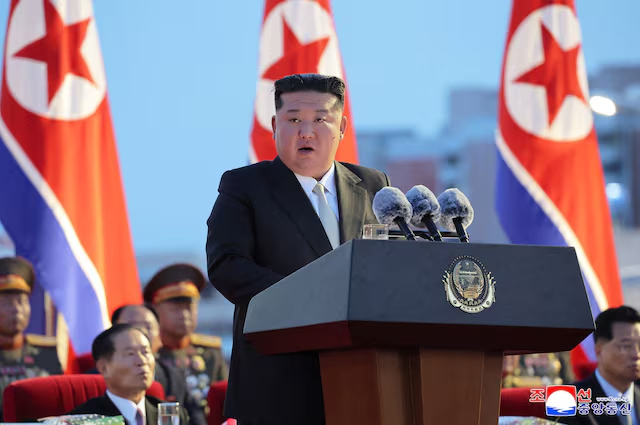
Kim Jong Un addresses ruling party meeting amid renewed nuclear stance
North Korea nuclear state claims were reinforced on Tuesday after leader Kim Jong Un said that acting as a “nuclear state” remains the only viable response to what he described as an increasingly unpredictable global security environment, according to state media KCNA. The comments on North Korea nuclear state policy came during a high-level ruling party meeting in Pyongyang.
Kim accused the United States of driving global instability and worsening conflicts in Europe and the Middle East, describing Washington’s actions as “hegemonic” and “gangster-like”. He also blamed US and South Korean military cooperation for escalating tensions on the Korean Peninsula.
MQM-P: MQM-P delegation to meet Prime Minister Shehbaz Sharif with budget support conditions
Speaking at a Central Committee meeting of the Workers’ Party held over several days, Kim said North Korea must continue strengthening its nuclear forces while expanding conventional military capabilities. He argued that this approach offers the most “correct and confident” way to respond to global military and political uncertainty.
State media KCNA reported that Kim ordered accelerated development of military assets, including a 10,000-ton strategic guided missile cruiser, as part of wider defence expansion plans. However, no specific details were provided about nuclear weapons development.
Analysts in South Korea say the remarks underline Pyongyang’s refusal to consider denuclearisation. They add that North Korea now appears focused on seeking recognition as a nuclear weapons state rather than returning to phased disarmament talks.
Experts also say Pyongyang is using US-South Korea defence cooperation, including nuclear consultation mechanisms, as justification for expanding its own arsenal. They warn this position further reduces the chances of renewed diplomatic progress.
North Korea continues to operate under international sanctions imposed by the United Nations and the United States over its nuclear and missile programmes. Despite long-running diplomatic efforts, the country has repeatedly declared that it will not abandon its nuclear weapons.
The party meeting also highlighted domestic priorities, including plans to modernise the coal industry, which remains a key energy source for the country.