US Wildfires: National Fire Preparedness Raised to Highest Alert as Blazes Spread Across States
Authorities deploy thousands of firefighters as dozens of uncontrolled wildfires threaten homes, infrastructure and communities across the United States.
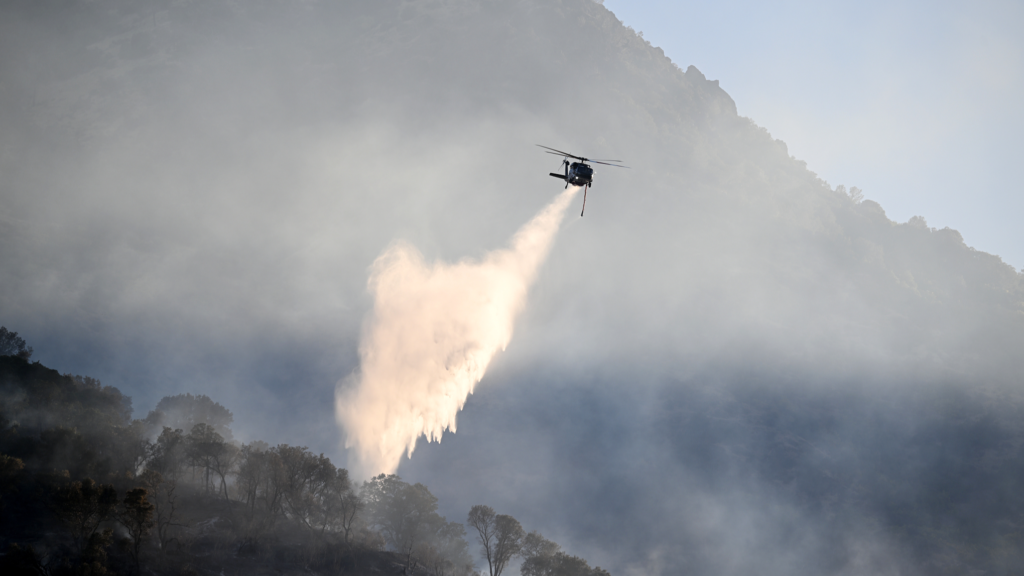
Firefighters battle rapidly spreading wildfires as the US raises its highest national fire alert.
US Wildfires reached a critical stage on Saturday after US fire authorities raised the national wildfire preparedness level to Level 5, the highest on the country’s five-tier scale, as dozens of large, uncontrolled fires stretched firefighting resources nationwide.
The National Interagency Coordination Center (NICC) reported 73 uncontained large wildfires, including 17 new major incidents recorded within the past 24 hours. More than 17,600 firefighters and support personnel, along with 22 complex incident management teams, are currently battling active fires across the country.
The Northwest Geographic Area remained the nation’s hardest-hit region and also reached Preparedness Level 5. Officials reported 36 active large fires, including 13 of the 17 new major incidents, making it the busiest wildfire region in the United States.
Authorities recorded 58 new fires in the Northwest during the past day. Nearly 5,900 emergency personnel, supported by 151 fire crews, 382 fire engines and 31 helicopters, continue working to contain the fast-moving blazes.
Blue Passports: Government Promises Tighter Rules After Bill Draws Criticism
In Oregon, the East Evans Creek Road Fire threatened homes, communication facilities and critical infrastructure, prompting evacuation orders and road closures. The Salmon Fire, Olive Butte Fire and Akawa Butte Fire also endangered residential areas, while firefighters reported extreme fire behaviour in several locations.
In Washington state, the Lyons Ferry Fire forced evacuations and threatened numerous structures as crews worked to slow its advance.
The Rocky Mountain Geographic Area remained at Preparedness Level 4, with seven large uncontrolled fires, including six in Colorado. The Gold Mountain, Elk, Willow and Ferris fires continued to threaten homes, buildings and essential infrastructure despite ongoing suppression efforts.
In northern Minnesota, recent rainfall helped reduce fire activity, but officials warned that homes, communication facilities and energy infrastructure remain at risk. The Bear Trap Fire has burned approximately 140 square kilometres, while the Sioux Fire has scorched about 44 square kilometres and destroyed three structures.
Authorities also confirmed that the Little Knife Fire crossed the international border from Canada into the United States, adding another challenge for emergency crews.
To strengthen firefighting efforts, the US military deployed four C-130 aircraft equipped with the Modular Airborne Fire Fighting System (MAFFS). Two aircraft are operating from Klamath Falls, Oregon, while the remaining two are based in San Bernardino and Santa Maria, California.
According to the NICC, wildfires have burned approximately 15,600 square kilometres across the United States this year, around 33% above the national 10-year average. More than 20 states have experienced significant wildfire activity, with the most severe conditions concentrated in the Northwest, Rocky Mountains, Great Basin and Upper Midwest.
Forecasters from the National Interagency Fire Center warned that hot, dry and windy weather will continue across the inland Northwest, northern California and the western Great Basin in the coming days. They also forecast a combination of wet and dry thunderstorms across parts of the Great Basin, Colorado, Wyoming and Montana, conditions that could trigger additional wildfire outbreaks.