National Security Strategy: Ikram Sehgal Launches New Book on Pakistan’s Security Vision
National leaders, security experts and academics highlight the need for a comprehensive, people-centred approach to Pakistan’s national security at Islamabad launch event.
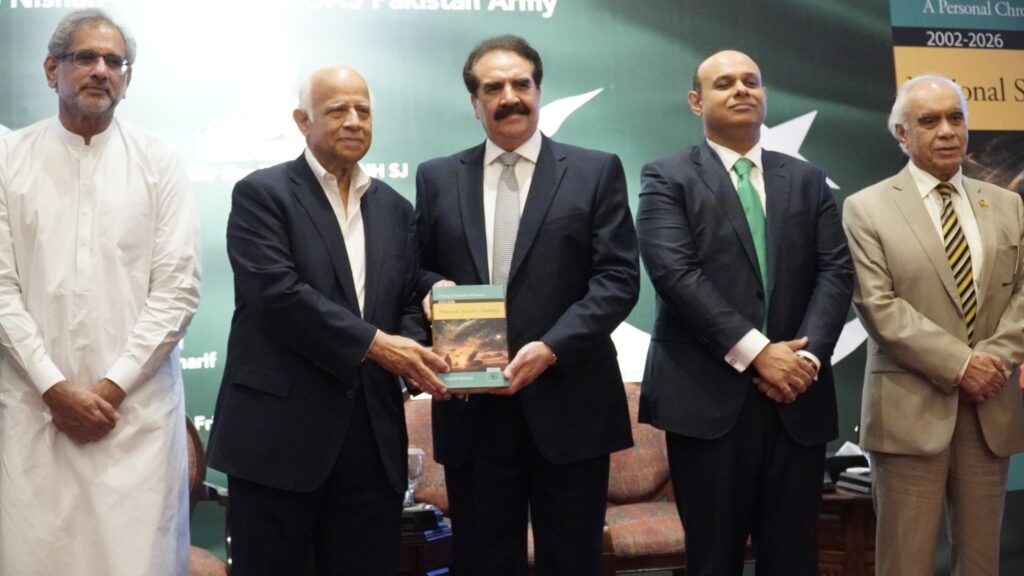
National leaders and security experts attend the launch of Ikram Sehgal's latest book in Islamabad.
National Security Strategy took centre stage at the launch of “National Security Strategy 2002–2026,” the 16th volume of A Personal Chronicle of Pakistan by Ikram Sehgal, during a ceremony held at the Serena Hotel in Islamabad.
The event brought together senior military officials, diplomats, policymakers, academics, government representatives, educationists and business leaders to discuss Pakistan’s evolving security landscape and the importance of adopting a broader national security framework.
The book review session featured a distinguished panel that included Prof. Dr. Huma Baqai, Vice Chairperson of the Karachi Council on Foreign Relations (KCFR) and Rector of the Millennium Institute of Technology and Entrepreneurship (MiTE); Air Marshal (Retd) Masood Akhtar, former Deputy Chief of Air Staff (Training); Gulmina Bilal Ahmad, former Chairperson of NAVTTC; Dr. Salma Malik, Associate Professor of Defence and Strategic Studies at Quaid-i-Azam University; Brigadier (Retd) Mujahid Alam, CEO of Pathfinder Group’s Enhanced Harmony Division; Dr. Chaudhry Faisal Mushtaq, Founder and CEO of Roots Millennium Education Group; and former Prime Minister Shahid Khaqan Abbasi, who delivered the keynote address.
The ceremony welcomed General (Retd) Raheel Sharif, NI(M), Military Commander of the Islamic Military Counter Terrorism Coalition and former Chief of Army Staff, as the chief guest.
During the event, The Right Reverend Nadeem Kamran, Bishop of Lahore, presented a token of appreciation to Pathfinder Group for its continued support of church security, Christian communities, minority rights and interfaith harmony.
Speaking about the book, Prof. Dr. Huma Baqai praised Ikram Sehgal’s lifelong commitment to Pakistan, highlighting his patriotism, his father’s legacy and the sacrifices made by the country’s armed forces. She described the publication as a people-focused chronicle of Pakistan’s geopolitical and economic transformation, addressing issues such as state-society relations, food security, population growth, education and equality.
Air Marshal (Retd) Masood Akhtar noted that Pakistan has historically lacked a consistently implemented national security framework. He stressed that developing and executing national security policy remains the government’s responsibility and requires effective coordination among the Cabinet, ministries and the National Security Division.
Gulmina Bilal Ahmad said the book expands the concept of national security beyond military affairs by examining food security, climate change, taxation, cryptocurrency, education, skills development and human welfare.
US Wildfires: National Fire Preparedness Raised to Highest Alert as Blazes Spread Across States
Dr. Salma Malik described Pakistan as a shared national space and argued that national security extends beyond defence. She said economic stability, education, governance, technology, foreign policy and both traditional and emerging threats should be treated as interconnected elements of a unified security strategy.
Brigadier (Retd) Mujahid Alam highlighted several social welfare initiatives, including Elenacare employee welfare programmes, support for bereaved families, the Providentia Books Foundation, the Pathfinder Interfaith Harmony Initiative and the Kashmala Welfare Center.
Dr. Chaudhry Faisal Mushtaq emphasised that human security forms the foundation of national security. He commended Ikram Sehgal for his long-standing contributions to education, social welfare and youth mentorship through the Providentia Books initiative.
Delivering the keynote address, former Prime Minister Shahid Khaqan Abbasi said Pakistan must honestly acknowledge its challenges and seek practical solutions. He encouraged Ikram Sehgal to document the experiences of individuals who helped shape Pakistan’s national security policy. Abbasi also observed that inadequate coordination between political and military leadership has weakened policymaking over the years.
He added that national security should be measured by employment opportunities, economic growth, the rule of law, constitutional governance and the protection of fundamental rights, including in Balochistan and Kashmir, while paying tribute to those who sacrificed their lives in the fight against terrorism.
Chief Guest General (Retd) Raheel Sharif described national security as a complex and multidimensional concept. He said the book stands out for its emphasis on economic resilience, institutional strength and practical policy recommendations. Reflecting on Ikram Sehgal’s career as an aviator, his work in the Karakoram Highway region, his leadership in business and his international engagement at the World Economic Forum in Davos, Raheel Sharif said Sehgal’s life offers valuable inspiration for younger generations.
In his closing remarks, Ikram Sehgal thanked participants for attending the launch and reflected on his personal journey, his father’s influence, his association with the Sharif family and his vision for Pakistan’s national security. He also expressed deep faith in Allah and said his belief and trust in those around him have played a significant role in his life’s achievements.