The Vanishing Girl of Kabul: A Journalist’s Fight to Keep Afghan Women’s Stories Alive
Zahra Joya’s memoir connects childhood survival, journalism and exile while documenting the struggle of Afghan women under Taliban rule.
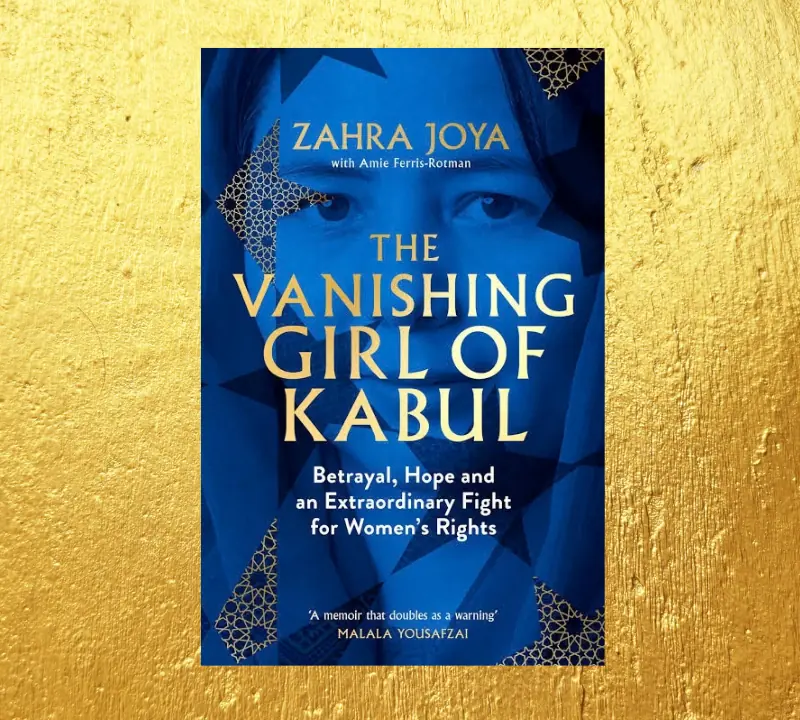
Zahra Joya’s memoir The Vanishing Girl of Kabul explores journalism, exile and the struggle of Afghan women
There is a defining tension at the heart of The Vanishing Girl of Kabul. Zahra Joya is both a journalist and a woman who has lived through Taliban rule. When the Taliban returned to power in 2021, she understood what the change could mean.
Her notebook therefore became more than a professional tool. It became a record of events that could affect her, her colleagues and countless Afghan women.
Published in July and co-written with British-American journalist Amie Ferris-Rotman, the memoir combines personal experience with investigative reporting. It follows Joya’s journey from childhood in Afghanistan to journalism, exile and her efforts to document the lives of women under Taliban rule.
A Childhood Shaped by Gender
Joya’s story begins with a simple ambition. She wanted to attend school.
During the Taliban’s first period in power in the 1990s, education was largely denied to girls. Her family therefore allowed her to live as a bacha posh, a girl dressed and treated as a boy.
She became Mohammed. The identity allowed her to move more freely and attend school.
The experience was not simply a childhood adventure. Instead, it exposed the restrictions created by a system in which basic opportunities depended on gender.
When Joya eventually returned to school as Zahra, the experience remained complicated. Some boys continued to call her Mohammed, while girls knew her as Zahra.
Her memories reveal how deeply the experience affected her. She recalls wanting to disappear. That idea later became central to her understanding of Afghan women facing exclusion from public life.
From Education to Journalism
After the first Taliban government fell, Joya experienced opportunities that had once seemed impossible.
She became the first woman in her family to attend university. Later, she entered journalism and began reporting on corruption and abuses against women.
For Joya and many other Afghan women, the post-Taliban period created new possibilities. Education and professional opportunities expanded, although the period also contained serious political and social contradictions.
The Taliban’s return in 2021 therefore represented a profound personal rupture.
Joya had built a professional identity that would have been almost unimaginable during her childhood. Suddenly, she had to hide and eventually leave Afghanistan.
Building a Women-Led Newsroom
Joya’s career also highlights the importance of women telling their own stories.
Her encounter with Sahar Speaks, an initiative founded by Ferris-Rotman, became an important turning point. Ferris-Rotman had identified a major gap in international reporting on Afghanistan.
Foreign journalists frequently reported on Afghan women. However, Afghan women themselves were often missing from the foreign press corps.
Joya arrived at Sahar Speaks with limited English. She simply wanted an opportunity to learn.
That experience eventually contributed to the creation of Rukhshana Media, the women-led organisation Joya founded to report on Afghan women and girls.
After the Taliban takeover, the mission became even more significant. Reporting was no longer only about increasing women’s participation in journalism. It also became a way to document events that powerful actors might prefer to remain hidden.
Documenting Women’s Disappearances
Some of the memoir’s most disturbing sections focus on investigations carried out by Joya and her colleagues.
The team documented cases involving women who were allegedly killed or disappeared after the Taliban returned to power.
One case involved Khatera, a teacher who was found strangled with her own scarf. Her death was described by the Taliban as an armed robbery.
In Mazar-i-Sharif, the murders of two teenage girls became another warning for young women pursuing education.
Another case involved Frozan Safi, a 29-year-old economics lecturer and activist. She was eventually identified in a morgue through the clothes she was wearing.
These investigations show why the book extends beyond conventional memoir. Joya is not only recounting her own experiences. She is also investigating the experiences of other women.
Her personal history gives her an understanding of repression. Her journalism provides another set of tools. She looks for names, evidence, patterns and gaps in official accounts.
Challenging Western Narratives
The memoir also questions some Western interpretations of Afghan women’s lives.
Joya challenges the suggestion that women who fled Afghanistan simply abandoned the struggle. Her own experience provides a different picture.
She came from the provinces, developed a media organisation and continued reporting despite the risks.
Her criticism extends beyond the Taliban. She also examines the decisions made by Western governments during negotiations with the Taliban and the consequences of the eventual withdrawal.
The result is a more complicated picture of Afghanistan. It is not simply a story of victims waiting for outside intervention.
Instead, Afghan women appear as journalists, investigators, witnesses and political actors.
Journalism Under Threat
The memoir becomes particularly powerful when personal experience meets major political events.
Joya’s understanding of violence is shaped by repeated exposure to attacks. The 2016 attack on a Tolo TV bus, which killed seven employees and injured more than 20 people, became part of that experience.
The chaotic evacuation from Afghanistan in 2021 brought another devastating image.
Joya watched footage of 17-year-old Zaki Anwari falling from an American evacuation aircraft. The incident transformed a wider political crisis into the story of a young person whose future disappeared in the chaos.
For Joya, such events cannot be reduced to statistics. They represent individual lives and lost possibilities.
Petrol Price Rises by Rs4.61, Diesel Falls by Rs1.96 Per Litre
Starting Again in Exile
Exile brings another difficult transition.
In London, Joya and her family initially lived in a hotel. They eventually established a home in North London.
They arrived with little more than a shared backpack and diapers. Gradually, they accumulated books, clothes and suitcases.
Joya describes the process of rebuilding their lives with a mixture of relief and sadness.
Starting again was possible. However, rebuilding a life did not mean recovering the one they had left behind.
A Record Against Disappearance
Ultimately, The Vanishing Girl of Kabul is about more than one journalist’s journey.
Its central focus is the struggle to ensure that Afghan women remain visible in the historical record.
The title evokes disappearance. Yet the memoir works against that very process.
Women excluded from classrooms, professionals pushed out of workplaces and journalists forced into exile can easily become statistics.
Joya’s response is to document their names, experiences and circumstances. She investigates what happened and records the evidence.
The memoir does not suggest that journalism alone can end repression. Nor does it offer an easy message of optimism.
Instead, it presents documentation as a form of resistance.
The Taliban’s restrictions may attempt to remove Afghan women from public life. Joya’s journalism seeks to make that disappearance harder.
Her work carries a simple message: these women lived, their stories matter and the world should not be able to claim that it did not know.