PSX Weekly Review: KSE-100 Falls 1,066 Points as Oil Prices Top $100
Geopolitical tensions, rising bond yields and economic concerns weigh on the stock market despite progress in Pakistan’s IMF programme review.
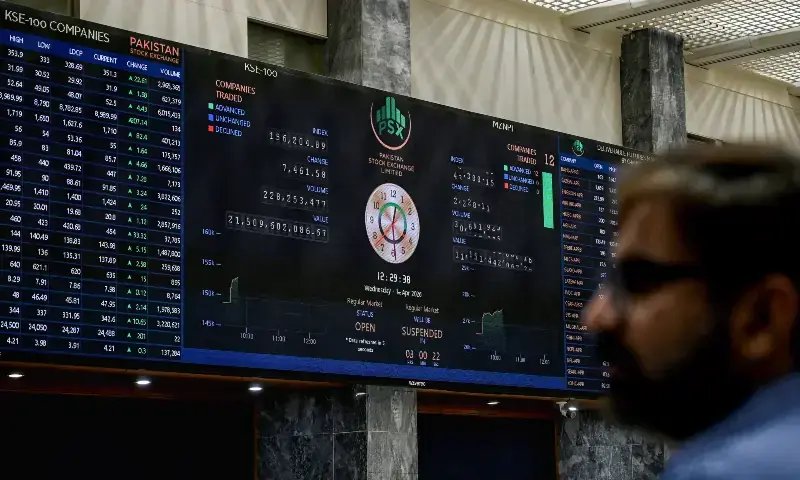
Pakistan Stock Exchange faces weekly losses amid rising oil prices, geopolitical tensions and bond yield concerns
KARACHI: The Pakistan Stock Exchange (PSX) remained volatile during the outgoing week as geopolitical tensions, elevated international oil prices and rising bond yields offset optimism over Pakistan’s Staff-Level Agreement (SLA) with the International Monetary Fund (IMF).
The benchmark KSE-100 index declined 0.6% week-on-week, shedding 1,066 points to close at 167,089 points, according to Arif Habib Limited (AHL).
Geopolitical Tensions Pressure Market Sentiment
Investor sentiment remained subdued amid escalating tensions in the Middle East and concerns over global energy supplies. Attacks on key shipping routes, including reported Houthi targeting of Saudi civilian infrastructure and energy facilities, added to uncertainty.
Ukrainian drone strikes on Russian refineries and concerns over US energy supplies also supported elevated oil prices. Brent crude futures remained above $100 per barrel, according to AKD Securities Limited.
IMF Agreement Offers Some Support
Pakistan’s Staff-Level Agreement with the IMF on the fourth review of the Extended Fund Facility (EFF) and the third review of the Resilience and Sustainability Facility (RSF) provided some support to the market.
The agreement could pave the way for $1.2 billion in disbursements, subject to approval by the IMF Executive Board. Total disbursements under the two programmes would reach approximately $5.7 billion.
However, concerns over the widening trade deficit, inflation and the future direction of interest rates continued to weigh on investor confidence.
Rising Bond Yields Raise Rate Concerns
According to AHL, the government raised Rs381 billion in its latest Pakistan Investment Bonds (PIBs) auction, exceeding the Rs350 billion target.
Cut-off yields increased by 26–41 basis points across the three-, five- and 10-year tenors. In contrast, the two-year yield declined by 19 basis points, while bids for 15-year bonds were rejected.
The rise in longer-term yields fuelled expectations of a possible policy rate hike at the next monetary policy announcement.
Foreign Reserves and Rupee Show Modest Improvement
Pakistan’s foreign exchange reserves held by the State Bank of Pakistan rose by $15 million to $21.5 billion as of October 2.
The rupee also appreciated marginally by 0.03%, closing at Rs277 against the US dollar.
Meanwhile, central government debt stood at Rs82.95 trillion at the end of August. This represented a 7.1% increase year-on-year, although debt declined 0.5% compared with the previous month.
KP Emergency and Governor’s Rule: Federal Government Announces Constitutional Measures
Banking and Fertiliser Stocks Lead Decline
Banks were the largest drag on the KSE-100 index, contributing a negative 566 points. Fertiliser companies followed with 234 points, while automobile assemblers, cement companies and textile composite firms reduced the index by 97, 75 and 43 points, respectively.
Habib Bank Limited, MCB Bank and United Bank Limited collectively accounted for 388 points of the decline. Fatima Fertiliser and Fauji Fertiliser Company also weighed on market performance.
Oil marketing companies provided the strongest sectoral support, adding 110 points. Power companies contributed another 36 points.
Pakistan State Oil was the largest individual positive contributor, adding 113 points. Hub Power Company, Pakistan Oilfields, Engro Holdings and Mari Energies also supported the index.
Trading Activity Weakens
Trading activity slowed during the week. Average daily volume fell 18.6% week-on-week to 427 million shares.
Average daily traded value declined 2% to $67 million, reflecting subdued investor participation.
Cement Sales and Bank Deposits Improve
Cement dispatches increased 6% year-on-year to 4.62 million tonnes in September. Domestic sales rose 7%, while exports remained flat.
During the first quarter of FY27, total cement dispatches increased 4% to 13.14 million tonnes. Local sales rose 8%, offsetting an 11% decline in exports.
Banking sector deposits climbed 14% year-on-year to Rs39.2 trillion at the end of August, according to AKD Securities. Cotton arrivals also increased 5% to 3.2 million bales during September.
Oil and Gas Production Declines
Oil production fell 6.4% week-on-week to 63,700 barrels per day, while gas output declined 1.4% to 2,999 million cubic feet per day.
The declines were mainly attributed to lower production from northern oilfields and the Mari, Sui and Sharf fields.
Meanwhile, petrol prices increased 2.1% to Rs398.96 per litre, while high-speed diesel prices decreased 0.9% to Rs395.72 per litre.
Thar Coal Expansion Targets Lower Import Dependence
Sindh Engro Coal Mining Company is expanding its Thar Block-II mine to supply additional coal to Lucky Electric Power Company.
The expansion could enable the power plant to transition fully to local coal, potentially reducing reliance on imported fuel.
Outlook: Earnings and Geopolitics in Focus
Analysts expect quarterly earnings announcements and geopolitical developments to influence market direction in the coming weeks.
The KSE-100 index was trading at a price-to-earnings ratio of 7.5 times, with a dividend yield of 6.7%.
They said easing inflation, improving economic indicators and a potential de-escalation in the Middle East could moderate oil prices and strengthen the case for monetary easing. However, persistent geopolitical uncertainty and elevated energy prices may continue to limit market gains.