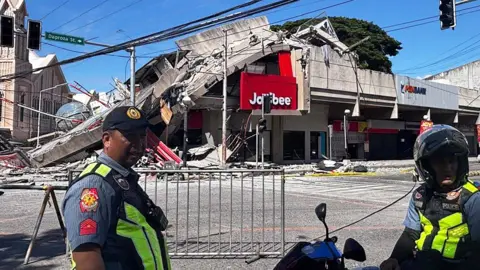
Rescue teams assess earthquake damage across Mindanao, Philippines. PHOTO BBC.
The Philippines Earthquake has left at least 35 people dead after a powerful magnitude-7.8 tremor struck off the coast of Mindanao on Monday morning. The disaster triggered tsunami alerts across several countries and caused widespread destruction in southern regions of the Philippines.
Moreover, the Philippines Earthquake displaced around 10,000 families and injured at least 134 people, according to officials. Authorities continue to verify casualty figures as emergency teams respond to affected communities.
Mindanao Earthquake Causes Widespread Damage
The earthquake struck at 07:37 local time near Mindanao, the country’s second-largest island. Shortly afterward, tsunami alerts were issued for the Philippines, Indonesia, Japan, and Australia.
However, authorities later downgraded or canceled those warnings after assessing wave activity. Even so, the quake caused severe structural damage in several areas.
Videos circulating online showed collapsed buildings and damaged infrastructure. One widely shared clip showed a Jollibee restaurant reduced to rubble following the powerful shaking.
Soccsksargen Reports Highest Earthquake Fatalities
According to the Office of Civil Defense, 31 deaths were recorded in Soccsksargen. Meanwhile, four additional fatalities were reported in Davao.
Officials also reported at least 134 injuries and significant displacement across affected communities. Furthermore, earlier reports indicated that 12 people remained missing as rescue efforts continued.
Authorities stated that casualty figures remain preliminary and require verification by the national disaster agency.
Ferdinand Marcos Jr Orders Emergency Response
Philippine President Ferdinand Marcos Jr said government agencies were coordinating disaster response operations across Mindanao.
“The national government is moving and we will not leave Mindanao behind,” he stated.
In addition, Marcos ordered the suspension of classes in affected areas. The earthquake struck on the first day of the new school year, creating additional challenges for students and educators.
Emergency services have since been deployed to support affected families and assess infrastructure damage.
Davao Communities Experience Strong Shaking
Several communities in Davao experienced intense shaking during the earthquake. A video shared by a primary school in Davao Occidental showed students taking cover as the ground moved beneath them.
Meanwhile, a corrugated-roof shelter collapsed behind the students. School officials reported that no injuries occurred during that incident.
Residents across the region described scenes of panic as people rushed outdoors seeking safety.
Philippines Earthquake Followed by Numerous Aftershocks
The Philippines Earthquake was followed by more than 130 aftershocks. These ranged in magnitude from 1.3 to 6.7, increasing concerns among residents already affected by the disaster.
Later in the evening, a magnitude-5.7 earthquake struck waters near Balut Island in Sarangani. Authorities continue monitoring seismic activity throughout the region.
As a result, many displaced residents remain cautious about returning to damaged homes.
Tsunami Alerts Reach Japan and Neighboring Countries
The earthquake prompted tsunami warnings across parts of the Pacific region. Japanese authorities initially warned that waves of up to one meter could reach coastal areas.
Later, officials recorded small tsunami waves in Okinawa and the Ogasawara Islands. Authorities also detected waves along coastlines in Indonesia, Palau, and the Philippines.
Wave heights ranged from a few centimeters to approximately 1.4 meters, according to official reports.
Mindanao Earthquake Highlights Ring of Fire Risks
The Philippines sits along the Pacific Ring of Fire, one of the world’s most seismically active regions. Consequently, earthquakes occur frequently throughout the archipelago.
While many tremors cause limited damage, stronger events can be deadly. Last year, a magnitude-6.9 earthquake in the Visayas region reportedly killed more than 70 people.
Therefore, disaster preparedness remains a major priority for Philippine authorities as recovery efforts continue in Mindanao.