PHDEC Unveils Strategic Roadmap to Transform Balochistan into a Global Pistachio Hub; Targets USD 12 Million Economic Potential
QUETTA, PAKISTAN (April 20, 2026) – The Pakistan Horticulture Development and Export Company (PHDEC) successfully conducted a high-level webinar today titled “Pistachio Farming in Balochistan: Challenges, Yield Constraints & Future Prospects,” identifying a massive, untapped economic opportunity for Pakistan within the arid regions of Balochistan.
The session highlighted an urgent economic need to address the country’s burgeoning pistachio import bill, which has surged from USD 2.14 million in 2022 to USD 8.96 million in 2024. Experts noted that while Balochistan offers the ideal “Mediterranean-type” climate necessary for nut development, current cultivation is restricted to only 203 hectares with significantly low yields compared to global competitors.
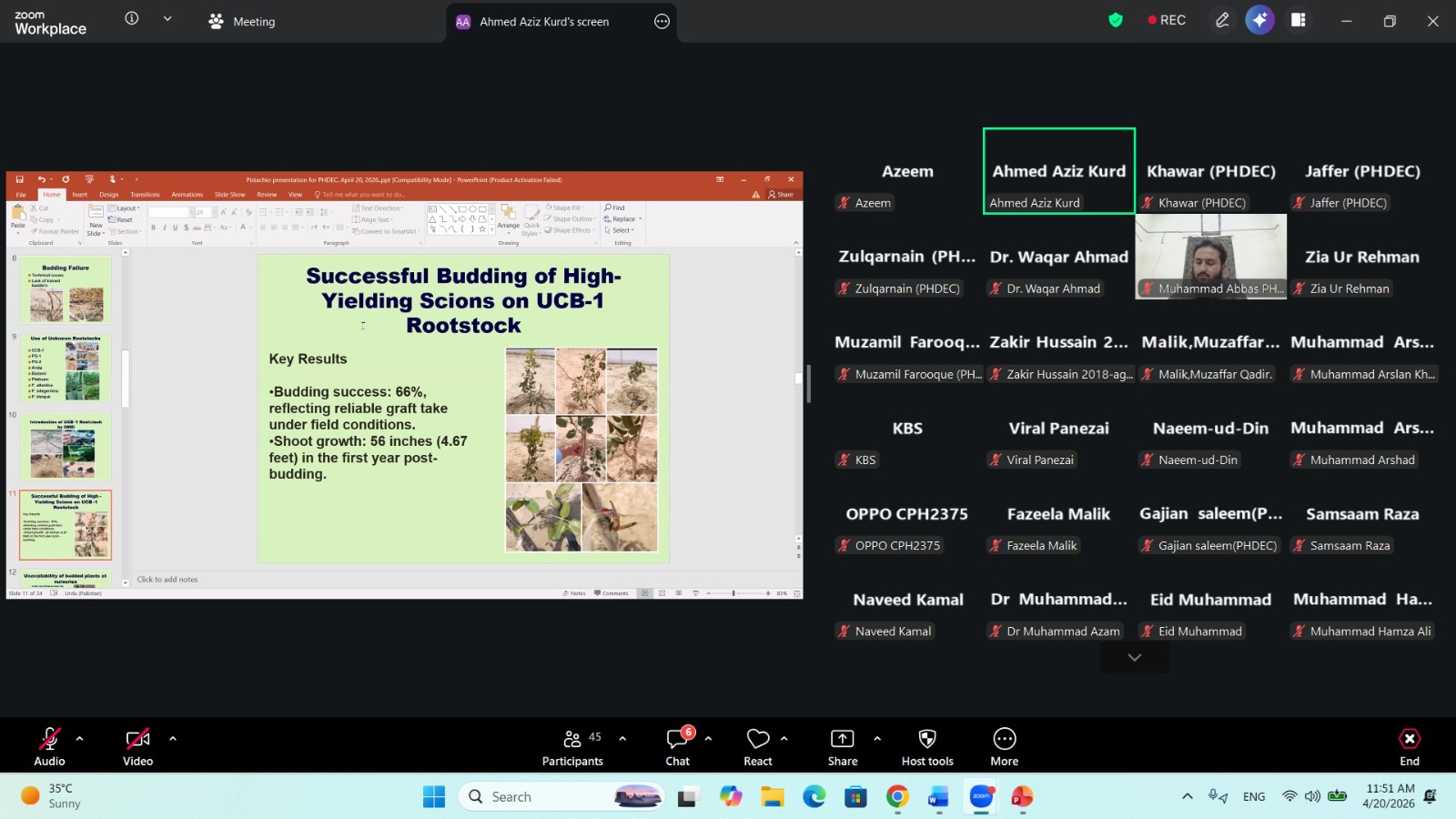
Strategic Interventions and Breakthroughs: Dr. Muhammad Azeem Khan, Consultant-Agro, PHDEC, emphasized that scientific intervention is the key to transforming this sector from subsistence farming to a commercial powerhouse. Recent research at the BARDC Mastung farm has already shown promising results, achieving a 66% budding success rate on the UCB-1 rootstock. Additionally, a new landrace variety, PARC-Mastung-1, has been proposed, offering superior cold tolerance and a 98% suture opening rate, outperforming many common international varieties.
The 2,000-Acre Roadmap To capitalize on this “Green Gold,” PHDEC presented a comprehensive strategic roadmap featuring:
- Large-Scale Plantation: A target to establish 2,000 acres of pistachio orchards, requiring the procurement of 216,000 high-yielding budded plants from international leaders like the USA, Iran, or Turkey.
- Orchard Re-engineering: Modernizing existing orchards by correcting tree ratios to a 1:9 male-to-female standard to guarantee harvests.
- Certified Nursery Development: Utilizing tissue culture at institutions like BUITEMS to produce “true-to-type” plants and high-performing rootstocks locally.
Economic Impact The financial projections for this initiative are substantial. Achieving the 2,000-acre target is expected to produce a yield of 1,344 tons after ten years, generating an estimated PKR 3,424 million (approx. USD 12.08 million). This growth would effectively offset current imports and position Pakistan as a future exporter.
Closing Remarks Mr. Khawar Nadeem, Manager of Agri-Products at PHDEC, concluded the session by calling for a multi-stakeholder approach to transition the province toward a commercially viable, export-oriented pistachio industry. He noted that modernizing nursery management and utilizing certified rootstocks is not just an agricultural goal, but a vital economic necessity to reduce foreign exchange drainage.
For more information and to access the Pistachio Production Technology Brochure, please visit PHDEC’s official social media platforms.