Pakistan-UK Ties: Aurangzeb, British High Commissioner Discuss Economic Reforms and Investment
Finance Minister Muhammad Aurangzeb and UK High Commissioner Jane Marriott review Pakistan’s reform agenda, investment opportunities and bilateral economic cooperation.
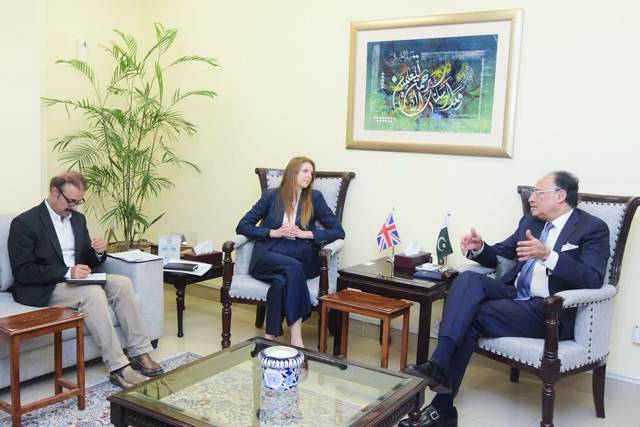
Finance Minister Muhammad Aurangzeb meets British High Commissioner Jane Marriott in Islamabad.
ISLAMABAD: Pakistan-UK Ties took center stage on Wednesday as Federal Minister for Finance and Revenue Senator Muhammad Aurangzeb met British High Commissioner to Pakistan Jane Marriott to discuss Pakistan’s economic outlook, reform agenda and opportunities to expand bilateral cooperation.
The meeting focused on Pakistan’s macroeconomic progress, fiscal reforms, sustainable economic growth and stronger economic and development partnerships between the two countries.
Senator Aurangzeb thanked the United Kingdom for its continued support for Pakistan’s economic reform programme and acknowledged the longstanding partnership in areas including economic governance, fiscal reforms, climate resilience, public finance, healthcare and social development.
The finance minister highlighted Pakistan’s recent macroeconomic gains, including the approval of the Federal Budget 2026-27, continued fiscal consolidation and measures aimed at maintaining economic stability while supporting sustainable growth.
Pakistan LNG: Spot Import Price Hits Record High Amid Regional Supply Disruptions
He reaffirmed the government’s commitment to structural reforms by broadening the tax base, strengthening public financial management and improving investor confidence.
The two sides also reviewed Pakistan’s population management and public health initiatives. Aurangzeb appreciated the UK’s technical assistance in population planning and stressed the importance of a coordinated national framework with measurable outcomes. He said greater investment in women’s education, workforce participation and public awareness would support long-term economic development.
During the meeting, the finance minister outlined the government’s strategy to expand access to international capital markets and diversify financing sources. He highlighted plans for sovereign bond issuances, Sukuk, Panda Bonds and innovative financing tools, including the tokenisation of sovereign debt, under Pakistan’s Medium-Term Debt Management Strategy.
Aurangzeb also briefed the British High Commissioner on ongoing reforms at the Federal Board of Revenue (FBR), including technology-driven, AI-enabled and risk-based tax administration systems designed to improve transparency, facilitate taxpayers and enhance revenue collection.
The discussions covered wider structural reforms, including energy sector restructuring, the privatisation of selected state-owned enterprises and governance improvements aimed at strengthening Pakistan’s long-term economic resilience and improving the ease of doing business.
Jane Marriott welcomed Pakistan’s progress in restoring macroeconomic stability and reaffirmed the United Kingdom’s continued support for the country’s reform agenda. Both sides agreed to deepen cooperation in trade, investment, financial markets and climate resilience while maintaining close engagement between public and private sector institutions.
Separately, Pakistan’s Ambassador to China, Khalil Hashmi, also met Senator Aurangzeb to review Pakistan-China economic cooperation, investment promotion and financial collaboration.
The ambassador briefed the finance minister on investment facilitation initiatives undertaken by Pakistan’s Embassy in Beijing. He informed the meeting that Pakistani and Chinese entities had signed Memorandums of Understanding (MoUs) worth more than US$20 billion, with several projects already progressing into commercial agreements.
Hashmi highlighted growing Chinese private-sector interest in manufacturing, logistics, pharmaceuticals, biotechnology, textiles and industrial services. He noted that nine agreements had recently been concluded in the pharmaceutical and biotechnology sectors, while more than 150 Chinese companies were actively engaged through the Embassy’s investment facilitation platform.
The meeting also reviewed progress on major Chinese investments in industrial manufacturing, logistics infrastructure and export-oriented textile projects across Pakistan.
Both sides discussed expanding business-to-business partnerships, particularly for small and medium-sized enterprises (SMEs), strengthening capital market cooperation and enhancing collaboration with financial institutions, including the Asian Infrastructure Investment Bank (AIIB) and the Silk Road Fund.
Senator Aurangzeb stressed the importance of translating investment commitments into timely implementation through stronger institutional coordination and investor facilitation.
The meeting also reviewed opportunities to strengthen trade under the China-Pakistan Free Trade Agreement (CPFTA), expand exports, promote value-added manufacturing and improve market access for Pakistani products.
The finance minister reaffirmed the government’s commitment to strengthening Pakistan’s strategic economic partnerships through sustained reforms, improved investment facilitation and closer engagement with international development partners.