Pakistan-Sri Lanka Trade Stagnant Despite Duty-Free Access, Consul General Says
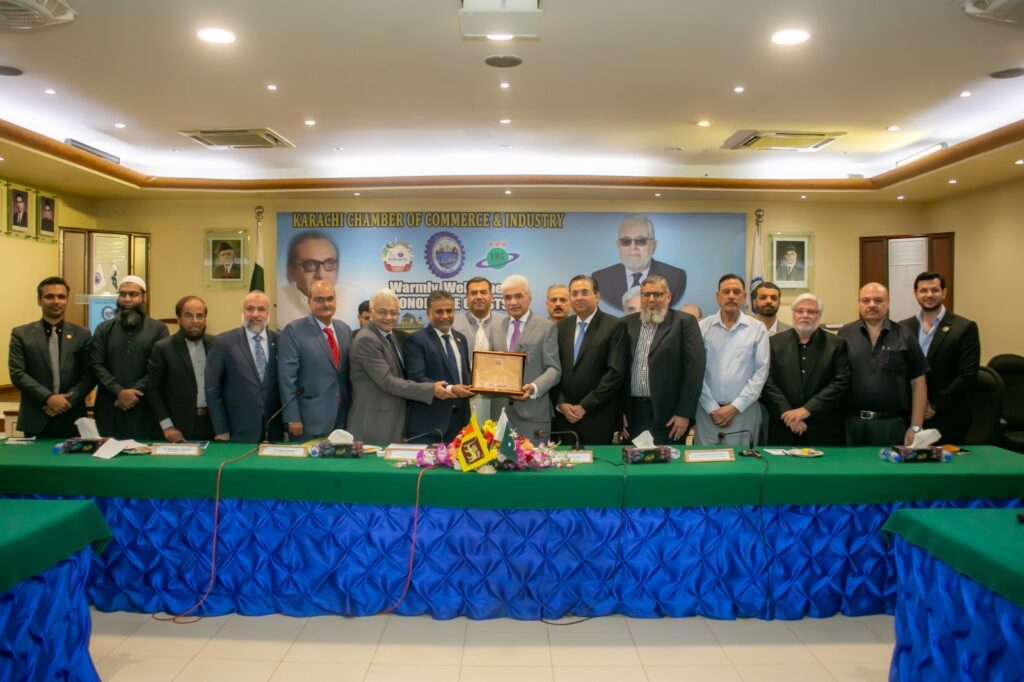
President Karachi Chamber of Commerce & Industry Talat Mahmood presenting crest to Consul General of Sri Lanka P.K. Sanjeewa Pattiwila during his visit to KCCI. Senior Vice President Aslam Pakhali, Vice President Atif Jamil Ur Rahman, Ex-Officio Rehan Hanif and KCCI Executive Committee Members
Pakistan and Sri Lanka need stronger business engagement to unlock their bilateral trade potential, Sri Lankan Consul General P.K. Sanjeewa Pattiwila has said. He urged both countries to remove trade barriers and improve market access despite the duty-free arrangements available under their bilateral trade agreement.
Speaking during a visit to the Karachi Chamber of Commerce & Industry (KCCI), Pattiwila said trade had yet to reach its potential since the two countries signed their agreement in 2005. He called for a more proactive approach to market development and closer cooperation with government authorities.
“In the business world, we cannot always remain on the defensive. We must proactively pursue markets and break down barriers to unlock the true potential of bilateral trade,” he said.
KCCI President Talat Mahmood, Senior Vice President Aslam Pakhali, Vice President Atif Jamil Ur Rahman, Ex-Officio Rehan Hanif and members of the chamber’s Executive Committee attended the meeting.
Trade Imbalance Highlights Scope for Growth
Pattiwila highlighted the imbalance in bilateral trade. According to the figures he cited, Pakistan exports approximately US$450 million worth of goods to Sri Lanka. In comparison, Sri Lankan exports to Pakistan stand at around US$90 million.
Sindh Auqaf Minister Reviews Development Work at Masooma-e-Sindh Shrine
Pakistan supplies industrial products, including cement and other heavy materials. Meanwhile, Sri Lanka exports betel leaves, electrical and electronic products, finished garments and, more recently, pineapples to Pakistan.
The Consul General said both countries could diversify their export baskets. He encouraged Pakistani businesses to explore emerging opportunities in Sri Lanka and expand their market presence.
He also offered to help KCCI members strengthen commercial links and resolve trade-related difficulties.
Technical Barriers and Taxes Need Attention
Although Pakistan and Sri Lanka have an established trade framework, technical barriers and additional taxes continue to affect market access, Pattiwila said.
He urged businesses in both countries to work with their respective governments to identify and address these obstacles. He cited the facilitation of pineapple exports as an example of how targeted engagement can open new commercial opportunities.
Furthermore, the Consul General offered assistance with trade-related engagement and visa matters. He encouraged KCCI members to contact his office whenever they needed support.
KCCI Calls for Stronger Business Cooperation
KCCI President Talat Mahmood reaffirmed the chamber’s commitment to strengthening economic and commercial relations between Pakistan and Sri Lanka. He called for closer cooperation between the two countries’ business communities to increase exports and unlock untapped potential.
Mahmood appreciated the Sri Lankan Consulate’s role in facilitating business engagement. He also pledged that KCCI would continue working with the Consul General to promote trade, investment and commercial cooperation.
He said the chamber and the consulate shared a responsibility to connect businesses in both countries. Continued coordination, he added, could help identify opportunities and resolve trade-related challenges.
Recent KCCI Visit to Sri Lanka Opens Further Opportunities
Mahmood also referred to a recent KCCI delegation visit to Sri Lanka. Former Senior Vice President Muhammad Raza led the delegation, which included Aslam Pakhali.
He appreciated the Sri Lankan Consulate’s assistance in arranging the delegation’s successful engagements. He also called on both countries to make fuller use of their existing freight trade agreement and strengthen business-to-business interaction.
Mahmood identified several sectors with potential for joint ventures and commercial cooperation. These include pharmaceuticals, textiles, rubber products, plastics, engineering goods, surgical instruments and food processing.
He urged Karachi’s business community to pursue these opportunities and focus on expanding Pakistani exports to Sri Lanka.
“I want to see the available potential translated into tangible results on the ground. Our objective should be to turn these opportunities into real business activity and stronger exports,” he said.
Both sides expressed their commitment to closer coordination. Removing trade barriers, improving facilitation and encouraging direct business engagement could help convert existing trade arrangements into stronger commercial ties.