KPT Chief Urges Pre-Arrival GD Filing to Cut Cargo Clearance Time to 90 Hours

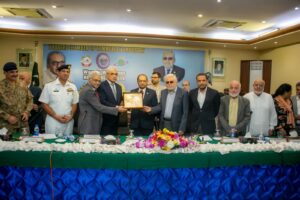
KPT Chairman Rear Admiral (Retd) Shahid Ahmed addresses the Karachi business community on faster cargo clearance and port modernisation.
Karachi Port Trust (KPT) Chairman Rear Admiral (Retd) Shahid Ahmed has urged importers, customs agents and clearing brokers to adopt pre-arrival filing of Goods Declarations (GDs) to speed up cargo clearance and reduce port congestion.
Speaking at a meeting at the Karachi Chamber of Commerce and Industry (KCCI) on Monday, he said cargo with pre-arrival GDs was being cleared in approximately 90 hours, compared with 296 hours for shipments without advance filing.
He said wider adoption of the practice could reduce terminal congestion, improve cargo movement and lower the cost of doing business. He also invited KCCI to submit a consolidated list of operational issues with practical recommendations, assuring that KPT would coordinate with Pakistan Customs, the Federal Board of Revenue (FBR), the Sindh government and other relevant authorities.
KPT Reports Progress on Dredging and Port Infrastructure
Rear Admiral Shahid Ahmed said KPT had made progress in port infrastructure, dredging, shipping connectivity, digitalisation and cargo-handling efficiency.
According to the chairman, around 90% of the long-pending dredging project had been completed, deepening the main channel to approximately 14.5 metres. He said the approach channel was expected to reach 16 metres after the remaining work, which he projected would take another 30–40 days.
Governor Sindh Meets Private Schools Association, Invited to Teachers Award Day
The deeper channel would allow larger vessels to call at Karachi Port and improve operational efficiency.
He added that KPT and terminal operators had invested substantially in port infrastructure over the previous eight to 10 months. KPT had also reduced relevant transshipment charges by approximately 80%, while terminal operators were offering a 25% discount and a 14-day free period to attract transshipment and transit cargo.
The chairman also cited off-dock facilities with a combined capacity of approximately 150,000, although the supplied statement did not specify the unit of measurement.
New Shipping Services Aim to Strengthen Connectivity
Shahid Ahmed said Karachi Port ranked 34th among approximately 980 ports in the global Liner Shipping Connectivity Index.
He also announced that a new direct Europe service by Mediterranean Shipping Company (MSC) was expected to begin on October 26. KPT aims to increase direct shipping services by at least 100% by December, according to the chairman.
The planned expansion is intended to strengthen links with international markets and reduce reliance on transshipment through foreign ports.
He estimated that improved vessel operations and cargo handling could save the business community Rs30 billion to Rs40 billion annually. Larger vessels, he added, could reduce cargo unloading times from around seven days to between one and one-and-a-half days.
Bunkering and Digitalisation Offer New Opportunities
The KPT chairman said more than 160 vessels had called in Pakistani waters for bunkering services. He projected that the bunkering business could exceed Rs300 billion annually within two to three years, creating opportunities for refineries and other maritime businesses.
KPT is also moving towards technology-enabled port operations. Planned and ongoing measures include artificial intelligence-based bulk cargo handling, automated equipment, a Vessel Traffic Management System and Enterprise Resource Planning systems.
The chairman put the estimated combined investment in these systems at Rs2 billion to Rs2.5 billion. KPT is also introducing online services and electronic tendering to improve transparency and reduce administrative delays.
Road Projects Key to Reducing Port Congestion
The chairman identified Shahrah-e-Bhutto connectivity, Main Line-I, the 54-kilometre KPT–Pipri Freight Corridor and the proposed M-10 connection as important projects for improving cargo evacuation. The Lyari Expressway Elevated Corridor also remains under consideration.
He said timely completion of these projects could ease port-related traffic congestion and improve the movement of goods across Karachi.
KPT has recovered more than 250 acres of encroached land and is pursuing mangrove rehabilitation across approximately 4,000 acres, he added. To address marine waste, a trash-skimming vessel with a reported daily capacity of 100 tonnes has been ordered from Karachi Shipyard.
KPT is also coordinating with relevant authorities to facilitate round-the-clock customs inspections, increase the availability of customs sealers and improve shift coordination.
KPT Seeks Support for Port-Related Roads
Shahid Ahmed urged the business community to support better road infrastructure serving Karachi Port and Port Qasim. He said importers collectively paid an estimated Rs140 billion to Rs160 billion annually in Sindh Infrastructure Development Cess (SIDC).
KPT is seeking the Sindh government’s support to allocate a portion of these collections to roads and other infrastructure serving the ports.
Addressing transporters’ concerns, he said KPT had offered land for transport-related facilities. The Sindh government had also committed approximately 100 acres near the Northern Bypass for a terminal, subject to coordination and the resolution of competing claims.
BMG Calls for Accountability and Faster Clearance
Chairman of the Businessmen Group (BMG) Zubair Motiwala welcomed progress in dredging, modernisation and port operations. However, he said these improvements must deliver measurable benefits for importers, exporters and industrial consumers.
Motiwala questioned why dredging had remained pending for decades. He called for accountability, regular maintenance and institutional continuity to prevent similar delays.
He also urged KPT to assess whether additional revenue from transshipment could help reduce costs for domestic businesses.
To improve transparency, Motiwala proposed enforceable cargo-clearance timelines and systematic reporting of containers delayed beyond prescribed periods. He called for a joint committee involving KPT, Pakistan Customs and business representatives to identify the causes of delays, assign responsibility and ensure corrective action.
He further advocated a risk-based profiling system under which compliant businesses could receive faster clearance through the Green Channel, subject to applicable laws and risk-assessment criteria. This would allow authorities to focus inspections on higher-risk consignments.
KCCI Seeks Joint Action on Terminal and Transport Issues
KCCI President Talat Mahmood welcomed the KPT chairman and his delegation, which included senior officials and Chief Collector of Customs Wajid Ali.
Mahmood said close coordination between KPT, Pakistan Customs and terminal operators was essential to resolving the business community’s concerns. He described terminal congestion as a major obstacle to trade and urged KPT, Customs and operators, including KGTL and SAPT, to work together on faster clearance.
He also highlighted unresolved transporters’ concerns, acknowledged Zubair Motiwala’s role in addressing a recently threatened strike and called for a lasting solution.
Mahmood drew attention to difficulties clearing agents face when accessing containers at SAPT. He urged better coordination with terminal management to address the problem.
He also proposed a dedicated truck parking and staging area, potentially operated on a rental basis. Trucks could wait in an organised location and enter the port when capacity became available, reducing congestion on Karachi’s roads.
KCCI Proposes Permanent Coordination Committee
Mahmood called for a permanent KPT–KCCI coordination committee to resolve genuine operational complaints promptly.
He said lengthy administrative procedures often allowed demurrage costs to accumulate before problems reached the relevant authorities. A dedicated coordination mechanism, he argued, would enable direct communication and follow-up without bypassing regulatory requirements.
The meeting highlighted the need for coordinated reforms across port operations, customs procedures, shipping connectivity and road infrastructure. Business representatives stressed that measurable improvements in clearance times, transparency and transport facilities would be essential to strengthening Karachi Port’s role in Pakistan’s international trade.