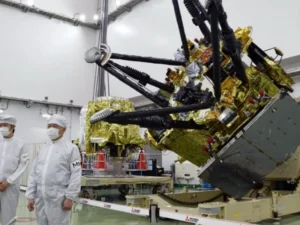
Japan Launches Historic MMX Mission to Retrieve Samples From Mars’ Moon
The MMX spacecraft will target Phobos to investigate the origins of Mars’ moons and advance future space exploration.
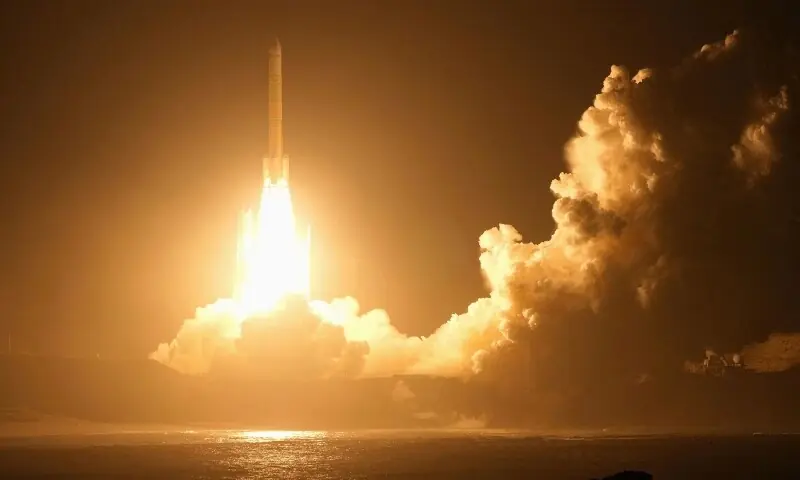
MMX Mission: Japan launches a spacecraft to collect samples from Mars’ moon Phobos.
TOKYO: Japan has launched a landmark space mission to collect samples from one of Mars’ moons, aiming to uncover clues about the formation of the solar system and the origins of life on Earth.
The unmanned Martian Moons eXploration (MMX) spacecraft lifted off aboard Japan’s H3 rocket from the Tanegashima Space Center at 4:41am local time on October 20, 2026. The Japan Aerospace Exploration Agency (JAXA) broadcast the launch live.
More than an hour after liftoff, JAXA confirmed that the spacecraft had separated successfully from the rocket and was beginning its journey towards the Martian system.
The agency also received signals from the probe, confirming that it was operating normally.
“I’d dreamt of this day, so I’m incredibly happy,” JAXA scientist Mari Aida said after the launch. “Right now I feel really relieved.”
Thousands of people watched the launch online despite the early hour in Japan, sharing messages of support for the mission.
Spacecraft Targets Phobos
The MMX spacecraft is expected to reach the vicinity of Mars around August 2027. It will then focus on Phobos, one of the Red Planet’s two moons.
A French-German rover named IDEFIX will support the mission by travelling across Phobos and examining its surface. The observations will help scientists assess conditions for a safe landing.
Once the spacecraft reaches Phobos, it plans to collect at least 10 grams of surface material. The mission is expected to spend approximately three years in the Martian system before beginning its return journey.
The project brings together JAXA, US and European space agencies, universities and technology companies. It aims to achieve the first round trip to the Martian moons and return samples to Earth for detailed analysis.
Scientists Seek Answers About Mars’ Moons
Researchers hope the samples will help resolve a long-standing question: how did Mars acquire its two moons, Phobos and Deimos?
One theory suggests that a massive collision involving Mars produced debris that eventually formed the moons. Another proposes that Mars captured two asteroids through its gravitational pull.
Analysing material from Phobos could help scientists determine which explanation is more likely. The findings may also shed light on how potentially habitable environments developed on rocky planets, including Earth and Mars.
JAXA says the mission could also help establish whether Phobos might serve as a natural staging point for future crewed missions to Mars.
The spacecraft will observe Deimos as well, although it will not attempt to land on the smaller moon.
Nicky Fox, head of NASA’s Science Mission Directorate, described the scientific potential of the mission as significant.
She said the samples could produce major advances in understanding the Martian system for future generations, particularly as NASA prepares for eventual human exploration of Mars.
Global Race to Return Mars Samples
Japan’s mission comes amid international efforts to bring material from Mars back to Earth.
NASA’s Perseverance rover has been exploring Mars since 2021 and has collected rock samples. However, plans to return those samples have faced major setbacks, with the original programme undergoing significant changes.
China is also developing its Tianwen-3 mission, which is scheduled to launch around 2028. The programme aims to return Martian samples to Earth as early as 2031.
Although MMX will collect material from Phobos rather than directly from Mars, scientists believe the mission could provide valuable evidence about the planet’s history and the evolution of the wider solar system.
The results could help researchers better understand the origins of Mars’ moons and prepare for future robotic and human exploration of the Red Planet.