Germany Thrash Xavi’s Netherlands 5-0: Klopp Has Finally Found the Formula
Derry Scherhant, Florian Wirtz, Nico Schlotterbeck and Brajan Gruda headline a stunning German performance that raises fresh questions about the national team’s recent struggles
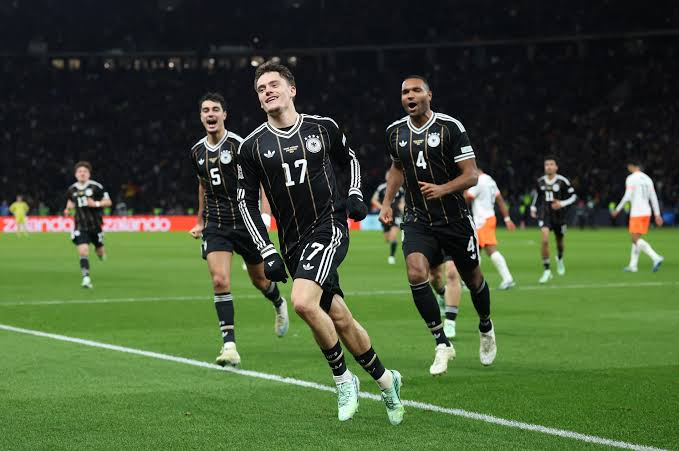
Germany 5-0 Netherlands: Jürgen Klopp celebrates a stunning victory as his side dominates Xavi's team.
Germany have just beaten the Netherlands 5-0. Let that sink in.
This is the same Dutch side that demolished Greece 7-0 last week. Germany did not simply win. They dismantled them.
So savour this result. Tell everyone. Enjoy it for as long as you want.
Here are my three observations from a performance that could mark a turning point for German football.
Only three observations? Muller_Era, what happened to you? Germany just won 5-0. The last time we checked, you could write fifteen observations about a dead-rubber 2-1 victory.
1. You’re Only Washed Up or a Nobody Until You Score
I love that every time Germany plays, another player appears whom the average football fan has barely heard of.
Unfortunately, this became a familiar feature of German football for several years. There were multiple reasons. One was the obsession with short-term results, which often influenced squad selections. A player could become a starter one month and old news just two months later. The second reason, of course, was injuries.
However, Jürgen Klopp has only been in charge for a few months. It makes sense that we are still seeing new faces.
Take Derry Scherhant. The Berlin-born forward developed through several youth setups before settling at Hertha. SC Freiburg signed him last year, and he has since continued his development there.
Brajan Gruda came through Mainz’s youth system. He helped the club through a difficult relegation battle before moving to Brighton. Florian Wirtz, meanwhile, arrived at Liverpool amid enormous expectations. His performances had already attracted criticism, with some questioning whether he could deliver on his potential.
And then there is Kai Havertz. His place in the German setup has often felt settled, even when his performances have invited debate.
My point is simple: before this match, few casual observers would have expected this collection of attacking players to produce such a performance.
Robert Pattinson Confirmed as New James Bond, Succeeding Daniel Craig as 007
But there was one important detail. Their manager was Jürgen Klopp.
Who can call Havertz and Wirtz washed up when they deliver? Who can call Scherhant and Gruda nobodies after performances like this?
The Perfect Opponent for a Statement
This was also the perfect opponent for Germany to make a statement. It was Xavi Hernández’s Netherlands, a side that had just scored seven goals against Greece. Even people who had not watched Germany closely would recognise the significance of beating such an opponent 5-0.
I would go further. This performance strengthens the argument that Germany’s problem was never simply a lack of talent. The bigger issue was how that talent was identified, organised and used.
Let’s establish a few things.
Identity Matters
After the World Cup, criticism of Germany’s lack of a clear footballing identity became increasingly common. Under Klopp, however, there is now a recognisable approach.
The team presses aggressively, counter-presses quickly and takes risks when moving the ball forward. Vertical progression is supported by attacking overloads and quick decisions.
There is a clear Kloppian idea. More importantly, the players are beginning to execute it.
Even the experimentation in earlier international windows now looks useful. Klopp needed to discover which players could deliver the intensity and tactical discipline his system demands.
Hold Your Horses: The Squad Is Not Settled
Notice that I said a set of players, not a fixed squad.
Germany’s recent victories against Serbia and the Netherlands featured different personnel and tactical combinations. Klopp appears willing to select players according to the opponent rather than rely on one permanent starting eleven.
Against Serbia, Malick Thiaw and Maximilian Mittelstädt featured. Against the Netherlands, Nathaniel Brown and Nico Schlotterbeck offered different qualities.
Schlotterbeck’s distribution was particularly valuable against a Dutch midfield capable of playing through pressure and exploiting spaces between defensive lines.
This flexibility matters. A manager should not simply select his favourite eleven and expect them to solve every problem.
Sometimes, It Is All in Your Head
Klopp also seems to understand the psychological side of management. Wirtz looks increasingly confident, while younger players such as Gruda and Scherhant are beginning to play without fear.
There is no single explanation for a player’s transformation. Confidence, tactical clarity and the right environment all matter.
Klopp has addressed the fundamentals: establish an identity, keep selection options open, adapt to opponents and help players overcome their limitations.
2. That Thing Ant-Man Said in Endgame
At the beginning of Avengers: Endgame, Scott Lang emerges from the Quantum Realm and discovers that the world has changed dramatically.
He reaches the Avengers headquarters and asks a rather important question:
“What the hell happened here?”
That is exactly how I imagine Dutch supporters feeling after this match.
The same Netherlands that beat Greece 7-0 suddenly collapsed against Germany. What happened?
The Dutch have talented players, but their defensive structure offered Germany several opportunities to exploit.
There were some obvious vulnerabilities.
Aggressive Full-Backs Leave Space Behind
When full-backs push forward, invert or overlap, they can leave significant space in wide defensive areas.
That is not necessarily a problem. However, it becomes one when the opposition has players capable of exploiting those spaces.
Wirtz and Gruda offered Germany pace, movement and direct attacking intent. They could carry the ball forward, attack defenders and punish gaps before the Dutch defence recovered.
A High Defensive Line Needs Coordination
A high line works when the midfield and defence move together. However, even small gaps can become dangerous.
When an opponent bypasses the midfield, attackers can run beyond the centre-backs and exploit the space behind them.
Germany repeatedly looked capable of finding those openings.
The Dutch Midfield Offered Attacking Opportunities
The Netherlands have technically gifted midfielders who like to move forward. But that attacking instinct can leave defensive spaces when possession is lost.
Germany’s quick transitions made those spaces particularly dangerous.
Defensive Leadership Matters
The absence of experienced figures such as Virgil van Dijk can make organisation more difficult. Without strong defensive leaders, a team can struggle to recover when its structure breaks down.
Germany understood these weaknesses and built an attack capable of exploiting them.
Germany Found the Perfect Attacking Combination
Wirtz was clever enough to find pockets between the lines. Gruda was direct and aggressive, repeatedly taking on defenders. Scherhant made dangerous runs beyond the defensive line.
Havertz offered another dimension. He could move into the box, drop deeper to create chances and draw defenders away from Wirtz.
The result was an attack that constantly gave the Dutch defence something different to deal with.
Klopp assembled the right combination of players to dismantle a talented Netherlands side.
The scoreline tells the story, but the way Germany created those opportunities is even more encouraging.
3. It Was Never a Germany Issue
For almost a decade, the blame has often fallen on Germany’s players.
The argument has been familiar: this generation simply does not have the talent of the previous one.
And, in some ways, that is true.
There will never be another Thomas Müller. There will never be another Philipp Lahm, Bastian Schweinsteiger, Mats Hummels, Mesut Özil, Sami Khedira, Toni Kroos or Mario Götze.
But why does Germany need another version of those players?
Football does not work that way. Every generation brings different strengths, weaknesses and personalities.
Germany Needs Vision, Not Copies of Former Stars
Germany does not need identical replacements for its former stars. Instead, it needs a manager who can identify new talent and build a system around the players available.
If the DFB fails to identify emerging talent, the manager may eventually have to do more of that work himself.
That is not how a football association should operate. Scouting and player development should be institutional priorities. However, someone had to start looking beyond the familiar names.
The criticism of Germany’s available talent becomes difficult to sustain when relatively unfamiliar players deliver two emphatic victories.
There is an enormous pool of German talent beyond the usual Bayern Munich stars and established internationals playing abroad.
For too long, the same group of thirty-odd players appeared in different combinations. The results remained largely unchanged.
Klopp Has Opened New Possibilities
Klopp’s willingness to explore a wider group has given Germany new options. His experimental 40-man squad may have looked excessive at the time, but the recent performances suggest that the approach has value.
The more you watch this Germany side, the clearer the picture becomes.
They needed vision. They needed a recognisable footballing identity. They needed someone willing to trust new players and give them a system in which they could succeed.
They needed Klopp.
And when you consider the talent already available, including Jamal Musiala, the possibilities become even more exciting.
Does this make Germany a guaranteed World Cup winner? Absolutely not. One outstanding result cannot settle that debate.
But it does make them a team opponents will have to take seriously.
The formula is beginning to take shape. Now Germany must prove that this performance was not an exception.
For once, German football has something genuinely exciting to build on.