Food Safety: Nestlé Pakistan and National Stakeholders Push for Stronger Food Standards
Government officials, researchers, industry leaders and academics unite to strengthen Pakistan’s food safety system through science-based and consumer-focused solutions.
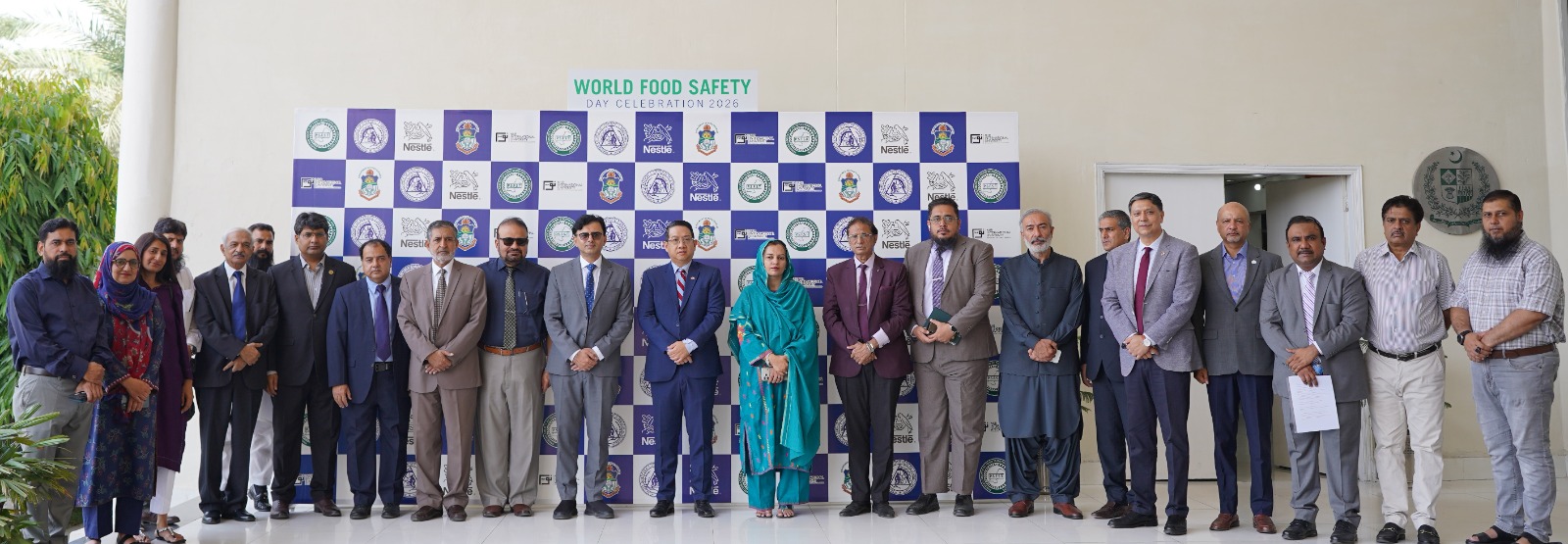
National stakeholders gather in Lahore to discuss food safety and consumer protection initiatives.
LAHORE: Nestlé Pakistan joined national stakeholders to mark World Food Safety Day 2026 with a renewed commitment to improving food safety standards and strengthening consumer trust across Pakistan.
Held in collaboration with the Pakistan Council of Scientific & Industrial Research (PCSIR), the Pakistan Society of Food Scientists & Technologists (PSFST), the Department of Food Science at the University of the Punjab, and NUR International University (NIU), the event was organised under the theme, “From Burden to Solutions: Safe Food Everywhere.”
The gathering brought together government representatives, regulators, academics, industry experts and students to encourage dialogue on building a stronger and more resilient food safety ecosystem in Pakistan.
Participants included Dr Kiran Khurshid, Secretary of the Food Safety and Consumer Protection Department (FS&CPD) Punjab, Jason Avanceña, Chief Executive Officer of Nestlé Pakistan, and senior representatives from the Punjab, Sindh and Balochistan Food Authorities, along with the Pakistan Standards and Quality Control Authority.
Discussions focused on improving food safety, product quality, traceability, nutritional labelling and consumer information. Speakers stressed practical and science-led approaches that can help consumers make informed food choices.
Speaking at the event, Jason Avanceña said food safety remains central to Nestlé’s operations and consumer confidence. He described it as the company’s foundation of trust and a key responsibility toward consumers.
Dr Kiran Khurshid highlighted the need for collective action and said government institutions, regulators, academia and industry must work together to achieve safer food systems.
Saudia Award: Airline wins 2026 APEX Best Cabin Service in Middle East
Dr Ijaz, Director General of PCSIR, emphasised the importance of research in strengthening food safety frameworks. Munir Hussain Chopra, Director Planning and Coordination at Punjab Food Authority, said effective planning, enforcement and public awareness remain essential to safe food practices throughout the supply chain.
Dr Ahmed Ali Sheikh, Director Technical at Sindh Food Authority, called for stronger implementation and technical oversight to address food safety concerns, particularly in unpackaged food. Habib Ullah Khan, Director General of Balochistan Food Authority, stressed the importance of regulatory coordination and expanding practical food safety measures nationwide.
Academic leaders also highlighted the role of evidence-based policy and scientific collaboration. Prof Dr Imran Pasha from the University of Agriculture Faisalabad underscored academia’s contribution to research and capacity building, while Prof Dr Shinawar Waseem of PSFST said professional and scientific platforms can connect regulators, industry and consumers more effectively.
The dialogue also examined nutritional labelling and explored alignment with Codex principles and international best practices. Participants supported evidence-based front-of-pack nutrition systems designed to provide simple and consumer-friendly information suited to Pakistan’s public health and economic environment.
The event concluded with a shared commitment from all participating organisations to strengthen food safety culture and ensure reliable, high-quality food access for consumers across Pakistan.