Charter of Democracy: Khawaja Asif Urges Opposition to Reflect on Past and Seek Political Consensus
Defence Minister Khawaja Asif urged the opposition on Wednesday to reflect on its own political record before criticising the government and called for a renewed commitment to democratic principles through a Charter of Democracy.
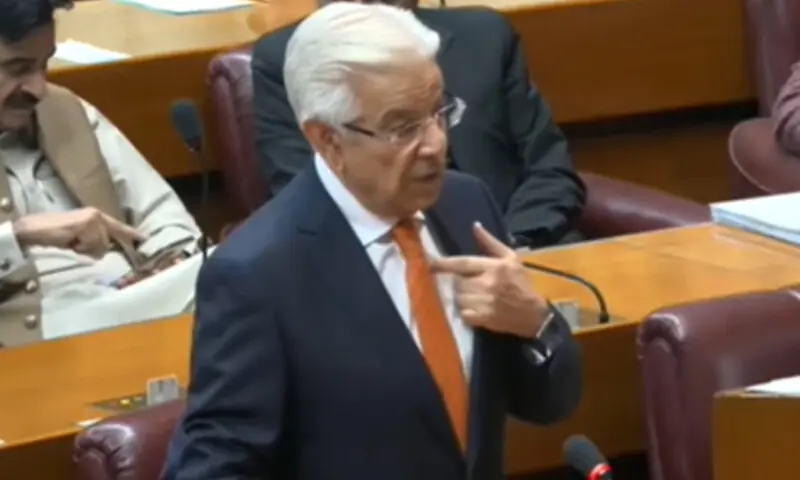
Khawaja Asif addresses the National Assembly during debate on political reform
Defence Minister Khawaja Asif urged the opposition on Wednesday to reflect on its own political record before criticising the government and called for a renewed commitment to democratic principles through a Charter of Democracy.
His remarks came a day after sharp exchanges in the National Assembly, where opposition leaders strongly criticised the government, the judiciary and the establishment during a heated parliamentary session.
Addressing the lower house of Parliament, Asif said political accountability should begin with self-examination.
“Whenever I issue instructions or make any demand, I refer to one principle: if you seek equity, you should come with clean hands,” he said, directing his comments towards opposition members.
Balochistan Police: Athletes Turned Officers as Sports Careers Stall
The defence minister questioned the opposition’s criticism and referred to events that took place during previous administrations.
“What did not happen in this House during their time in power?” Asif asked, adding that lawmakers and even the institution itself had witnessed past political confrontations.
Calling for political reconciliation, Asif invited opposition parties to move forward and sign a Charter of Democracy with the government.
“We have also made mistakes,” he said. “But neither side should forget what happened in the past.”
Drawing comparisons with Pakistan’s political landscape in the 1990s, Asif recalled the intense rivalry between the Pakistan Peoples Party (PPP) and Pakistan Muslim League-Nawaz (PML-N), which now govern together at the federal level.
He said both parties eventually recognised the need to reduce political hostility and establish mechanisms for cooperation.
According to Asif, former prime ministers Benazir Bhutto and Nawaz Sharif agreed that political competition should operate within a defined code of conduct that protects respect and parliamentary dignity.
The minister also criticised the former PTI administration, alleging that parliamentary procedures were bypassed during its tenure.
He claimed that 55 pieces of legislation had been approved rapidly before the dissolution of the assembly, describing the move as politically inappropriate.
Reflecting on past political conduct, Asif acknowledged shortcomings among established parties but argued that reforms followed through constitutional and democratic processes.
“Our past may not have been something to be proud of, but we tried to learn from it,” he said.
He added that further constitutional reforms may still be necessary, arguing that previous amendments had not delivered their full intended impact.
Asif also referred to Prime Minister Shehbaz Sharif’s recent interaction with opposition lawmakers in Parliament and described it as an example of political engagement.
Comparing the current atmosphere with previous governments, the defence minister claimed dialogue between government and opposition had become increasingly difficult in recent years.
Commenting on opposition leader Mehmood Khan Achakzai, Asif described him as a political colleague but questioned the internal democratic culture of opposition parties.
“No political party can function on the wishes of one individual,” he said, arguing that internal democracy remains essential for healthy parliamentary politics.