Arles night: Van Gogh’s Café Terrace painting reveals how an ordinary square was transformed
A detailed look at how Vincent van Gogh reimagined light, history and the cosmos in his 1888 Arles masterpiece, Café Terrace at Night.
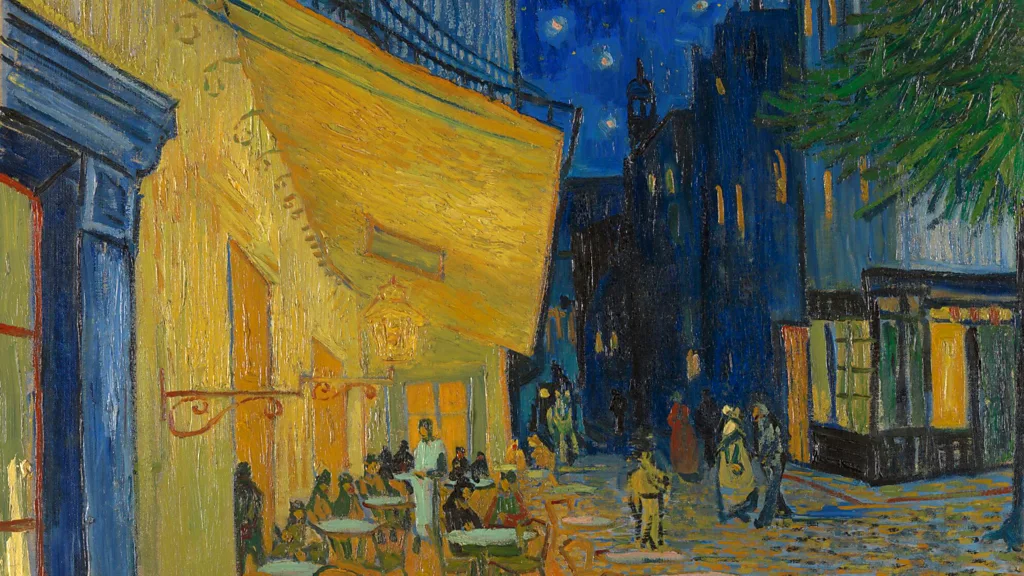
Café Terrace at Night by Vincent van Gogh showing illuminated café terrace in Arles under a starry night sky.
Arles night takes centre stage in a new reading of one of Vincent van Gogh’s most celebrated works, as the artist’s vision of Café Terrace at Night continues to reshape how modern audiences understand his time in southern France.
The painting, Café Terrace at Night, completed in September 1888 in Arles, shows a lantern-lit café spilling warm light onto a cobbled square beneath a deep, star-filled sky. It is widely regarded as the first of Van Gogh’s “starry night” compositions, marking a decisive shift in his artistic approach.
Van Gogh, Vincent van Gogh, had moved to Arles earlier that year in search of creative renewal. In letters to his brother Theo, he expressed a desire to move beyond simple representation and instead capture what he called “a sense of the infinite”.
Meloni–Trump Row: Italy’s PM Rejects ‘Begged for Photo’ Claim as Diplomatic Tensions Rise
The scene at Place du Forum appears ordinary at first glance, but it is carefully constructed to dissolve the boundary between the everyday and the cosmic. Light from a single café lantern spreads across stone and street, while the sky above is rendered as a pulsating field of blue and gold.
Much of the foreground is dominated by rippling cobblestones, painted in shifting tones that resist realism. The ground is presented not just as a surface, but as a layered space shaped by centuries of Roman and medieval history beneath Arles itself. In this way, the city is portrayed as both visible and buried.
Architectural details in the composition subtly depart from reality. Classical elements, including columns and fragments of ancient structures, are woven into the scene, blending historical memory with artistic interpretation. These alterations suggest that the past is never fully absent, even in a modern street scene.
The café itself appears lively yet strangely empty, with rows of unoccupied chairs drawing attention to absence as much as presence. Scholars have noted that the arrangement evokes a staged atmosphere, as if the viewer is witnessing a performance suspended in time.
In the distance, a tower rises above the rooftops, anchoring the composition and guiding the viewer’s gaze upward. Once part of a church and later repurposed as a museum structure, it is presented as a bridge between historical fragments and the night sky.
Above all, it is the stars that define the painting’s emotional weight. Their placement has been linked by researchers to the constellation Aquarius, suggesting Van Gogh observed and reconstructed the night sky with striking precision.
Unlike other elements in the composition, the stars remain fixed and unchanging. Everything else appears in motion or transformation, reinforcing the idea that stability exists only beyond the earthly world.
Shortly after completing the work, Van Gogh wrote of going outside at night to paint the stars, a habit that would come to define his final years. In Arles, the ordinary was repeatedly transformed into something vast, uncertain and luminous—an artistic shift that continues to shape his legacy.