Merck Foundation CEO Rasha Kelej Highlights Human Capacity in Cancer Care
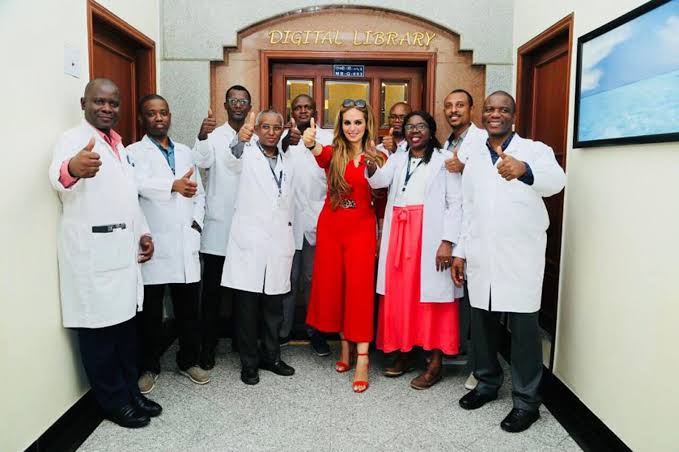
Merck Foundation CEO Dr. Rasha Kelej highlights the importance of building local expertise to strengthen cancer care across Africa.
Merck Foundation CEO Senator Dr. Rasha Kelej has published a new leadership article highlighting the importance of developing specialized healthcare professionals to strengthen cancer care across Africa.
The article, titled “We Did Not Donate Cancer Care. We Built the People Who Could Deliver It,” appears on her virtual mentorship and leadership platform, Beyond Power; Leadership, Global Influence and Impact.
Dr. Kelej argues that sustainable healthcare systems depend on skilled professionals as much as hospitals, equipment and medicines.
“You cannot build a sustainable healthcare system without building its people first,” she says.
Building Local Cancer Care Expertise
Dr. Kelej explains that infrastructure alone cannot deliver effective cancer treatment without trained professionals who can diagnose patients, determine treatment, operate medical equipment and manage chemotherapy and palliative care.
The International Agency for Research on Cancer estimated that Africa recorded about 1.19 million new cancer cases and 764,000 cancer deaths in 2022. Patients across the continent continue to face late diagnosis, limited screening and diagnostic services, shortages of specialists and inadequate referral systems.
Geographical inequality also limits access to specialized cancer services, particularly outside major cities.
US Justice Department Launches National Fraud Center to Tackle Cross-Border Schemes
Merck Foundation says it has provided more than 280 one-, two- and three-year scholarships in multidisciplinary cancer care for healthcare professionals from 35 African countries.
According to Dr. Kelej, these programs have supported the training of first local oncologists in Liberia, The Gambia, Burundi, Niger and the Central African Republic. The programs have also strengthened oncology capacity in Namibia, Zambia, Zimbabwe and Sierra Leone.
“For me, this is what capacity building really means,” Dr. Kelej says. “It is not about arriving with a temporary solution. It is about helping a country develop the expertise to care for its own people.”
Extending Specialist Care Beyond Major Cities
The article also focuses on geographical inequalities in cancer care.
Dr. Kelej says increasing the number of specialists alone cannot solve the problem if most professionals remain concentrated in capital cities and major urban centers.
“Our capacity-building strategy has increasingly focused not only on how many specialists a country has, but also on where those specialists are needed,” she says.
Her approach emphasizes partnerships that help healthcare professionals from different regions and institutions gain specialist knowledge. The goal is to gradually extend cancer-care expertise to secondary cities, regional hospitals and underserved communities.
Merck Foundation also works with academic institutions, medical societies, governments, Ministries of Health and Education, First Ladies and Presidents to strengthen national healthcare capacity.
Knowledge Creates Long-Term Impact
Dr. Kelej says specialized medical education requires sustained postgraduate and clinical training rather than short workshops or seminars.
Merck Foundation supports long-term clinical oncology training, multi-year master’s programs and structured postgraduate oncology education through academic and clinical institutions in countries including India, Egypt and the United Kingdom.
The article argues that a trained specialist can create an impact far beyond an individual scholarship.
A specialist can treat patients, support colleagues, mentor younger doctors and eventually help train the next generation of healthcare professionals.
“When you help a country develop its first locally trained oncologist, its first specialist in a field that previously did not exist, or its first structured cancer-care capacity, something has fundamentally changed,” Dr. Kelej writes.
Focus on Sustainable Healthcare Systems
Dr. Kelej also contrasts short-term donations with long-term human capacity development.
While donated equipment can deliver an immediate and visible benefit, developing a specialist may take several years. Once trained professionals return home, however, their knowledge can continue benefiting patients and healthcare institutions for decades.
“Infrastructure may age. Technology may become obsolete. A supply of medicine will eventually be consumed or expired. But knowledge can multiply,” she says.
The article further stresses that capacity building should help countries reduce dependence on outside expertise by developing specialist knowledge locally.
“The ultimate success of capacity building is that countries become less dependent on outside expertise because the expertise now exists at home,” Dr. Kelej writes.
Mentorship Platform for Future Leaders
Dr. Kelej’s Beyond Power; Leadership, Global Influence and Impact platform aims to provide leadership guidance and mentorship to aspiring leaders, particularly women and young people across Africa, Asia and other Global South countries.
The platform draws on her 32 years of professional experience and offers leadership insights intended to help individuals develop their potential and pursue their professional and personal goals.
The full article is available through Dr. Kelej’s mentorship and leadership platform and the Merck Foundation’s digital channels.