US vs Iran: Complete History of the Conflict (1953–2026)
Discover the complete history of the US-Iran conflict from the 1953 coup to the 2026 military tensions. Explore the key events, nuclear disputes, sanctions, proxy wars, and diplomatic efforts that shaped one of the world’s longest geopolitical rivalries.
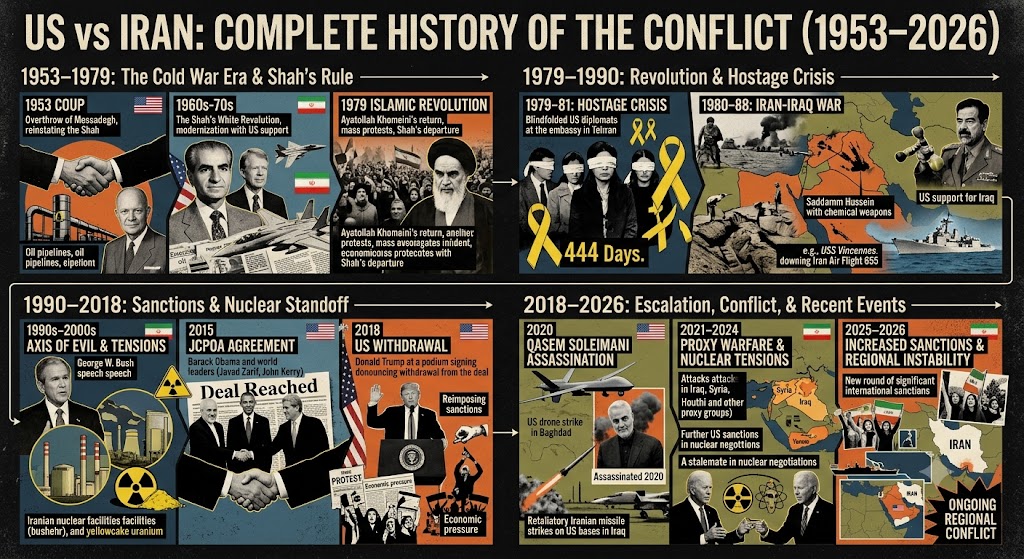
Learn the complete history of the US vs Iran conflict from the 1953 coup to the 2026 tensions, including the Islamic Revolution, nuclear dispute, sanctions, proxy wars, and diplomacy.
For more than seven decades, the relationship between the United States and Iran has evolved from close partnership to one of the world’s most complex and dangerous geopolitical rivalries. The conflict has influenced global oil markets, Middle East security, international diplomacy, and nuclear non-proliferation efforts.
Although the two countries have never fought a full-scale declared war against each other, their relationship has been marked by coups, sanctions, proxy conflicts, cyberattacks, assassinations, and military confrontations.
Rehan Tariq Case: Court Grants NCCIA Six-Day Physical Remand in Blasphemy Investigation
This article explains the complete history of the US-Iran conflict from 1953 to 2026.
1953: The CIA-Backed Coup
The modern conflict began in 1953 when Iran’s democratically elected Prime Minister, Mohammad Mossadegh, nationalized the country’s oil industry.
Britain and the United States feared losing influence in the region and worried that instability could strengthen Soviet influence during the Cold War.
The CIA and Britain’s MI6 organized Operation Ajax, which removed Mossadegh from power and restored Shah Mohammad Reza Pahlavi’s authority.
For many Iranians, the coup became a symbol of foreign interference in their country’s sovereignty.
1953–1979: America Supports the Shah
Following the coup, the United States became Iran’s closest Western ally.
Washington provided:
- Military assistance
- Economic aid
- Intelligence cooperation
- Advanced weapons
The Shah launched modernization programs known as the White Revolution.
However, political opposition grew due to:
- Authoritarian rule
- Corruption
- Economic inequality
- Suppression of political dissent
These grievances eventually fueled a nationwide revolution.
1979: The Islamic Revolution
In February 1979, Ayatollah Ruhollah Khomeini returned from exile and led the Islamic Revolution.
The monarchy collapsed, and Iran became an Islamic Republic.
The revolution fundamentally changed Iran’s foreign policy.
The United States lost one of its strongest allies in the Middle East almost overnight.
1979–1981: The US Embassy Hostage Crisis
In November 1979, Iranian students stormed the US Embassy in Tehran.
They captured 52 American diplomats and citizens, holding them hostage for 444 days.
The crisis shocked the United States and destroyed diplomatic relations.
Washington froze Iranian assets and imposed sanctions that remain the foundation of many restrictions today.
Diplomatic relations between the two countries have never been restored.
1980–1988: The Iran-Iraq War
Shortly after the revolution, Iraq invaded Iran.
The United States officially remained neutral but gradually supported Iraq with intelligence and strategic assistance.
The eight-year conflict killed hundreds of thousands of people and devastated both countries.
Iran accused the United States of indirectly helping Saddam Hussein during the war.
1988: Iran Air Flight 655
One of the darkest moments occurred in July 1988.
A US Navy missile cruiser accidentally shot down Iran Air Flight 655 over the Persian Gulf.
All 290 people onboard were killed.
The United States stated that the civilian aircraft had been mistaken for a military target.
Iran considered the incident a deliberate attack, further worsening relations.
The 1990s: Sanctions Expand
Throughout the 1990s, Washington accused Iran of:
- Supporting militant organizations
- Pursuing missile technology
- Seeking nuclear capabilities
The United States imposed broader economic sanctions targeting Iran’s energy and financial sectors.
Iran described these sanctions as economic warfare.
2002: Iran’s Nuclear Program
International concern increased after previously undeclared nuclear facilities became public.
The United States accused Iran of secretly pursuing nuclear weapons.
Iran insisted that its nuclear program was intended solely for peaceful energy production.
The dispute became one of the biggest international security issues of the 21st century.
2015: The Nuclear Deal (JCPOA)
After years of negotiations, Iran and six world powers signed the Joint Comprehensive Plan of Action (JCPOA).
Under the agreement:
- Iran reduced uranium enrichment.
- International inspectors gained greater access.
- Economic sanctions were eased.
- Iran regained access to global markets.
The deal was viewed by supporters as a major diplomatic breakthrough.
Critics argued that it did not permanently prevent Iran from developing nuclear weapons.
2018: The United States Withdraws
In 2018, President Donald Trump withdrew the United States from the JCPOA.
Washington restored severe sanctions under its “Maximum Pressure” campaign.
Iran gradually reduced compliance with the agreement and expanded uranium enrichment.
The withdrawal marked a major turning point in US-Iran relations.
2019: Rising Gulf Tensions
During 2019, attacks on oil tankers and Saudi oil facilities increased tensions across the Gulf.
The United States blamed Iran for several incidents.
Iran denied direct involvement.
Military deployments in the region increased significantly.
2020: Killing of Qasem Soleimani
In January 2020, a US drone strike near Baghdad International Airport killed Iranian General Qasem Soleimani, commander of the Islamic Revolutionary Guard Corps’ Quds Force.
Iran described the strike as an act of state terrorism.
Days later, Iran launched ballistic missiles against US military bases in Iraq.
The confrontation brought both countries to the brink of open war.
2021–2024: Diplomatic Efforts and Proxy Conflicts
Efforts to revive the nuclear agreement continued but repeatedly stalled.
Meanwhile:
- Regional proxy conflicts intensified.
- Maritime incidents continued.
- Cyberattacks targeted infrastructure.
- Armed groups supported by Iran increased attacks against US interests.
The rivalry increasingly shifted into indirect confrontation.
2025: Escalating Military Confrontation
During 2025, regional instability increased significantly.
Military exchanges involving Iran, Israel, and the United States raised fears of a wider Middle East conflict.
Air defense systems, missile attacks, and naval deployments became increasingly frequent.
International organizations urged restraint while diplomatic efforts struggled to reduce tensions.
2026: A New Phase of the Conflict
By 2026, US-Iran tensions remained among the world’s most serious geopolitical flashpoints.
Several developments contributed to renewed instability:
- Continued disputes over Iran’s nuclear activities.
- Expanded economic sanctions.
- Regional military operations.
- Cybersecurity confrontations.
- Increased naval activity in the Persian Gulf.
- Concerns about disruption to global energy supplies.
Although both countries have avoided a full-scale war, the risk of miscalculation remains high.
Major Turning Points in the US-Iran Conflict
| Year | Event |
|---|---|
| 1953 | CIA-backed coup against Mossadegh |
| 1979 | Islamic Revolution |
| 1979 | US Embassy hostage crisis |
| 1980–1988 | Iran-Iraq War |
| 1988 | Iran Air Flight 655 tragedy |
| 2002 | Nuclear program controversy |
| 2015 | Nuclear Deal (JCPOA) signed |
| 2018 | US withdraws from JCPOA |
| 2020 | Qasem Soleimani killed |
| 2025 | Regional military escalation |
| 2026 | Continuing nuclear and regional tensions |
Why the Conflict Matters
The US-Iran rivalry affects far more than the two countries themselves. Its consequences include:
- Global oil prices
- Middle East security
- International trade routes
- Nuclear non-proliferation efforts
- Counterterrorism operations
- Global financial markets
- International diplomacy
Any major escalation could have worldwide economic and political consequences.
Conclusion
The US-Iran conflict is rooted in decades of political change, ideological differences, security concerns, and competing regional interests. From the 1953 coup and the 1979 Islamic Revolution to nuclear negotiations and modern-day military tensions, each chapter has deepened mistrust between the two nations.
While diplomacy has occasionally reduced tensions, lasting peace remains elusive. As of 2026, the relationship continues to shape global politics, making it one of the most closely watched rivalries in international affairs.