Security Breach at Trump-Headlined Correspondents’ Dinner Raises Fresh Questions Over Protection of U.S. Leaders
Web Desk April 26, 2026Washington, D.C. — The shooting of a Secret Service agent during the White House Correspondents’ Association dinner has triggered renewed scrutiny over the security framework protecting America’s top political leaders, at a time of escalating political violence in the United States.
Washington, D.C. — The shooting of a Secret Service agent during the White House Correspondents’ Association dinner has triggered renewed scrutiny over the security framework protecting America’s top political leaders, at a time of escalating political violence in the United States.
Trump Evacuated from White House Correspondents’ Dinner After Armed Attack on Security Personnel
The incident occurred Saturday night at the Washington Hilton hotel, where President Donald Trump was the featured guest and a large number of senior officials—including Vice President JD Vance, Secretary of State Marco Rubio, Attorney General Todd Blanche, Defense Secretary Pete Hegseth, Treasury Secretary Scott Bessent, and Interior Secretary Doug Burgum—were gathered alongside lawmakers, journalists, and celebrities.
Despite extensive security deployment involving hundreds of agents from multiple federal and local agencies, an armed suspect carrying a shotgun, handgun, and knives managed to enter the hotel and reach a floor above the main ballroom where approximately 2,600 attendees were dining.
Suspect Breached Hotel Security Perimeter
According to law enforcement officials, the suspect was reportedly staying inside the same hotel, raising immediate questions about access control and screening procedures. While guests were required to pass through metal detectors to enter the ballroom area, entry into the hotel itself only required ticket verification, with public access still partially open.
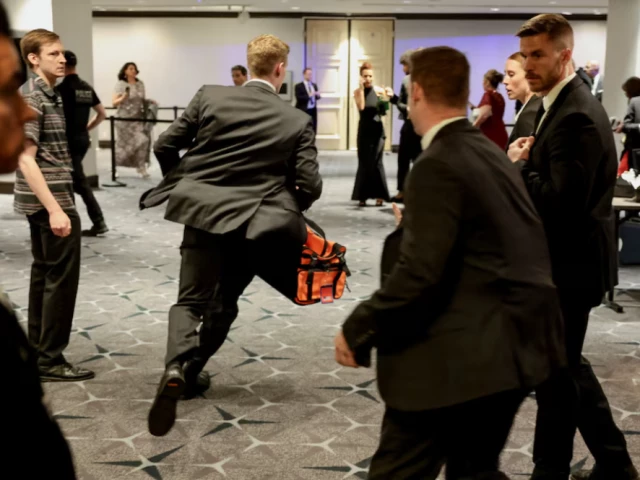
CCTV footage reviewed by authorities reportedly shows the suspect running through a hallway near a security checkpoint before opening fire on a Secret Service agent. The agent was struck during the confrontation before the attacker was tackled, subdued, and taken into custody.
Washington police confirmed that the suspect acted alone, though investigations are ongoing to determine motive and potential planning.
Chaos Inside a High-Profile Gathering
Inside the ballroom, guests were reportedly still eating dinner when gunshots were heard from the rear of the venue, triggering panic among attendees. Security personnel immediately evacuated President Trump and Vice President Vance from the head table.
Other cabinet members and senior officials experienced staggered evacuations, as protective teams responded in varying ways—some forming human shields, others rushing protectees out through crowded exits, and several officials being forced to the ground for protection.
Witnesses described scenes of confusion, with agents climbing over chairs, overturning tables, and guiding high-value individuals out of the hall while guests took cover beneath tables.
Trump Praises Response, Questions Security
Speaking afterward at the White House, President Trump praised the Secret Service response, calling their actions “quick and effective,” while also acknowledging the severity of the incident.
He noted that the suspect never came close to breaching the ballroom itself, but questioned the security of the venue, stating, “It’s not particularly a secure building,” referring to the Washington Hilton—also the site of the 1981 assassination attempt on President Ronald Reagan.
Trump added that while he had initially wanted the event to continue, security officials determined it was not feasible.
Investigation Into Security Gaps
Authorities are now focusing on how an armed individual was able to navigate inside a heavily secured hotel hosting one of Washington’s most prominent political events. The presence of multiple security layers—including federal agents, local police, and private protection teams—has raised concerns about coordination and access control failures.
The incident is especially significant given that Trump himself survived two assassination attempts during the 2024 election cycle, further highlighting persistent threats against high-profile political figures.
Heightened Political Tensions
The attack comes amid an increasingly volatile political climate in the United States, with officials warning of rising extremism and politically motivated violence.
Security experts say the breach underscores the challenge of protecting large-scale public political events held in partially open venues, even when elite protection details are deployed.