Punjab Floods: Government Orders High Alert Amid Uncertainty Over River Flow Data
Punjab directs authorities to strengthen flood preparedness as the suspension of the Indus Waters Treaty limits access to river flow information from India.
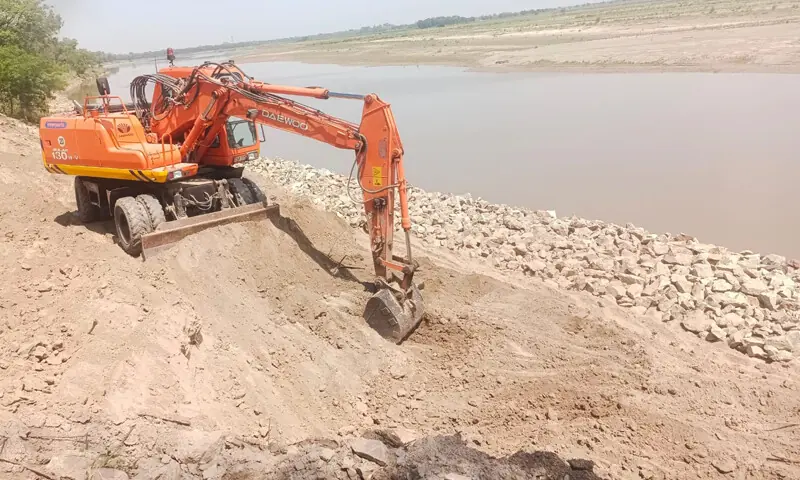
Officials inspect flood preparedness measures along the Ravi River ahead of the monsoon season.
Punjab Floods preparedness has entered a high-alert phase after the provincial government instructed the irrigation department to strengthen flood response measures amid uncertainty over river flow data from India.
According to officials, Lahore Commissioner Nauman Yousaf chaired a meeting where the irrigation department highlighted difficulties in assessing flood risks because India has stopped sharing river flow information following its unilateral suspension of the Indus Waters Treaty.
Officials said the absence of official data has forced authorities to rely on social media reports and other unofficial sources, making accurate flood forecasting more difficult.
In response, the commissioner directed the irrigation department to adopt a more cautious approach. He instructed officials to prepare for medium-level flooding when conditions appear normal and to activate high-flood preparedness whenever medium-level risks emerge.
Bannu Operation: CTD, Police Kill Five Suspected Terrorists in Intelligence-Based Raid
The commissioner also ordered deputy commissioners to complete all flood management arrangements without delay to ensure a timely response to any emergency.
Officials from Lahore and Sheikhupura informed the meeting that they had identified all vulnerable points along the Ravi River. They also confirmed plans to launch an operation to remove temporary encroachments from the riverbed to improve water flow during the monsoon season.
A senior irrigation official confirmed the government’s instructions and acknowledged that the lack of river flow information from India continues to complicate planning. However, he expressed confidence that the department would complete all necessary preparations before the flood season reaches its peak.
The official clarified that water levels in the Ravi and other major rivers, including the Indus, Kabul, Jhelum, Chenab, and Sutlej, currently remain within normal limits. He also urged the public not to rely on unverified social media reports claiming that water levels had risen sharply.
The Punjab government has instructed district administrations, particularly those affected by last year’s floods, to remain on high alert and coordinate daily with the irrigation department to monitor river conditions.
Authorities have also ordered district administrations in Lahore and Sheikhupura to crack down on illegal sand mining at prohibited locations. Officials warned that excavation near bridges and river bays could weaken critical infrastructure and increase flood risks.
The commissioner directed the irrigation, highways, and railway departments to clear bridge bays along the Ravi River to ensure uninterrupted water flow. He stressed that protecting lives, property, and public infrastructure remains a shared responsibility for all government departments.
Last August, the Ravi River carried around 220,000 cusecs of water, causing widespread flooding in several areas of Lahore. Floodwaters inundated roads, damaged homes, and affected neighbourhoods including Shafiqabad, Farrakhabad, Tallat Park near Shahdara Bridge, Theme Park near Chuhng, and Park View near Thokar Niaz Baig.
The floods impacted at least 31 villages, including Mohlanwal and Chuhng, and affected more than 82,000 people in Lahore alone.
Lahore experienced its most devastating Ravi River flood in 1988, when water flow reached approximately 345,000 cusecs—far above the river’s designed capacity—causing extensive destruction in Shahdara and surrounding areas.