

Petroleum Prices: Pakistan Weighs Daily Fuel Pricing Amid Global Oil Volatility
The government is reviewing a daily petroleum pricing mechanism as rising global oil prices and Strait of Hormuz tensions increase pressure on fuel imports.
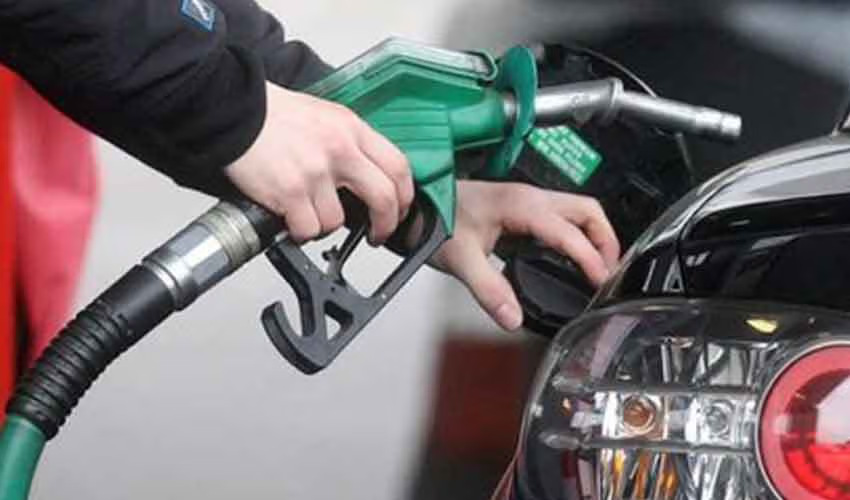
Petrol and diesel prices rise in Pakistan from September 11.
Petroleum Prices are under review as the Pakistani government considers introducing a daily fuel pricing mechanism in response to rising global oil prices and increasing geopolitical tensions in the Middle East.
The proposal emerged during a meeting of the Petroleum Price Reform Committee, chaired by Federal Minister for Petroleum Ali Pervaiz Malik. The committee reviewed the impact of volatile international oil markets on Pakistan’s existing fuel pricing system.
Global crude prices have climbed sharply following renewed tensions between the United States and Iran, raising concerns about possible disruptions to shipping through the Strait of Hormuz, one of the world’s busiest oil transit routes.
U.S. crude recently rose to around $82 per barrel, while Brent crude reached nearly $84 per barrel. Both benchmarks traded near $68 and $71 per barrel only weeks earlier.
The surge in oil prices has increased concerns that Pakistan, which relies heavily on imported petroleum products, could face higher fuel import costs in the coming weeks.
To respond more quickly to international market movements, the committee discussed replacing the current periodic pricing system with a daily petroleum price adjustment mechanism. Officials will submit the committee’s recommendations to Prime Minister Shehbaz Sharif, who will make the final decision.
The committee also proposed that the Oil and Gas Regulatory Authority (OGRA) publish petroleum price data on its website every day to improve transparency and public access to pricing information.
Participants agreed that the Petroleum Price Stabilization Fund should operate under a rules-based framework to ensure consistency and predictability in fuel pricing. They also supported the digitalization of Pakistan’s oil supply chain to improve efficiency and transparency across the petroleum sector.
Ali Pervaiz Malik said the renewed uncertainty surrounding the Strait of Hormuz has made fuel pricing reforms more important than ever. He added that the committee is reviewing different pricing models that better reflect rapidly changing global energy markets.
The minister also noted that petrol prices in Pakistan remain lower than those in Bangladesh, Sri Lanka, and Turkey, while remaining broadly comparable with prices in India.
Malik said the government has proposed amendments to the national refinery policy to strengthen domestic refining capacity and reduce dependence on imported diesel. He described the reforms as part of a broader strategy to improve Pakistan’s energy security.
Economic analyst Syed Wasif Naqvi said implementing daily fuel price revisions may prove difficult in the short term. He explained that the government still needs to consider several factors, including international oil prices, exchange rates, and petroleum levies, before adjusting domestic fuel prices.
The Petroleum Price Reform Committee will submit its final recommendations after completing its review of different pricing models. The government’s decision will determine whether Pakistan adopts a daily fuel pricing system to respond more effectively to global market fluctuations.