Mars Moons Japan Prepares Historic Mission to Collect Phobos Samples
Mars Moons: Japan’s MMX spacecraft prepares to collect samples from Phobos and investigate the origins of Mars’s moons.
Japan is preparing a historic mission to explore the moons of Mars and bring samples back to Earth. Scientists hope the findings will reveal how the solar system formed and how the ingredients for life reached rocky planets.
The Martian Moons eXploration (MMX) mission is led by the Japan Aerospace Exploration Agency (JAXA). It involves US and European space agencies, universities and technology companies.
The spacecraft is designed to make the first round trip to the Martian system. It could also help scientists plan future human missions to Mars.
According to JAXA, the H3 rocket carrying MMX is scheduled to launch from the Tanegashima Space Center at 4:41 am Tuesday. The spacecraft is expected to reach the Mars region about a year later.
Mission Will Collect Samples From Phobos
MMX will study Phobos, one of Mars’s two moons. The spacecraft plans to orbit Phobos for up to three years before landing and collecting at least 10 grams of surface material.
Anthropic Co-Founder Predicts AI Could Boost US Economy to $44 Trillion by 2030
Before the landing, a small rover named IDEFIX will examine the moon’s surface. Its observations will help the mission team identify a safe landing area.
IDEFIX takes its name from the French name for Dogmatix, the dog belonging to comic-book hero Asterix.
“The sampling (from) Phobos is of course the world’s first, but it means… this is the first round trip to the Martian system,” MMX project manager Yasuhiro Kawakatsu told AFP.
The spacecraft will also observe Deimos, Mars’s second moon. However, it will not land there before beginning its return journey to Earth.
Scientists Investigate How Mars’s Moons Formed
One of the mission’s main goals is to determine how Phobos and Deimos formed. Scientists are studying two leading theories.
The first is the giant-impact hypothesis. It suggests that a celestial body struck Mars, sending material into space that eventually formed the moons.
The second is the capture hypothesis. It proposes that Mars captured the moons through its gravitational pull, possibly drawing in passing asteroids.
Identifying the correct explanation could help scientists understand the early history of the solar system.
JAXA says the findings may also reveal how habitable environments developed on rocky planets. These include Mercury, Venus, Earth and Mars.
French astrophysicist Patrick Michel, who works on the IDEFIX project, said the moons could preserve evidence of material transported from the outer solar system.
“MMX will shed light on the transport mechanisms that delivered water, volatiles, and organic compounds from the outer solar system to the inner rocky planet region,” Michel told AFP.
He explained that these processes may have helped make rocky planets suitable for life.
If Phobos and Deimos preserve remnants of these ancient delivery systems, their samples could reveal important clues. They may show how the materials needed for life reached the planets.
Weak Gravity Creates Engineering Challenges
MMX is an international project involving several major space organisations. These include France’s National Centre for Space Studies (CNES), the German Aerospace Center (DLR), NASA and the European Space Agency (ESA).
Around 20 universities and technology companies are also contributing to the mission.
Building the spacecraft’s landing legs has proved particularly challenging. Phobos has extremely weak gravity, making landing and surface operations difficult.
Japan has already demonstrated its ability to conduct complex robotic space missions.
In 2024, its Smart Lander for Investigating Moon (SLIM), nicknamed the “Moon Sniper”, tipped over after landing on the Moon. Despite its position, the lander transmitted data and survived several lunar nights.
Japan also has experience returning extraterrestrial samples to Earth. Its Hayabusa2 mission brought back 5.4 grams of asteroid material in 2020.
However, MMX faces a different challenge. The spacecraft must travel close to Mars, operate around its moon and return safely to Earth.
“Going deep into what we call the ‘gravity well’ is difficult,” Kawakatsu said.
Phobos orbits approximately 6,000 kilometres above the Martian surface.
Mars Sample Race Continues
Space agencies in the United States and China are also pursuing missions to return samples from Mars itself.
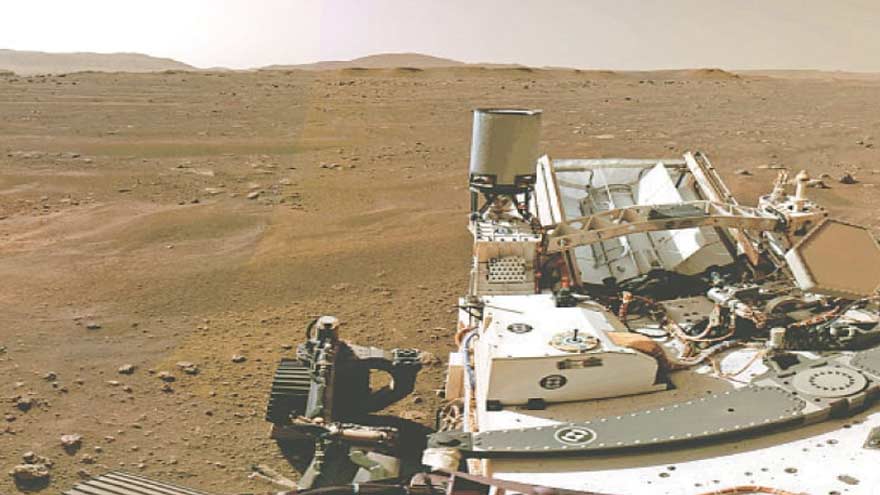
NASA’s Perseverance rover has collected samples while exploring the planet since 2021. However, the programme designed to bring those samples back to Earth faced major setbacks after the Trump administration moved to cancel it following a US congressional vote in January.
China, meanwhile, has announced plans to launch its Tianwen-3 Mars sample-return mission around 2028. The country aims to bring Martian material back to Earth as early as 2031.
That return could take place before MMX completes its own journey.
JAXA scientists believe samples from Phobos could offer a different scientific advantage. The moon may contain a wider variety of material than samples collected directly from Mars.
This possibility is especially significant if Phobos formed after a major collision with the planet.
By analysing these samples, researchers hope to uncover new details about Mars, the formation of its moons and the early conditions that shaped the solar system.