Khawaja Asif Says Tehran Talks Were Not Defence Ministry’s Mandate
Defence minister responds to Fazlur Rehman’s criticism, saying Field Marshal Asim Munir attended the meeting to promote regional peace and dialogue.
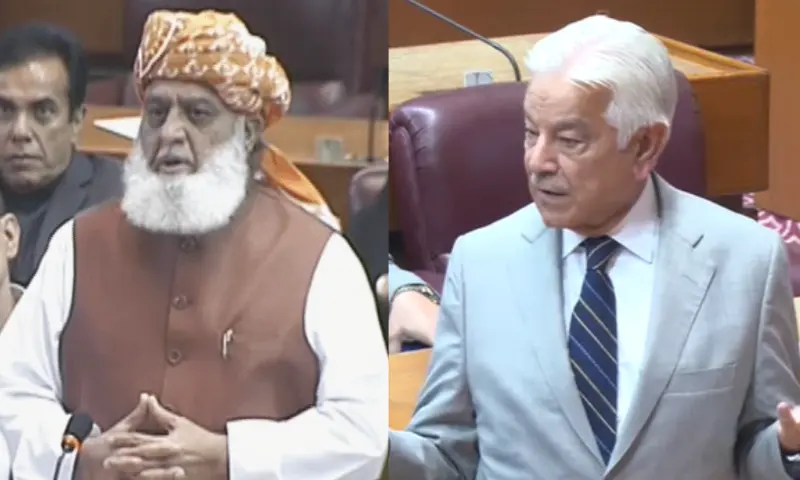
Khawaja Asif responds to Fazlur Rehman’s criticism over his absence from the Tehran meeting.
ISLAMABAD: Defence Minister Khawaja Asif has defended his absence from a recent regional meeting in Tehran, saying the discussions did not fall within the Defence Ministry’s mandate and did not concern a new defence pact involving Pakistan.
Asif responded on Thursday to criticism from Jamiat Ulema-i-Islam-Fazl (JUI-F) chief Maulana Fazlur Rehman, who questioned his absence from the meeting during a speech in the National Assembly.
The Tehran meeting brought together Saudi Defence Minister Prince Khalid bin Salman, Pakistan’s Chief of Defence Forces and Chief of Army Staff Field Marshal Asim Munir, and Turkish intelligence chief Ibrahim Kalin. Iranian Foreign Minister Abbas Araghchi and Supreme National Security Council Secretary Mohsen Rezaei also participated.
The participants agreed to continue dialogue aimed at strengthening cooperation among the four regional countries, particularly on regional peace and security.
Fazlur Rehman Questions Defence Minister’s Absence
During his National Assembly address on Wednesday, Fazlur Rehman questioned why Asif was not attending the Tehran meeting despite his position as defence minister.
He also referred to Interior Minister Mohsin Naqvi’s presence at the gathering and questioned why the interior minister was required there.
Fazl then took a swipe at Asif by repeating the phrase the defence minister had previously used against the Pakistan Tehreek-e-Insaf (PTI): “Koi sharam hoti hai, koi haya hoti hai” — a remark roughly translated as “Have some shame; show some modesty.”
His comments drew laughter and desk-thumping in the House.
Asif Says Tehran Meeting Focused on Peace
Responding to Fazl, Asif said no defence pact was being negotiated in Tehran and the discussions were not focused on Pakistan’s defence affairs.
He said Field Marshal Munir had assumed a role promoting peace and dialogue following last year’s military conflict between Pakistan and India. According to Asif, the objective was to help establish lasting peace in the region.
The defence minister noted that Pakistan had signed two defence agreements since then: the Makkah defence pact and the Badr Memorandum of Understanding. He said he had been involved in those agreements in his capacity as defence minister.
However, Asif maintained that the Tehran meeting did not fall under his ministry’s responsibilities. He said Munir had attended as a messenger of peace and helped lay the groundwork for the discussions.
Salima Hashmi Explores Changing Artistic Visions of Jinnah at Quaid-e-Azam House Museum
Iranian Foreign Ministry spokesman Esmaeil Baghaei had previously said that Munir proposed holding the Tehran meeting during his visit to Iran.
Asif Credits CDF’s Role in Regional De-escalation
Asif also said Munir had played a role in preventing a wider confrontation. Referring to tensions involving Saudi Arabia and Yemen, he suggested that discussions could lead to progress towards peace in the coming days or weeks.
The defence minister urged Fazlur Rehman to take a broader view of Pakistan’s diplomatic and security role. He described the criticism of his absence as misplaced and called for recognition of Pakistan’s and the CDF’s international contributions, regardless of domestic political differences.
Defence Minister Challenges Fazl’s Political Criticism
Asif also questioned Fazlur Rehman’s criticism in light of the JUI-F leader’s history of working with different political parties in government.
He suggested that political disagreements over power-sharing could influence such criticism. Asif added that politicians should remember their own past decisions before attacking their rivals.
Referring to his own political history, he said he remained conscious of his past associations, including the possibility of criticism over his party’s support for General Ziaul Haq’s government.
The exchange highlighted tensions between the two politicians as Pakistan’s military and diplomatic leadership pursues regional engagement amid continuing security challenges.