Kaspersky Reports 12.2% of Pakistan Users Faced Online Threats in First Half of 2026
Cybersecurity firm warns AI is accelerating cybercrime as phishing, malware and ransomware attacks become more sophisticated across the Middle East, Türkiye and Africa region.
Kaspersky unveils regional cyber threat trends during the Cyber Security Weekend 2026 event.
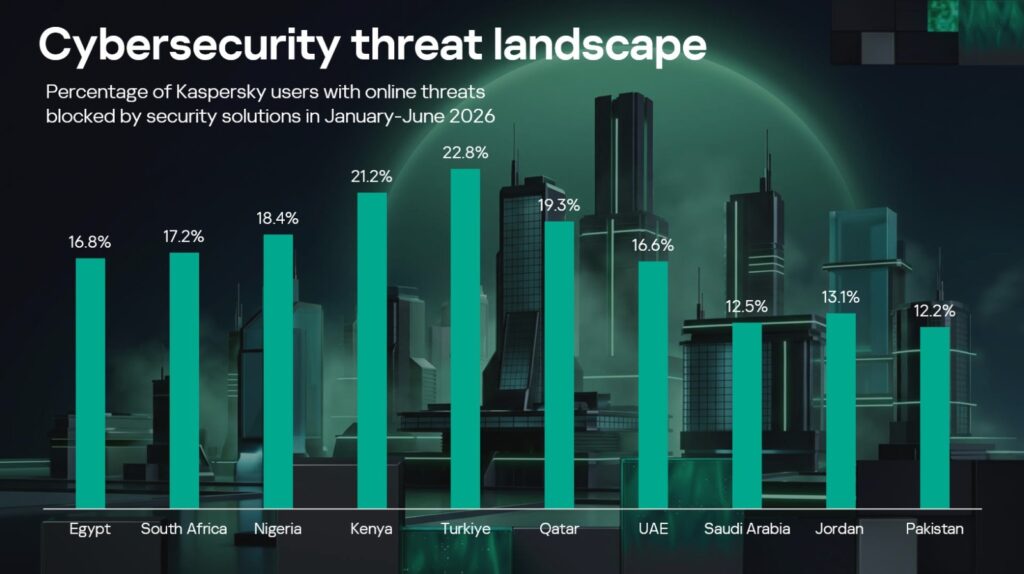
Pakistan recorded one of the lowest rates of web-based cyberattacks in the region, but Kaspersky says 12.2% of its users in the country encountered online threats during the first half of 2026.
Mango Diplomacy Fest Showcases Pakistan’s Premium Mangoes to Boost Global Trade
The findings were released by Kaspersky’s Global Research and Analysis Team (GReAT) during the Cyber Security Weekend for the Middle East, Türkiye and Africa (META) region.
Pakistan Among Lowest-Targeted Countries
According to Kaspersky’s telemetry, cybercriminals continued exploiting websites, emails and online services to target millions of users across the META region.
Türkiye recorded the highest percentage of users affected by web-based threats at 22.8%, followed by Kenya (21.2%) and Qatar (19.3%).
Saudi Arabia, Jordan and Pakistan reported the lowest proportion of users targeted by web-borne attacks. In Pakistan, Kaspersky blocked online threats targeting 12.2% of its users during the first six months of 2026.
AI Is Changing the Cyber Threat Landscape
Kaspersky researchers said cybercriminals are increasingly using artificial intelligence to improve the speed and effectiveness of their attacks.
Threat actors now use large language models to create phishing emails, write malicious code and generate operational content.
Researchers also observed AI-assisted malware development in campaigns linked to the FunkSec group. The group used Rust-based malware capable of stealing data, encrypting files and manipulating system processes.
Kaspersky also identified AI-generated code in the RevengeHotels cyber campaign during 2025.
Experts Warn of Faster Cyberattacks
Sergey Lozhkin, Head of Kaspersky’s Global Research and Analysis Team for the APAC and META regions, said AI will continue shaping the cyber threat landscape throughout 2026.
He said AI reduces the time and cost required to develop malicious software, allowing cybercriminals to launch attacks more quickly and adapt their tactics faster.
Lozhkin urged cybersecurity teams to prepare for increasingly rapid changes in attacker behaviour.
Cloud Services Becoming New Attack Route
Kaspersky also warned that attackers are increasingly using legitimate cloud storage and file-sharing platforms to move stolen data without raising suspicion.
The company said ransomware groups are no longer focusing only on encrypting files. Many now disrupt business operations to increase pressure on organisations to pay ransoms.
AI Agents Create New Security Risks
The report highlighted growing risks associated with AI agents that have broad access to enterprise systems.
If attackers compromise these AI tools, they could alter system settings, install malicious software during startup, steal sensitive information or maintain long-term access to corporate networks.
Kaspersky warned that trusted AI applications could become powerful tools for cyberattacks if organisations fail to secure them properly.
Kaspersky Recommends Stronger Cybersecurity Measures
Kaspersky advised organisations to strengthen their cyber defences through continuous vulnerability management, regular software updates, employee awareness training and threat intelligence.
The company also recommended deploying advanced security platforms, including Kaspersky Next, to detect sophisticated and AI-assisted cyberattacks before they cause significant damage.