
Iqra University Graduates First 40 Professionals from Islamic FinTech Programme
The postgraduate certification programme, developed with Meezan Bank, aims to strengthen expertise in Shariah-compliant finance and digital banking.
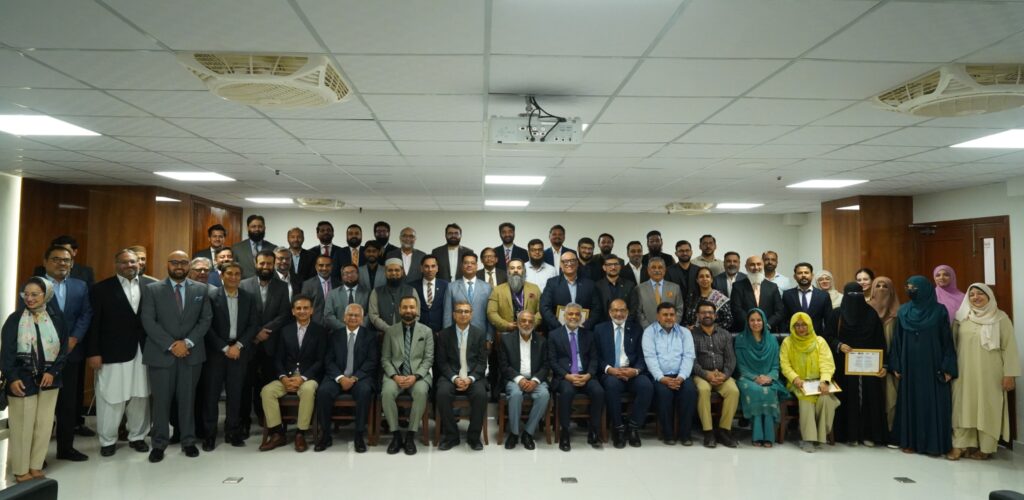
The first cohort of Iqra University's Postgraduate Certification in Islamic Fintech and Digital Banking at their graduation ceremony
Iqra University has graduated the first 40 professionals from its postgraduate certification in Islamic FinTech and Digital Banking.
The graduates included bankers, financial professionals and academics. They received their certificates at a ceremony held at the university’s main campus on Saturday.
The programme is offered through Iqra University’s Centre for Excellence in Islamic FinTech (IU CEIF). The centre was established in strategic collaboration with Meezan Bank.
It aims to advance education, research, innovation and professional development in Islamic finance and financial technology. It also seeks to connect academia with industry and promote Shariah-compliant financial innovation.
State Bank of Pakistan (SBP) Deputy Governor Saleem Ullah attended the ceremony as chief guest. Heads of several banks and financial institutions also participated.
Other attendees included Sindh Higher Education Commission Chairman Prof. Dr S. M. Tariq Rafi and Secretary Dr Noman Ahsan. CIEC Chairman Dr Sarosh Hashmat Lodhi also attended.
Higher Education Commission officials Nasir Shah Mangri, Dr Amjad Hussain and Engr Waheed Ahmed Mangi were also present.
SBP Highlights Growth of Islamic Banking
Addressing the ceremony, SBP Deputy Governor Saleem Ullah highlighted the growing share of Islamic banking in Pakistan.
He said Islamic banking accounts for nearly 31 per cent of industry deposits and around 26 per cent of total assets. He added that almost one-third of the banking industry operates on Islamic principles.
Khidmatgaar Foundation Hosts Rooftop Dinner for Community Leaders
Furthermore, he said approximately 45 per cent of bank branches offer Islamic banking services.
Ullah said Pakistan ultimately needed a fair, just, equitable and transparent financial system. Such a system, he added, should provide equal opportunities for all segments of society.
He identified technological advancement as a major opportunity for achieving that goal.
Meezan Bank President Highlights AI and Banking Transformation
Dr Syed Amir Ali, President of Meezan Bank and co-patron of IU CEIF, highlighted two major developments in Pakistan’s banking sector.
He said the first was the central bank’s direction to transform the entire banking industry towards Islamic banking. The second was the growing accessibility of generative artificial intelligence.
His remarks highlighted the importance of combining Islamic financial principles with emerging technologies.
University Calls for Industry-Academia Collaboration
Iqra University Vice Chancellor Dr Nassar Ikram stressed the need for closer cooperation between academics and industry professionals.
He said neither academics nor practitioners could shape the future of Islamic FinTech alone.
Instead, both sides needed to work together, share knowledge and develop practical solutions. These solutions, he said, must be academically sound, commercially viable, technologically resilient and Shariah-compliant.
Programme Focuses on Practical Industry Experience
Farhan ul Haq Usmani, Director of IU CEIF, said the centre aimed to bring Islamic finance and modern technology together.
He said the programme explored practical ways to use emerging technologies to improve financial services.
Usmani added that the certification was not designed as a purely theoretical course. Organisers brought together subject experts, industry opinion leaders and experienced professionals.
Participants also learned through real-life examples and practical industry experiences.
The first graduating cohort marks a step in Iqra University’s efforts to develop professional expertise in Islamic finance and digital banking.