EU Lawmakers Criticise Von der Leyen Over Remarks Linking Türkiye With Russia and China, Warn Against “Dividing the World”
Web Desk April 22, 2026Brussels/Hamburg: Members of the European Parliament have criticised European Commission President Ursula von der Leyen after her recent remarks grouping Türkiye alongside Russia and China in a geopolitical context, warning that such framing risks deepening global divisions and undermining the European Union’s engagement with a multipolar world.
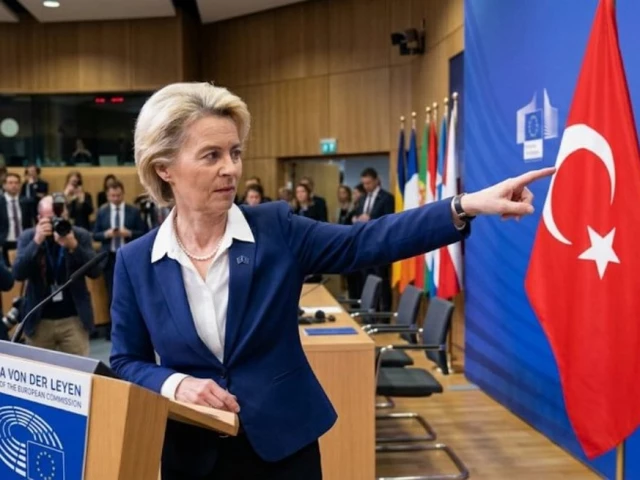
Brussels/Hamburg: Members of the European Parliament have criticised European Commission President Ursula von der Leyen after her recent remarks grouping Türkiye alongside Russia and China in a geopolitical context, warning that such framing risks deepening global divisions and undermining the European Union’s engagement with a multipolar world.
The controversy emerged after von der Leyen, speaking at an event marking the 80th anniversary of German newspaper Die Zeit in Hamburg, reaffirmed her support for EU enlargement and a more unified European geopolitical strategy. In her remarks, she stated that the EU must “succeed in completing the European continent so that it is not influenced by Russia, Türkiye or China,” a formulation that immediately drew political attention.
The European Commission later clarified the statement, stressing that Türkiye remains an “unquestionably important partner” for the European Union. A spokesperson highlighted Ankara’s role in migration cooperation, economic relations, and strategic connectivity projects such as the Trans-Caspian Middle Corridor. Türkiye’s status as a NATO ally and EU candidate country was also underscored, with officials saying the comment was intended in a broader geopolitical sense rather than as an equivalence between the countries mentioned.
However, the remarks sparked criticism from European lawmakers. Belgian Member of the European Parliament Rudi Kennes argued that such language reflects outdated thinking in a rapidly shifting global order. Speaking to Anadolu, he said global dynamics are increasingly shaped by a “multipolar world,” adding that Western powers are losing their ability to dominate international affairs.
Kennes further claimed that geopolitical tensions involving major powers are interconnected and described current Western policy approaches as “desperate,” arguing that Europe can no longer act as the world’s sole decision-maker. His comments reflect growing debate within parts of the European Parliament over how the EU should position itself amid rising global competition.
Another Belgian MEP, Marc Botenga, also criticised von der Leyen’s framing, saying it risks oversimplifying international relations by dividing the world into rigid blocs of “friends and enemies.” He stressed that the European Union maintains significant trade and diplomatic relations with China and continues cooperation with Türkiye despite political disagreements.
Botenga warned against what he described as a “purity test” approach to foreign policy, arguing that global relationships should not be reduced to ideological alignment. He noted that Türkiye remains a formal EU candidate country and continues to engage with the bloc across multiple sectors.
The debate highlights ongoing tensions within European policymaking circles over how to balance strategic competition with major global powers while maintaining pragmatic economic and diplomatic engagement. Analysts say the controversy also reflects broader uncertainty in Europe about its role in an increasingly multipolar international system.
Despite the criticism, the European Commission has reiterated its commitment to EU enlargement and strengthening strategic autonomy, while maintaining dialogue and cooperation with key global partners, including Türkiye.