
Arts Council Karachi Launches A.K. Hangal Autobiography Celebrating a Life Beyond Cinema
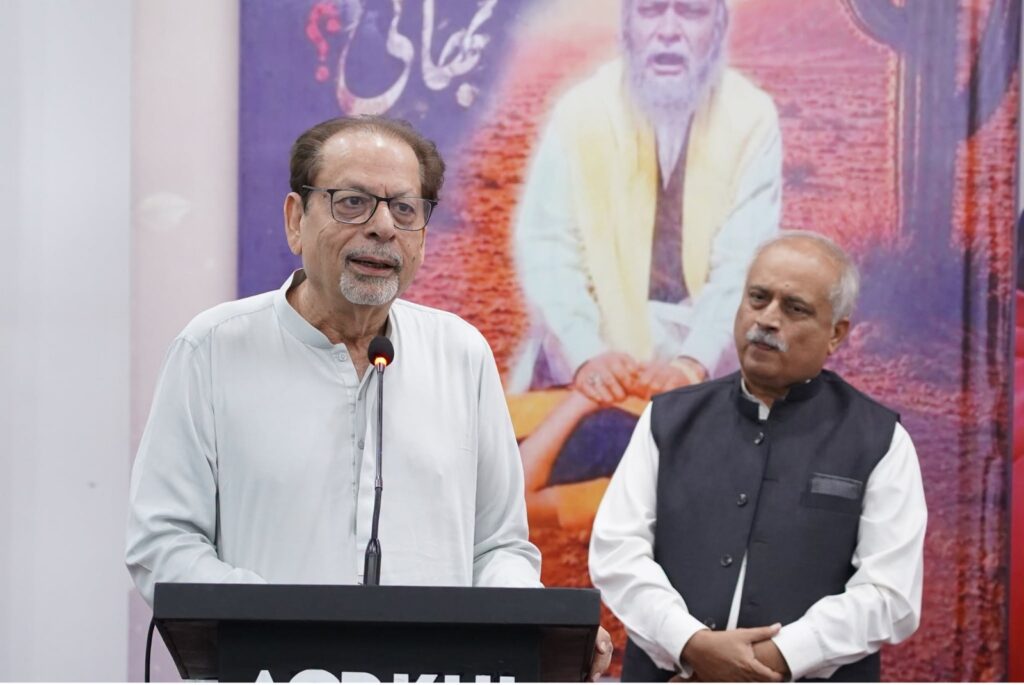
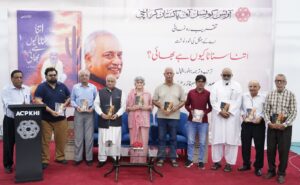
Speakers attend the launch of A.K. Hangal’s autobiography at Arts Council Karachi.
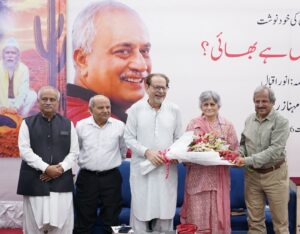
The Arts Council of Pakistan Karachi hosted the launch of A.K. Hangal’s autobiography, “Itna Sannata Kyun Hai Bhai?”, bringing together writers, journalists, artists and cultural figures to reflect on the celebrated actor’s life, political beliefs and contribution to theatre and cinema.
The ceremony took place at the Haseena Moin Hall in the Ahmed Shah Building. Mehnaz Rahman presided over the event, while Mohammad Ahmed Shah, Meraj Jami, Mazhar Abbas, Wusatullah Khan, Sajjad Zaheer Solangi, Jan Muhammad Baloch, Iqbal Rehman Mandoya and Sohaib Alvi shared their views.
Anwar Iqbal compiled and translated the book, while Shakeel Khan moderated the session. The programme opened with a showreel tracing Hangal’s life and artistic journey.
Mehnaz Rahman said A.K. Hangal represented more than a successful actor. She described him as part of a progressive generation that sought social change through literature, theatre, music and cinema.
She said many progressive artists viewed art as more than entertainment. They believed it could give a voice to workers, poor communities and other marginalised groups.
According to Rahman, “Itna Sannata Kyun Hai Bhai?” offers readers an opportunity to remember an entire generation and its struggle for social change.
Arts Council of Pakistan Karachi President Mohammad Ahmed Shah praised Anwar Iqbal for his work on Hangal’s life and struggles. He said the author had presented a complex subject in clear and accessible language.
Pakistan Eyes Bigger Saudi Fruit Market as Value-Added Exports Gain Focus
Ahmed Shah also recalled Hangal’s memorable appearance in the classic film Sholay. He said the actor’s famous dialogue, “Itna Sannata Kyun Hai Bhai?”, remains deeply rooted in popular memory.
He added that strong acting makes a performer appear completely natural on screen. Books about important cultural figures also help preserve personalities and histories that might otherwise fade from public memory.
Journalist Mazhar Abbas said the book offered a different perspective on the lives of left-wing personalities. He said it examined political ideas alongside their social and economic context.
The book, he noted, explores Hangal’s family life, ideological journey and public activities. Abbas also highlighted Hangal’s involvement with theatre, workers’ organisations and grassroots movements.
Wusatullah Khan said many people remembered Hangal primarily as Rahim Chacha from Sholay. However, he said Hangal’s broader identity was shaped by public theatre, political awareness and his connection with ordinary people.
Khan said Hangal remained associated with left-wing political thought, trade unionism and public theatre. He added that the book introduces readers to many political, social and cinematic personalities from Hangal’s era.
Jan Muhammad Baloch praised Anwar Iqbal for documenting Hangal’s association with workers’ movements and his opposition to oppression and exploitation. He said the book presented Hangal as more than an actor.
Sajjad Zaheer Solangi discussed the history of left-wing political movements in Karachi. He said the city had a long history of progressive political activity that began before Pakistan’s creation.
Iqbal Rehman Mandoya described the book as more than the story of one individual. He said it also brings attention to an era, its culture and the wider history of the subcontinent.
Sohaib Alvi said Anwar Iqbal had successfully presented both Hangal’s life and the social and cultural environment of Karachi, Peshawar and the wider region during that period.
Speaking at the event, Anwar Iqbal said his interest in writing developed through social media and his work on Karachi. He said his curiosity about A.K. Hangal began after watching him in Sholay.
Further research revealed that Hangal was born in Sialkot, spent his childhood in Peshawar and lived part of his early youth in Karachi.
Anwar Iqbal said the strong sense of humanity in Hangal’s life inspired him to translate and compile the work. He added that he had not expected such a positive response to the book.
The author also announced his next book, titled “Karchi Karchi Karachi Ka Kitabi Chehra.”
The event highlighted A.K. Hangal’s legacy beyond his celebrated film career. Speakers remembered him as an actor, theatre figure and politically conscious personality whose life reflected an important chapter in the cultural and social history of the subcontinent.