

Balochistan Flood Housing Plan Cut to 69,000 Homes Amid Dispute Over Funds
More than 134,000 verified flood-affected families had registered for assistance, while officials debate project delays, verification concerns and the use of remaining funds.
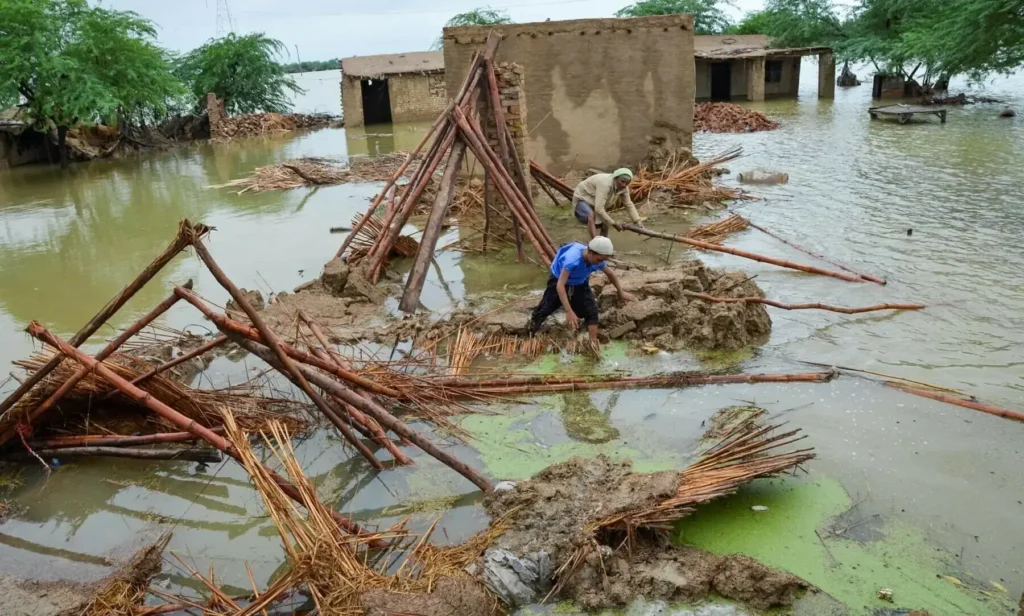
Balochistan’s flood rehabilitation programme faces restructuring amid funding and verification concerns.
ISLAMABAD: The government has restructured a Rs115 billion World Bank-funded flood rehabilitation project in Balochistan, limiting its housing component to about 69,000 homes amid disputes over progress, verification and the use of project funds.
Official documents and discussions around the Integrated Flood Resilience & Adaptation Project (IFRAP) show that authorities have also investigated allegations involving record tampering, duplicate claims and multiple payments linked to housing units.
The project steering committee, led by Planning Minister Ahsan Iqbal and Balochistan Chief Minister Sarfraz Bugti, approved changes to the programme at a meeting on June 22-23.
Under the revised plan, the $155 million housing component will remain capped at around 69,000 houses. The World Bank has also dropped proposed additional financing of $180 million that could have supported reconstruction for more families.
More Than 134,000 Families Had Been Registered
The decision affects more than 134,000 verified flood-affected families that had been surveyed and registered for assistance following the devastating 2022 floods.
Pakistan received international pledges exceeding $9 billion at the January 2023 Geneva Conference to support flood recovery and reconstruction.
IFRAP was designed to rebuild homes in Balochistan through a community-led and owner-driven approach.
Prime Minister Shehbaz Sharif had previously pledged that families who lost their homes would receive resilient housing.
The latest restructuring has raised questions about how the remaining housing needs will be addressed.
Officials Raise Concerns Over Project Reporting
Minutes of the project steering committee meeting show that Planning Minister Ahsan Iqbal raised concerns about reported construction figures.
According to the minutes, the number of completed houses presented to the prime minister was around 15,000, while official reports showed 8,694 completed houses.
The discrepancy prompted concerns over possible misreporting.
Officials have also discussed allegations involving duplicate claims, record changes and multiple payments. The allegations remain subject to investigation.
The planning minister and Balochistan chief minister ordered an independent high-level inquiry to examine the issues and improve accountability.
The committee also recorded serious allegations against certain officials. However, a fact-finding team reportedly faced difficulties obtaining access to relevant records in Balochistan.
Dispute Over Use of Remaining Funds
The restructuring has also triggered disagreement over how the remaining project funds should be used.
One side has raised concerns that slow housing construction could justify shifting funds towards infrastructure projects.
Others have argued that the housing programme faced practical obstacles, including land-title issues, difficulties opening financial accounts and concerns over transparency.
The Planning Commission has proposed using satellite imagery to verify construction progress.
The commission has rejected the suggestion that the housing programme has been abandoned.
It said around 75,000 fully damaged houses were under construction, with approximately 26,000 completed. It added that the project originally approved by the Executive Committee of the National Economic Council covered 68,922 homes and that this allocation would remain protected.
Swat Police Foil Militant Attack on Chatkekal Post as Bannu Operation Kills Suspect
Planning Commission Rejects Claims of Housing Project Closure
In a response, the Planning Commission said the inclusive development programme under IFRAP had suffered from what it described as a coordinated diversion of financing.
It argued that funds had been shifted towards housing at the expense of other sectors, including education, healthcare, public health engineering, irrigation, bridges, roads, livelihoods and youth skills development.
The commission also said some interests had sought to redirect funds towards housing in violation of the scope approved by Ecnec.
According to the commission, $245 million of the project’s total $400 million envelope had already been signed.
It said the allegation involving the reported 15,000 completed homes was raised by a local parliamentarian and that an inquiry found misrepresentation.
World Bank Financing Remains Part of Dispute
The restructuring has also exposed differences between government institutions over project management.
The Economic Affairs Division recorded concerns from the World Bank about changes to project leadership arrangements.
Sources familiar with the matter said Planning Minister Ahsan Iqbal and World Bank Country Director Bolormaa Amgaabazar held at least two meetings to resolve outstanding issues.
However, differences over the project’s direction have continued.
The World Bank’s decision not to provide the proposed $180 million additional financing means the government must now manage the remaining programme within the revised financing framework.
Sindh Project Offers Different Model
The Balochistan programme has also been compared with the Sindh People’s Housing for Flood Affectees (SPHF) project.
The Sindh initiative involves around $3 billion in financing and the reconstruction of more than two million homes.
It has been presented as a comparatively successful post-flood housing programme, although the Planning Commission has raised concerns about the absence of third-party verification.
The commission said the two projects could not be directly compared.
It explained that IFRAP operates as a federal budget project under a single World Bank loan to the federal government. The Sindh programme, by contrast, operates through a Section 42 non-profit entity and involves financing from multiple lenders.
The differing structures also create different requirements for disbursement, budget management and compliance.
For Balochistan’s flood-affected families, however, the central question remains how many homes will ultimately be rebuilt and how the remaining needs of registered households will be addressed.