Muhammad Aurangzeb Unveils Pakistan Budget With Major Economic Reforms
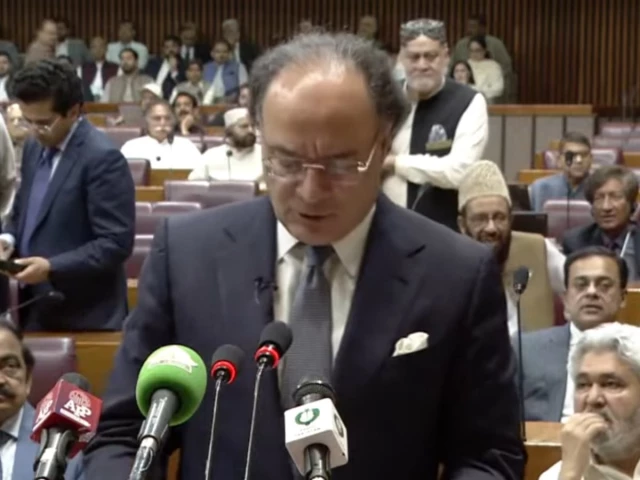
A formal parliamentary session during Pakistan’s federal budget presentation in the National Assembly.
The Pakistan Budget for FY2026-27 has been presented by Finance Minister Muhammad Aurangzeb in the National Assembly. The session took place amid strong political tension and opposition disruption.
The Pakistan Budget outlines major fiscal reforms, development allocations, and economic targets. It also highlights structural changes in taxation, privatization, and public spending priorities.
Shehbaz Sharif Government Economic Vision
The government under Shehbaz Sharif emphasized long-term stability and private-sector-led growth. According to the finance minister, Pakistan’s global economic image has improved significantly.
Moreover, officials claimed that Pakistan’s diplomatic standing has strengthened in recent months. This includes engagement with global partners and regional cooperation efforts.
Defense and Saudi Arabia Agreement
Aurangzeb stated that Pakistan and Saudi Arabia have reached a strategic defence agreement. He described it as a key milestone in bilateral relations.
Additionally, he said Pakistan’s defense sector is now contributing to foreign exchange earnings. This reflects a shift toward economic value from strategic capability.
Privatization PIA First Women Bank
The Pakistan Budget speech highlighted major privatization steps. These include the sale of Pakistan International Airlines and First Women Bank.
Furthermore, the government plans to privatize DISCOs, GENCOs, and airports. This move is aimed at improving efficiency and reducing public sector burden.
Economic Growth and Inflation Trends
Aurangzeb reported that Pakistan’s economy grew by 3.7% despite challenges. Inflation currently stands at around 7%, with expectations of improvement.
He also noted that foreign reserves increased significantly to over $17 billion. However, external pressures continue to influence domestic price stability.
Tax Reforms Pakistan Budget Focus
A major part of the Pakistan Budget focuses on tax reforms and relief measures. The Federal Board of Revenue Federal Board of Revenue has increased revenue collection substantially.
Moreover, salaried class tax rates have been reduced across multiple income brackets. Export-related taxes have also been rationalized to support competitiveness.
Digital Economy and Youth Programs
The government emphasized digital transformation and financial inclusion. According to officials, millions of merchants have joined digital payment systems.
In addition, youth training programs have shown strong employment outcomes. Around 53% of trained participants reportedly secured jobs after skill development.
Fiscal Outlook 2026-27 Projections
The Pakistan Budget projects GDP growth of 4.0% for the next fiscal year. Inflation is expected to stabilize around 8.2%.
Meanwhile, development spending and infrastructure investment have been increased. The State Bank of Pakistan State Bank of Pakistan continues to support monetary stability.
Fiscal Stability and China Relations
Economic cooperation with China remains a key pillar of Pakistan’s strategy. Officials highlighted growing investment and financial integration.
Overall, the government stressed stability, reform, and export-driven growth as the core direction of the Pakistan Budget.