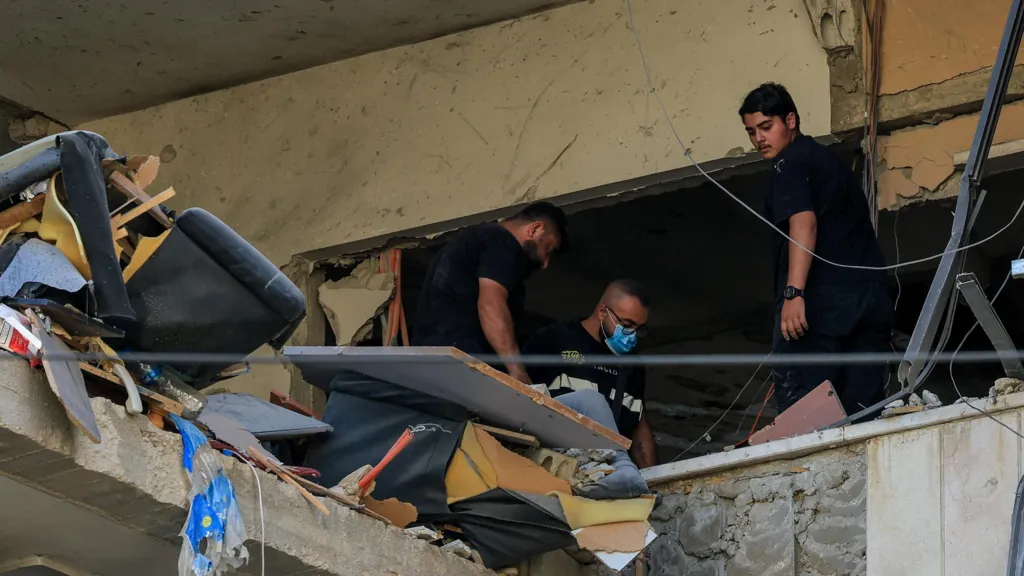
Emergency crews respond after airstrikes in southern Beirut. PHOTO BBC
The latest Beirut Strike has intensified concerns about regional stability after Israel targeted southern Beirut for the first time since a recent US-brokered truce. The attack marks a significant development in the ongoing conflict involving Israel, Hezbollah, and Iran.
Moreover, the Beirut Strike raises questions about the future of ceasefire efforts. While diplomatic channels have remained active, renewed military actions threaten to undermine attempts to reduce tensions across the region.
Benjamin Netanyahu Addresses Beirut Strike
Israeli Prime Minister Benjamin Netanyahu stated that Israeli forces targeted what he described as Hezbollah headquarters in Beirut’s Dahieh district. According to his statement, the operation responded to Hezbollah rocket fire directed toward Israeli territory.
Furthermore, Israeli military officials claimed they intercepted projectiles launched from Lebanon before carrying out the strikes. An Israeli army spokesperson also indicated that operations against Hezbollah infrastructure could continue.
The strikes hit apartment buildings in southern Beirut, causing significant structural damage. Debris covered nearby streets, while emergency crews rushed to assist affected residents.
Hezbollah Responds After Beirut Strike
Hezbollah later announced that it launched rockets toward Israeli artillery positions and military locations near the border. The group reportedly described the attacks as retaliation for what it called Israeli violations of the ceasefire.
Meanwhile, Hezbollah officials argued that continued Israeli military actions in southern Lebanon justified their response. The exchange highlights the fragile nature of the current truce.
Social media footage showed residents and rescue workers gathering at the strike locations. Emergency personnel worked through the night to search damaged structures and assist the injured.
Lebanon Officials Assess Beirut Strike Damage
Lebanon’s Health Ministry reported that two people were killed in the attack. At least 20 others suffered injuries, including women and children.
Additionally, health officials stated that four women and four children were among those wounded. Rescue operations continued for several hours following the strikes.
The attack damaged residential buildings in a densely populated area. As a result, many residents expressed concern about the possibility of further military escalation.
Iran Reacts To Beirut Strike Escalation
Iranian officials strongly condemned the attack. Ebrahim Rezaie, spokesperson for Iran’s parliamentary foreign policy and national security committee, reportedly promised a decisive response to the incident.
Earlier, Iran launched missiles toward Israel, describing the action as retaliation for increasing Israeli operations in southern Lebanon and Beirut’s suburbs.
Consequently, regional observers fear that direct and indirect confrontations involving Iran-backed groups could further complicate ongoing diplomatic efforts.
Donald Trump Comments On Beirut Strike Crisis
US President Donald Trump addressed the broader regional situation during an interview with NBC’s Meet the Press. He stated that Lebanon was not necessarily tied to any future peace arrangement involving Iran.
Previously, Trump announced that there would be no US troop deployment to Beirut following discussions with Netanyahu. According to reports, Washington also communicated with regional mediators seeking de-escalation.
However, Sunday’s events have renewed concerns that military actions could disrupt ongoing diplomatic initiatives aimed at reducing hostilities.
Lebanon Leaders Debate Ceasefire Future
The ceasefire remains under increasing pressure. Although an agreement has technically been in force since April, both sides have repeatedly accused each other of violations.
Lebanese Parliament Speaker Nabih Berri recently criticized a US-backed proposal, calling it inadequate because it did not include provisions for an Israeli withdrawal from disputed southern territories.
At the same time, Hezbollah leader Naim Qassem stated that disarming the group would serve what he described as the objectives of Israel.
As tensions continue to rise, regional leaders face mounting challenges in preserving stability. Therefore, the coming days may prove critical for both diplomatic negotiations and security conditions across Lebanon and Israel.