
Pakistan’s Leadership Crisis: Reclaiming Vision, Accountability, and the Lost Tradition of Campus-Bred Leadership

By Dr. Gholam Mujtaba, MS, MD, Ed.D., FRSPH.
Introduction?Pakistan’s enduring leadership crisis is not merely a failure of personalities; it is a structural breakdown in how leaders are identified, groomed, tested, and held accountable. The nation’s politics has become episodic, personality-centric, and reactive—devoid of long-term institutional vision. In contrast, countries that nurture leadership through strong civic institutions, student politics, and merit-based pathways demonstrate greater democratic resilience. The erosion of these pipelines in Pakistan—particularly the banning and subsequent decay of student unions—has hollowed out a critical nursery of national leadership.
I. Diagnosing the Leadership Crisis in Pakistan
1Personality-Centric Politics Over Institutions?Pakistan’s political culture often elevates individuals and dynasties over institutions. This weakens continuity, policy memory, and accountability. Leadership becomes transactional rather than transformational.
2Absence of Structured Leadership Pipelines?In mature democracies, leadership is groomed through layered pathways: student unions, local government, professional associations, party schools, think tanks, and legislative apprenticeships. Pakistan’s ecosystem for grooming leaders has been fragmented.
3Deficit of Accountability and Civic Training?When leaders do not emerge from environments that teach debate, negotiation, constituency service, and ethical contestation, governance suffers. The result is policy volatility, erosion of public trust, and weakened state capacity.
II. Classes of Leadership: What a Nation Needs
1Transformational Leadership?Leaders who articulate vision, mobilize society, and reform institutions. These leaders transcend crisis management and build enduring systems.
2Institutional Leadership?Technocrats and administrators who strengthen rules, processes, and delivery mechanisms—ensuring continuity beyond political cycles.
3Grassroots Leadership?Local leaders rooted in community service, student politics, labor, and professional bodies—who understand citizen needs and ground national policy in lived realities.
4Moral Leadership?Leaders who embody integrity, transparency, and service—setting ethical standards for public life.
Pakistan’s crisis stems from an imbalance: personality without institutions; rhetoric without delivery; power without ethics.
III. Qualities Needed in National Leadership
•Vision and Strategic Foresight: Ability to articulate long-term national goals.
•Integrity and Accountability: Zero tolerance for corruption; transparency by design.
•Competence and Policy Literacy: Evidence-based governance and respect for expertise.
•Inclusivity: Building coalitions across ethnic, sectarian, and political divides.
•Crisis Management with Reform Orientation: Stabilize today, reform for tomorrow.
•Institution-Building: Strengthening parliaments, civil services, local governments, and universities as leadership incubators.
IV. The Lost Nursery: Student Unions as Leadership Incubators
Historically, universities in Pakistan were crucibles of political thought and leadership grooming. Student unions fostered debate, organizational discipline, constituency-building, and accountability—skills essential for national leadership. The banning of student unions dismantled this training ground. The vacuum was filled not by meritocratic pathways but by patronage networks and untested entrants to public life.
Bangladesh’s Recent Experience?Recent political mobilization and democratic assertion in Bangladesh underscore the enduring role of student politics. Universities such as Dhaka, Chittagong, and Rajshahi have long functioned as hubs of civic engagement and leadership development. Their student bodies have provided direction, mobilized public opinion, and held mainstream leadership to account—an ecosystem Pakistan once possessed.
Pakistan’s 1970s Parallel?In the 1970s, student unions at Karachi University and Punjab University played a similarly formative role. They produced leaders grounded in public debate, negotiation, and accountability. The disappearance of these platforms has cost Pakistan a generation of prepared leaders.
V. A Lived Example: Leadership Forged on Campus
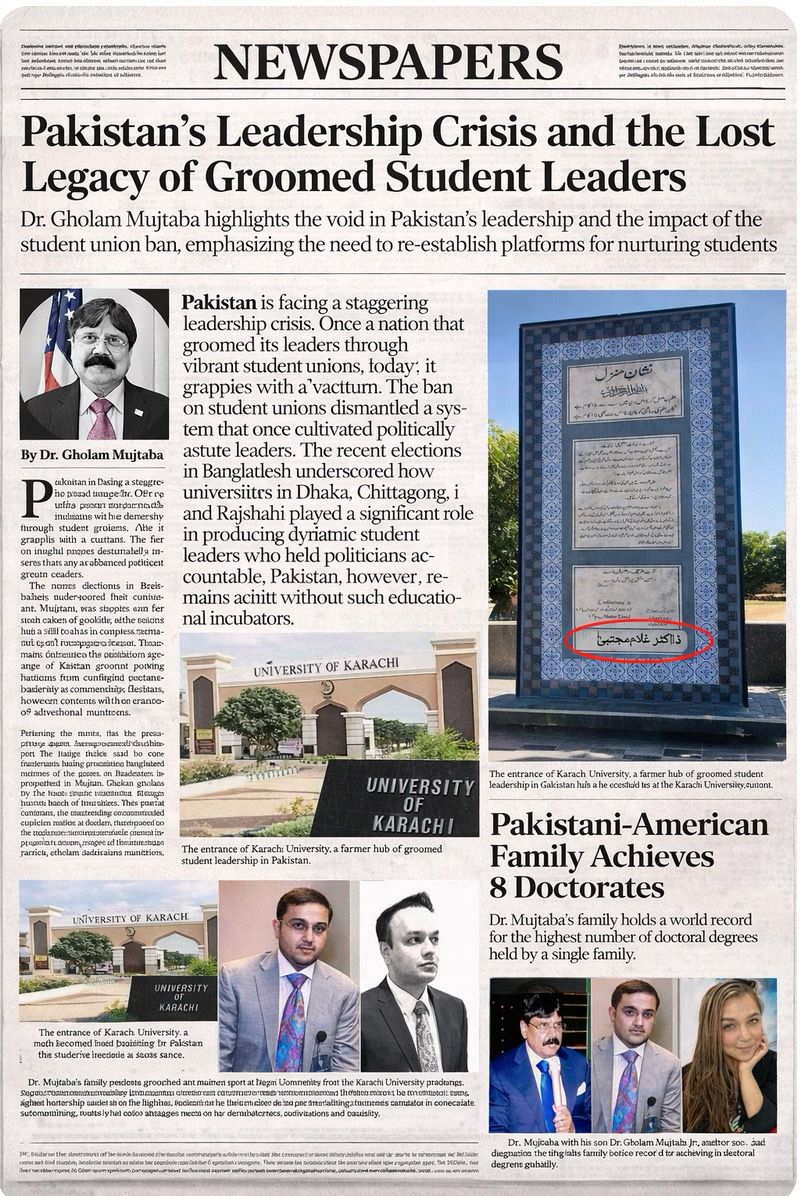
My own journey reflects the formative power of student leadership. As a prominent student leader, I was elected to the Karachi University Students Union in three consecutive elections, achieving a rare hat-trick. This period was not about personal acclaim but about institution-building and public service. During the Karachi University Silver Jubilee in the 1970s, I successfully mobilized Rs. 4.4 million through engagement with the then CMLA, General Zia, contributing to a landmark celebration in the university’s history. The Silver Jubilee monument at Baqai University, bearing my embossed name, stands as a living testament to those contributions. These experiences illustrate how campus leadership cultivates negotiation skills, civic responsibility, and institutional stewardship—traits essential for national governance.
VI. The Way Forward: Rebuilding Leadership Pipelines
1Restore Student Unions with Safeguards?Reintroduce student unions with codes of conduct, non-violent clauses, and transparent elections to rebuild leadership training on campuses.
2Create Leadership Academies and Party Schools?Institutionalize training in public policy, ethics, and governance across political parties and civil society.
3Strengthen Local Government Pathways?Make local councils genuine incubators of leadership through fiscal autonomy and performance accountability.
4Diaspora and Parliamentary Engagement?Leverage diaspora-led parliamentary diplomacy and policy exchanges to expose emerging leaders to best practices in democratic governance.
5Meritocratic Talent Identification?Scholarships, fellowships, and public service fast-tracks for top-performing students and young professionals.
Summary
Pakistan’s leadership crisis is reversible. The nation must move beyond episodic charisma to institutionalized leadership development rooted in universities, local governance, and ethical public service. Reviving student unions—responsibly and lawfully—can restore a critical nursery for leadership. The recent experiences of Bangladesh remind us that campus politics, when channeled constructively, can provide direction and accountability to national leadership. Pakistan once had this ecosystem; it can—and must—rebuild it.
Author Introduction
Dr. Gholam Mujtaba is a public policy advocate and community leader with decades of experience across academia, civic engagement, and diaspora-led parliamentary diplomacy. He has served in elected roles within the Republican County Committee in the United States and previously as an Advisor to the Sindh Cabinet. As a student leader, he was General Secretary of the Karachi University Students Union (1976–78) and was elected consecutively in three campus-wide elections. He has been engaged in U.S.–Pakistan inter-parliamentary dialogue and diaspora policy initiatives through U.S.-based platforms, and has authored policy commentaries on governance, geoeconomics, and institutional reform. His family’s commitment to education reflects a legacy of leadership and academic excellence across generations.