Pakistan Sends 100 Tonnes of Aid to Flood-Hit Nepal
Pakistan has dispatched emergency supplies to Nepal as rescuers continue searching for victims and survivors after devastating floods and landslides.
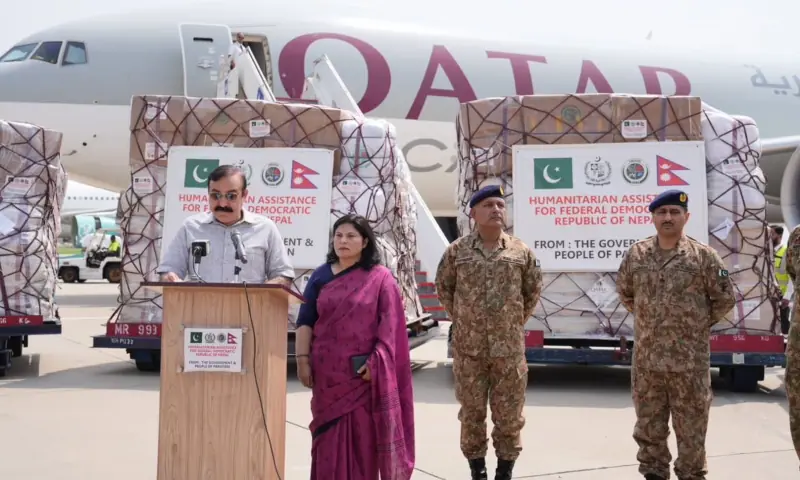
Pakistan sends humanitarian assistance to flood-hit Nepal.
ISLAMABAD: Pakistan on Sunday dispatched 100 tonnes of humanitarian assistance to Nepal to support relief operations following deadly floods and landslides.
The aid was coordinated by the National Disaster Management Authority (NDMA). A chartered flight carrying the relief supplies departed Islamabad for Kathmandu, according to the Foreign Office (FO).
The disaster has killed at least 1,384 people across China and Nepal. More than 5,500 people remain missing, according to the figures cited in the report.
Emergency Supplies Sent to Nepal
The Pakistani relief consignment includes tents, blankets, mats, hygiene kits and medicines. The supplies are intended for communities affected by the disaster.
A send-off ceremony was held at Islamabad airport before the flight’s departure. Parliamentary Affairs Minister Tariq Fazal Chaudhry attended the ceremony.
Nepal’s Ambassador to Pakistan Rita Dhital also participated. Senior officials from the Foreign Office and NDMA were present as well.
The Foreign Office said the assistance demonstrates Pakistan’s solidarity with Nepal during the crisis.
Hammad Azhar Arrest Claimed by PTI as Party Alleges Political Vengeance
Meanwhile, Deputy Prime Minister and Foreign Minister Ishaq Dar expressed condolences to the victims’ families.
He said Pakistan stands with the government and people of Nepal. He also reaffirmed Islamabad’s readiness to provide further support.
Rescue Operations Enter 12th Day
In Nepal, rescue teams continued their search operations on Sunday. The effort entered its 12th day despite difficult terrain, severe weather and damaged infrastructure.
However, rescuers have recorded several remarkable breakthroughs. Four people have been rescued alive in recent days.
Two survivors were found on Saturday. Two others had been rescued a day earlier.
Three of the survivors were discovered inside hydropower tunnels. Officials had initially feared that more than 100 workers could be trapped in the tunnels.
Energy Minister Biraj Bhakta Shrestha said rescue teams were continuing their efforts despite major challenges.
Survivors Found in Hydropower Tunnels
On Saturday, rescuers pulled a Chinese national alive from a hydropower tunnel.
They also rescued 64-year-old Nepali woman Chandrika Shrestha from her mud-covered home.
Prime Minister Balendra Shah said her rescue had brought hope to the country.
A day earlier, two Nepali hydropower workers were rescued from the Trishuli 3A tunnel.
Search operations are still underway at several locations. At least 12 hydropower projects have reportedly been affected by the disaster.
Massive Damage Across Mountain Districts
The disaster struck on August 26. A powerful flow of icy water and debris swept through mountain districts.
Roads, bridges and other infrastructure were destroyed. Consequently, rescue and relief operations have faced severe logistical difficulties.
Other stories of survival have also emerged. School principal Rajendra Dawadi ordered an evacuation as floodwaters approached.
His decision helped save hundreds of students.
“If the information was wrong, we would lose a day of schooling,” he said. “But if it was true, we were going to lose our lives.”
Nepal Faces Long Recovery
Authorities are also working to restore electricity in affected areas.
Shrestha said solar power was being used in locations that remained inaccessible.
Foreign Minister Shisir Khanal has described the disaster as a “Himalayan tsunami.” He warned that reconstruction could cost billions of dollars.
The United Nations has meanwhile described the scale of destruction as a major challenge for humanitarian operations.
The UN has launched a $50 million appeal to support more than 84,000 people affected by the disaster.
Mass Graves as Identification Continues
The humanitarian crisis has also placed pressure on Nepal’s mortuary facilities.
With morgues overflowing, hundreds of victims have been buried in mass graves. Police have taken DNA samples to help identify the bodies later.
Only around 100 bodies have reportedly been identified and returned to their families.
Nepal will observe a national day of mourning on Monday. The day will mark the 13th day since the disaster.
The mourning period also follows traditional Hindu practices.
The precise cause of the glacial collapse remains unclear. However, scientists have warned that climate change is accelerating glacier melt worldwide.
As a result, the risk of glacial floods and related disasters is increasing in vulnerable mountain regions.