Pakistan Renews Full-Spectrum Defence Resolve on First Anniversary of Marka-e-Haq
Web Desk May 10, 2026Islamabad: Pakistan’s civil and military leadership on Saturday renewed the nation’s commitment to defending the country’s sovereignty, warning that any future aggression would receive an “immediate, befitting and full-spectrum response” as the country marked the first anniversary of Marka-e-Haq.
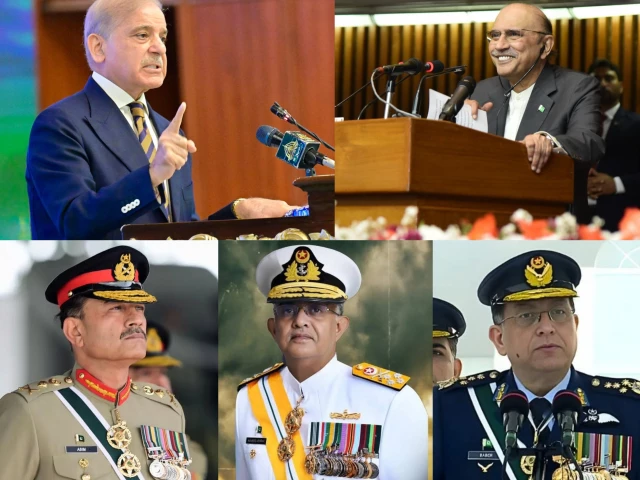
Islamabad: Pakistan’s civil and military leadership on Saturday renewed the nation’s commitment to defending the country’s sovereignty, warning that any future aggression would receive an “immediate, befitting and full-spectrum response” as the country marked the first anniversary of Marka-e-Haq.
Hanif Raja Wins Best Commercial Theatre Actor Award for “Eid Dhana Dhan”
The term Marka-e-Haq refers to the 2025 Pakistan-India conflict that erupted following the April 22 Pahalgam attack and concluded with a ceasefire on May 10 after Pakistan launched Operation Bunyanum Marsoos.
According to a statement issued by the Prime Minister’s Office, Shehbaz Sharif paid tribute to the martyrs, veterans and armed forces, describing the operation as a historic victory that demonstrated Pakistan’s courage, professionalism and strategic strength.
“Marka-e-Haq is etched in history as an epic feat of achieving overwhelming dominance over an enemy bent on unprovoked aggression,” the prime minister said, adding that Pakistan’s armed forces had shattered the “illusion of invincibility” held by the adversary.
The premier praised the coordinated military response across land, air, sea and cyber domains, calling it proof that Pakistan remains an “invincible nation” capable of defending its sovereignty under all circumstances.
He also paid tribute to Asim Munir, alongside the chiefs of the Pakistan Air Force and Pakistan Navy, for their leadership during the conflict.
“Pakistan clearly manifested its desire for peace while re-establishing deterrence and safeguarding its security, sovereignty and territorial integrity,” he said.
Warning against future hostilities, the prime minister declared that any attempt to undermine Pakistan would be met with a “full-spectrum response”.
He further reaffirmed Pakistan’s support for the people of Kashmir, stating that the issue remained an unfinished agenda of partition and must be resolved according to United Nations resolutions and the aspirations of the Kashmiri people.
The prime minister also highlighted Pakistan’s evolving diplomatic role internationally, citing its mediation efforts during the recent US-Iran tensions and describing Pakistan as a responsible state contributing to regional and global peace.
Meanwhile, Asif Ali Zardari also paid tribute to the nation and armed forces, stating that the success of Marka-e-Haq reflected the professionalism and preparedness of Pakistan’s military leadership.
He praised Field Marshal Asim Munir’s strategy and leadership, while also acknowledging the operational readiness of the Pakistan Air Force and Pakistan Navy.
“Pakistan is a responsible and peace-loving state. By giving a strong but measured response to enemy aggression, we have conveyed our defensive capability to the world,” President Zardari said.
The president reiterated Pakistan’s diplomatic, moral and political support for Kashmiris and criticised India’s attempt to suspend the Indus Waters Treaty, calling it “water aggression”.
He also urged Afghanistan to ensure its territory is not used for terrorism against Pakistan, stressing the need to eliminate externally backed militancy for lasting regional peace.
In a separate statement, the military leadership reaffirmed its commitment to protecting Pakistan’s territorial integrity and sovereignty.
According to the Inter-Services Public Relations, Field Marshal Asim Munir, Chief of Naval Staff Admiral Naveed Ashraf and Chief of Air Staff Air Chief Marshal Zaheer Ahmed Baber Sidhu extended congratulations to the nation and members of the armed forces on the anniversary.
The ISPR described Marka-e-Haq as a defining milestone in Pakistan’s history that reflected national resolve, military excellence and strategic maturity.
“Despite facing conventional and hybrid challenges, including proxy terrorism, the armed forces demonstrated superior operational competence across land, air, sea, cyber and information domains,” the statement said.
The military said Pakistan had significantly strengthened its defensive and deterrence capabilities despite resource challenges and remained fully prepared to confront all internal and external threats.
Ceremonies were held across the country to honour the sacrifices of martyrs and veterans, with floral wreaths laid at memorials and special prayers offered.
Background of Marka-e-Haq
Tensions between Pakistan and India escalated after the April 22, 2025 attack in Pahalgam that killed 26 people. India blamed Pakistan for the incident, while Islamabad strongly rejected the allegations.
The situation worsened after India suspended the Indus Waters Treaty, reduced diplomatic ties and imposed travel restrictions.
On May 7, 2025, missile strikes hit several cities in Punjab and Azad Jammu and Kashmir, killing civilians and damaging infrastructure, including a mosque.
Pakistan responded by downing several Indian fighter jets, including Rafale aircraft. The confrontation escalated further on May 10 when India targeted Pakistani airbases, prompting Pakistan to launch Operation Bunyanum Marsoos against strategic Indian military installations.
A ceasefire was later announced by Donald Trump following diplomatic efforts, with confirmation from both Pakistani and Indian officials.