FPCCI Calls for Stronger Economic Integration Among Islamic Countries
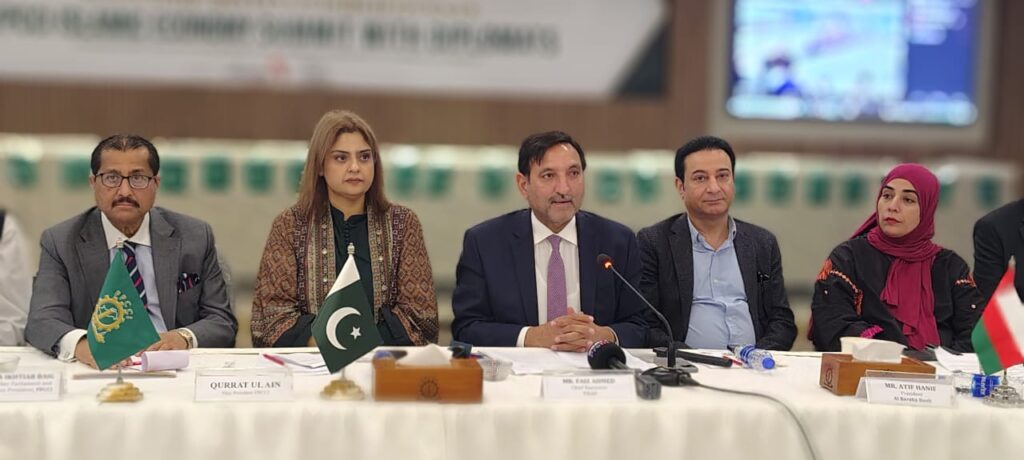
FPCCI Vice President Qurat-ul-Ain presides over the Islamic Economy Summit with Diplomats in Karachi.
The Federation of Pakistan Chambers of Commerce and Industry (FPCCI) has called for closer economic ties among Islamic countries. It urged them to expand trade, investment, joint ventures and business connectivity.
FPCCI Vice President Qurat-ul-Ain made the call while chairing the FPCCI Islamic Economy Summit with Diplomats. She said the 57 Muslim countries had enormous economic potential. Stronger cooperation could create jobs, attract investment and support sustainable development.
Qurat-ul-Ain urged Islamic countries to move beyond traditional bilateral trade. She called for stronger business links, joint ventures and investment partnerships. She also highlighted technology exchange, tourism and better connectivity.
The summit carried the theme “Promoting Islamic Economic Integration through Bilateral and Multilateral Cooperation for Community Development.” Diplomats, consuls general, commercial counsellors and business leaders attended. Representatives of financial institutions, academia and other Organisations also joined the event.
TDAP Pledges Support for Greater Trade
Chief guest Faiz Ahmed, Chief Executive of the Trade Development Authority of Pakistan (TDAP), pledged government support for greater economic cooperation among Muslim countries.
Nawaz Sharif Meets Sindh Governor Nehal Hashmi in Raiwind
He said trade among Islamic countries must become a priority. Pakistan, he added, needs stronger economic ties with member states of the Organisation of Islamic Cooperation (OIC).
Ahmed also called for better conditions for trade and investment. He urged the public and private sectors to work together.
Citing trade figures, he said intra-OIC trade reached around US$1 trillion in 2024. It stood at US$884 billion in 2023.
He added that intra-OIC trade accounted for about 20.36 per cent of member countries’ total foreign trade in 2024. The OIC aims to increase this share to 25 per cent.
Pakistan Eyes Growth in Halal Exports
Dr Mirza Ikhtiar Baig, MNA, said Pakistan could increase exports of halal food, meat, pharmaceuticals and cosmetics. He also highlighted opportunities for other halal-certified products in Muslim markets.
Pakistan’s textile and garment industries could also expand their reach. Baig said competitive prices, stronger branding and value addition would help exporters.
He identified further opportunities in rice, fruits, vegetables, seafood, livestock and processed food. Gulf markets offer particular potential for these products. He also pointed to demand for pharmaceuticals and healthcare products in developing Muslim countries.
However, Baig stressed the need for better international certifications and regulatory compliance. Stronger branding would also help Pakistani businesses compete in overseas markets.
Islamic Finance Can Support Business Growth
Sheikh Yousef Hassan Khalawi, Secretary General of the Islamic Chamber of Commerce and Development (ICCD), called for stronger economic connectivity. He also urged countries to explore new opportunities in economic tourism.
Khalawi stressed the importance of institutional and private-sector cooperation. Such partnerships, he said, could turn economic potential into practical business opportunities.
Ahmed El Wakil, ICCD Vice President and President of Bank Al Baraka, highlighted the role of Islamic financial institutions. He said these institutions could support trade, investment and cross-border partnerships.
He also called for financial mechanisms that help businesses invest across Islamic countries.
Muhammad Irfan Ahmed, Head of Shariah Compliance at BankIslami, discussed Shariah-compliant financial instruments. He highlighted their role in supporting trade, investment and small and medium-sized enterprises (SMEs).
Prof. Dr Irum Saba of the Institute of Business Administration (IBA) shared her views on Islamic finance and financial inclusion. She also stressed the need for research, education and skilled human resources.
Diplomats Seek Stronger Institutional Cooperation
Ambassador Fawad Sher, Pakistan’s Permanent Representative to the OIC, and Irfan Soomro, Director General at the Ministry of Foreign Affairs, highlighted the resources of Islamic countries.
They said these countries had complementary markets, investment opportunities and human capital. However, stronger institutional links are needed to connect these strengths.
They identified several areas for cooperation. These included trade facilitation, Islamic finance, agriculture, food security, tourism, technology, education and business mobility.
Diplomatic representatives from Afghanistan, Azerbaijan, Bangladesh, Oman, Maldives, Iran and Indonesia attended the summit. Representatives from Côte d’Ivoire, Malaysia, Thailand, Mauritius, Türkiye, the UAE, Sri Lanka, Uzbekistan and Jordan also participated.
Participants discussed joint ventures and regional value chains. Key sectors included halal food, agriculture, agro-processing, textiles, garments, pharmaceuticals, technology, energy, tourism, logistics and manufacturing.
FPCCI Calls for Practical Trade Initiatives
FPCCI reaffirmed its commitment to promoting economic cooperation with Islamic countries. It will continue to bring together government institutions, diplomats, chambers of commerce and financial institutions.
The federation also highlighted the role of academia and private businesses. These stakeholders can identify investment opportunities and develop practical plans for cooperation.
The summit concluded with a call for concrete action. Participants urged countries to turn discussions into trade deals, investment initiatives and joint ventures. They also called for greater private-sector involvement in building stronger economic ties among Islamic countries.